


When Kevin Warsh opened the Federal Reserve’s first public forum on artificial intelligence in San Francisco on 16 November, he called the moment a “hinge point” for the American economy. He spoke of faster innovation and growth well above the long-run average. What he did not talk about was inflation.
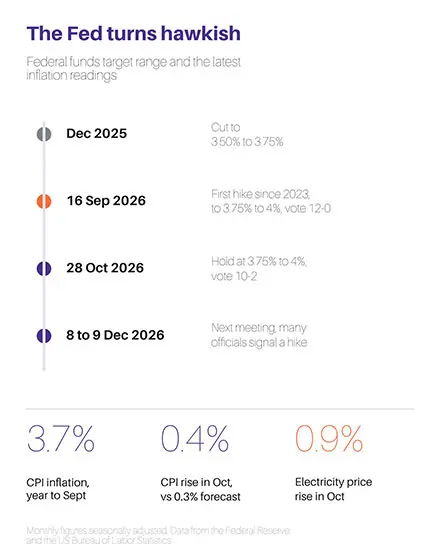
That silence was telling. The three-hour conference, hosted by the Fed Board and the San Francisco Fed to inform Warsh’s new Productivity and Jobs Task Force, came less than a week after official data showed consumer prices rising 0.4% in October, faster than economists had forecast.
Several of Warsh’s colleagues on the Federal Open Market Committee have spent recent weeks blaming the data centre building spree for pushing up the prices of chips, electronic components, electricity and copper. Smartphone prices rose at the fastest pace on record last month.
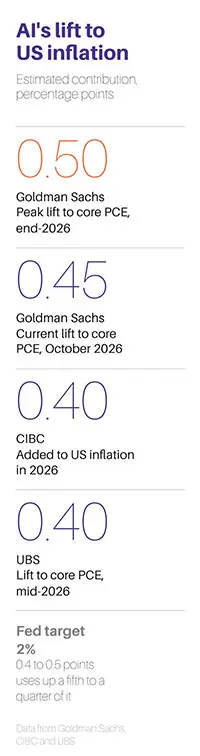
The estimates are now hard to ignore. CIBC reckons the AI investment boom could add about 0.4 percentage points to US inflation in 2026. Goldman Sachs puts the current lift to core personal consumption expenditures (PCE) inflation, the Fed’s preferred gauge, at about 45 basis points, peaking near 50 basis points by the end of the year.
Against a 2% target, that means a single technology trend is using up between a fifth and a quarter of the Fed’s entire inflation allowance.
Two questions follow. How long will this last? And can the Fed actually do anything about it?
A demand shock before a supply shock
Warsh himself has framed the problem clearly. Speaking at the IMF and World Bank annual meetings in Bangkok in October, he said AI spending was hitting the demand side of the economy before it reached the supply side, and that central bankers had to recognise it as a shock.
 Before AI makes anyone more productive, someone has to build the data centres, buy the processors, lay the cables and secure the power. That spending competes for scarce inputs. Memory chips are in short supply. Prices of industrial construction materials have risen at their fastest annual pace since the pandemic.
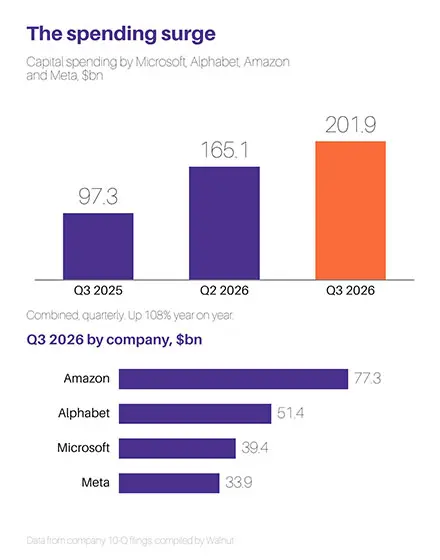
The scale is unprecedented. Microsoft, Alphabet, Amazon and Meta spent a combined USD 201.9 billion on property and equipment in the third quarter of 2026, more than double the USD 97.3 billion they spent a year earlier, according to their quarterly filings.
Including SpaceX, the biggest spenders have guided to as much as USD 828 billion of capital expenditure this year.
Jason Furman of the Peterson Institute for International Economics estimates that the data centre buildout and the computing and communications equipment inside it now runs at about 2.5% of GDP, or roughly USD 840 billion a year, surpassing the telecom and fibre boom of the late 1990s.
Goldman’s breakdown shows where the pressure lands. Software and accessories account for roughly 20 basis points of the core PCE lift, though the bank believes most of that is measurement bias, as AI features bundled into products are recorded as price rises rather than quality gains.
Pricier components feed through to computers and devices, while data centre demand pushes up power bills.
Overall, Goldman reckons roughly half the effect is genuine.
That offers little comfort to households. Electricity prices rose 0.9% in October alone on a seasonally adjusted basis, and this month’s midterm elections, fought largely on living costs, exposed a growing backlash against data centre construction.
How long will the pressure last?
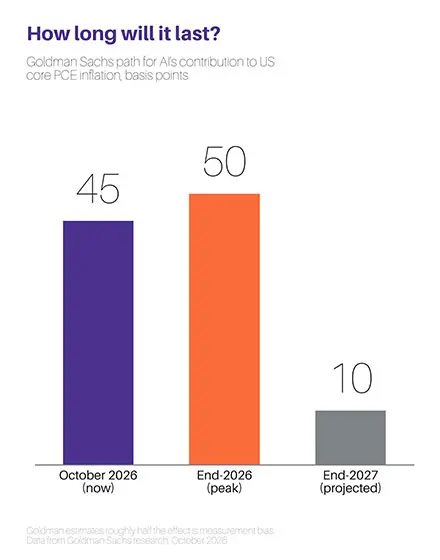
The most widely cited forecasts suggest the inflationary hit is near its peak. Goldman expects the AI contribution to core PCE to top out at about 50 basis points at the end of 2026 and fall back to about 10 basis points by the end of 2027.
Jan Hatzius, the bank’s chief economist, has also argued that the growth impulse from the AI boom will peak in late 2026 or early 2027.
There are good reasons to treat that timeline with caution, however.
 First, the spending is not slowing. Amazon chief executive Andy Jassy has said the company expects to spend meaningfully more in 2027, and Alphabet’s finance chief, Anat Ashkenazi, has said capital spending will rise significantly next year.
Analysts at Evercore and Bank of America projected earlier this year that combined Big Tech capital spending would pass USD 1 trillion in 2027.
If the buildout keeps accelerating, the bottlenecks that create price pressure are more likely to shift from one input to another than to disappear.
Second, electricity is a slow-moving problem. Power plants and transmission lines take years to approve and build, while data centres can be fitted out in months.
Goldman expects consumer electricity prices to rise by around 6% across 2026 and 2027 before slowing. Utility tariffs, once raised, rarely come back down.
Third, some academic work points to a longer tail. A May 2026 paper by economists at the University of Maryland, Baltimore County suggests AI could lift the long-run inflation rate by a percentage point or more over the next decade, partly by strengthening market power.
The honest answer is that the hardware price pulse is probably close to its peak, but pressure from power, capacity and continued spending could linger well into 2027. Much depends on whether the investment keeps compounding.
Can the Fed cool the boom?
Here Warsh’s dilemma sharpens. The Fed has already moved. In September it raised its benchmark rate by a quarter point to a range of 3.75% to 4%, its first increase since July 2023, in a unanimous vote that put Warsh at odds with President Donald Trump, who appointed him and wants far lower rates.
The committee held in October but left the door open to further increases, and after the latest inflation figures many officials have signalled support for another hike at the meeting on December 8 and 9.
Higher interest rates, however, are a blunt instrument against this particular kind of spending. The hyperscalers are not marginal borrowers who will shelve projects because financing costs rise by a quarter point.
They are locked in a strategic race in which falling behind is seen as an existential threat. A rate hike will not persuade Microsoft to buy fewer chips.
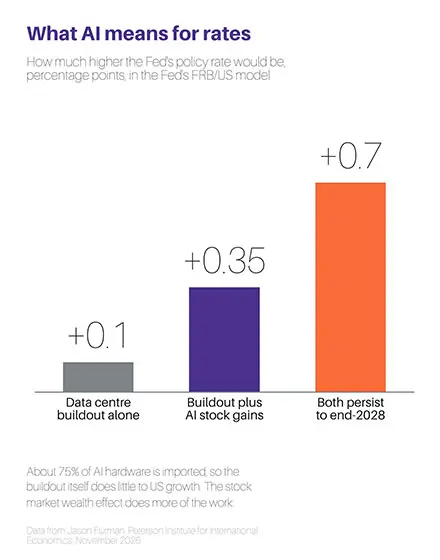
The Fed’s own model supports the point. Furman ran the buildout through FRB/US, the central bank’s main macroeconomic model, and found the investment itself had a modest effect on growth, lifting GDP by about 0.3% because roughly three quarters of the equipment is imported.
 In the model, the buildout alone justifies a policy rate only about a tenth of a percentage point higher.
The bigger channel is the stock market. AI-linked shares have gained about USD 11 trillion relative to the rest of the market since ChatGPT launched, and American households own around USD 7.6 trillion of that. The resulting wealth effect boosts consumer spending, which spreads demand pressure across the wider economy.
Combining the buildout and the equity gains, Furman’s simulation produces a policy rate about 0.35 percentage points higher, rising to around 0.7 points by the end of 2028 if both persist.
That is where the Fed actually has leverage. It cannot easily stop Amazon building data centres, but it can tighten financial conditions, cool equity valuations and slow the consumption that AI wealth is funding. It can also raise the cost of the debt that increasingly finances the buildout.
The Bank for International Settlements noted in October that hyperscaler bonds made up about 24% of corporate issuance at maturities of ten years or more in 2026. Long-term borrowing costs across developed markets have already risen by about 100 basis points on average since early 2026.
Yet each of those levers carries risk. Warsh warned in San Francisco that if the returns expected from AI infrastructure fail to materialise, equity prices could fall sharply, dragging growth down and pushing unemployment up.
Richmond Fed President Tom Barkin has voiced the same worry about what happens if this historic investment does not pay off. A central bank that tightens aggressively into a bubble risks being blamed for bursting it.
Fed Vice Chair Philip Jefferson has added another twist, arguing that a permanent AI productivity boost could push interest rates higher over time even as inflation falls, because companies would want more funding to invest.
 The case for patience
There is a respectable case for looking through the AI effect. Goldman notes that even if every AI effect is counted at face value and persists, core PCE inflation should still fall towards 2% next year, because tariffs and the energy shock from the Iran war explain about 0.9 percentage points of the current one-point overshoot.
On that view, AI is a secondary factor, and the Fed should focus on the larger shocks.
Warsh’s own instincts lean towards optimism. Before taking the job in May, he argued that AI would become a powerful disinflationary force.
The risk is that the Fed waits for a productivity payoff that may take years, while investment-driven inflation becomes embedded in wages and expectations.
 A narrow path
For now, Warsh is walking a fine line, talking up AI’s long-term promise while his committee leans towards tightening to deal with its short-term costs. The December meeting will be the clearest test yet of which instinct prevails.
The most likely outcome is that the Fed does not try to cool AI investment directly. Instead, it will tighten enough to restrain the spillover into broader demand and hope the hardware squeeze fades on schedule in 2027.
If the hyperscalers keep raising their budgets and electricity prices keep climbing, however, the AI premium on inflation could prove more stubborn than the forecasts suggest.
In that case, the central bank may find itself slowing the very revolution its chair has championed.