


When the US Commerce Department released its latest chip controls on Monday November 16, the target on paper was China. Much of the cost, however, is likely to fall on Johor, Singapore, Bangkok and Jakarta.
The interim final rule from the Bureau of Industry and Security goes after a route that has worried Washington for more than two years. Chinese companies have been barred from buying Nvidia’s most advanced processors since 2022, but many could still rent the same chips from data centres in third countries and use them remotely.
The new rule is meant to close that gap, and in doing so it brings Southeast Asia’s fastest-growing industry under American licensing.
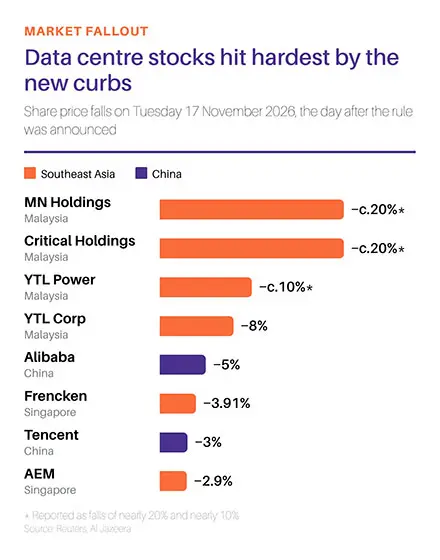
Markets reacted within a day. On Tuesday, Malaysian data centre infrastructure firms MN Holdings and Critical Holdings each fell close to 20%, while YTL Power, an Nvidia partner on AI infrastructure, lost almost 10% and its parent YTL Corp shed 8%.
In Singapore, ASML supplier Frencken dropped 3.91% and chip testing firm AEM fell 2.9%. Chinese technology stocks slid as well, with Alibaba down 5% and Tencent down 3%.
What the rule does
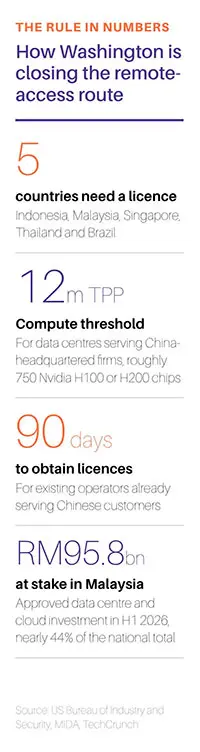
The rule has two parts. The first requires a US licence to export, re-export or transfer advanced AI chips and servers to any data centre, anywhere in the world, that supplies more than 12 million units of total processing performance (TPP) to companies headquartered in China, Macau or the other countries in the US D:5 group, which includes Russia, Iran and North Korea. That threshold is roughly the maximum output of 750 Nvidia H100 or H200 chips.
It counts capacity across linked facilities and covers access arranged through brokers and intermediaries. Operators already serving such customers have 90 days from the effective date to obtain licences.
 The second part names five countries, Indonesia, Malaysia, Singapore, Thailand and Brazil, as presenting “a higher-than-normal risk of diversion”. Shipping advanced chips to any of them now requires a US licence, and the Commerce Secretary can add more countries to the list.
There are carve-outs. US-headquartered recipients, and companies whose ultimate parent is American, are exempt from the country requirement if they meet reporting conditions. Commercial recommendation systems, of the kind used by online retailers and social media platforms, fall outside the remote-access licensing.
Applications will be reviewed case by case rather than refused outright. The rule also formally rescinds the Joe Biden administration’s AI Diffusion Rule of January 2025, which was never enforced.
Commerce describes the measure as “a logical extension of existing controls”. It also says it will watch for countries that tolerate evasion, with possible responses including import restrictions, new licence requirements and Entity List designations.
The rule takes effect on publication in the Federal Register, followed by a 60-day public comment period.
 The Nvidia scandal behind the timing
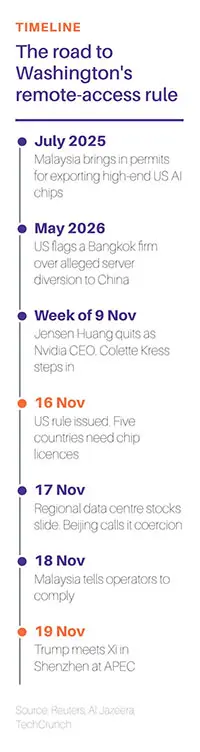
A rule of this kind has been under discussion since at least July 2025, when reports first emerged of a draft aimed at Malaysia and Thailand.
What pushed it out now is the crisis at Nvidia. Jensen Huang, the company’s co-founder, resigned last week during a board investigation, and chief financial officer Colette Kress was named interim chief executive.
Unnamed US officials have alleged in media reports that Huang had a relationship with a woman recruited by China’s Ministry of State Security, identified as Alice Huang, a former executive at Singapore-based data centre company Megaspeed. She has not commented publicly, and Beijing has dismissed the spying allegations as “entirely groundless”.
Megaspeed is the link between the scandal and Southeast Asia. The Information has reported, as cited by Fortune, that at least USD 7.5 billion of Nvidia chips moved through Megaspeed and its Malaysian subsidiary Speedmatrix to Chinese companies.
The Commerce Department and the Justice Department have confirmed a criminal investigation into the firm, and Singapore police are running their own inquiry. Megaspeed denies the allegations and says it takes its US compliance obligations seriously.
Nvidia’s own disclosures show how central Singapore had become. In the quarter to July 2025, revenue billed to Singapore reached USD 10.2 billion, or 22% of the total, up 81% on a year earlier.
The company then stopped reporting a Singapore figure.
Nvidia has said customers use Singapore to centralise invoicing and that physical shipments there were under 2% of its fiscal 2025 revenue. Huang’s exit also removes one of the most prominent voices in Washington against tighter chip restrictions.
Malaysia carries the most risk
No country has more at stake than Malaysia. It has drawn close to USD 100 billion in data centre investment since 2021.
Data centre and cloud projects made up RM95.8bn of approved investment in the first half of 2026, nearly 44% of the RM218.5 billion national total, according to the Malaysian Investment Development Authority.
Those figures are approvals, not money already spent.
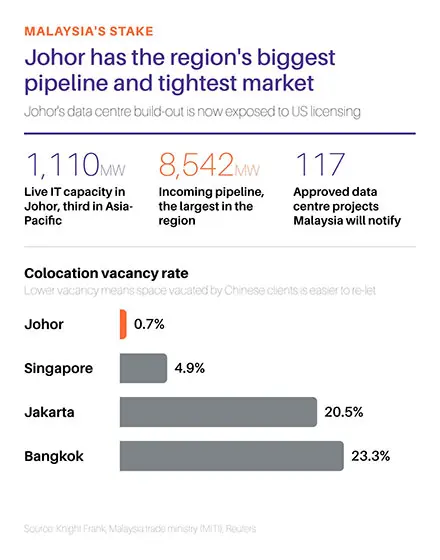
Johor is at the centre of it. Knight Frank puts the state’s live IT capacity at 1,110MW, third in Asia-Pacific behind Tokyo and Singapore, with an incoming pipeline of 8,542MW, the largest in the region.
Malaysia accounts for more than half of the data centre capacity under construction in Southeast Asia, according to DC Byte.
Goldman Sachs expects Johor to be the biggest hub in Asean by 2030 and estimates that data centres will add an average of 30 basis points to Malaysian growth between 2026 and 2028.
Kuala Lumpur has chosen to comply rather than resist.
Trade Minister Johari Abdul Ghani said on Wednesday that operators should follow the US rules, which treat advanced chips as strategic assets, and that the government would notify all 117 approved data centre projects once the requirements are communicated. He added that Malaysia “remains open to investment” and would seek clarity from Washington on licensing and on services to third parties.
Malaysia has required permits since July 2025 for exporting or transshipping high-performance US AI chips, and its trade ministry says it never cleared Megaspeed or Speedmatrix.
The worry is demand.
Ong Kian Ming, a former deputy trade minister, has warned that Malaysia would take the brunt of any fall in Chinese orders for computing power, which would weigh on existing and planned facilities across the region.
Maybank Securities analyst Brian Lee has said Chinese demand for regional capacity could fall, adding risk to the data centre pipeline. The scale of that demand is hard to judge, because operators have been reluctant to name their clients.
 Singapore, Thailand and Indonesia
Singapore, which hosts more than 70 data centres with about 1.4GW of capacity, said it was studying the details. Its trade and digital ministries are contacting affected companies and US authorities, and exploring ways to secure “trusted access” for Singapore firms.
They also said they do not condone companies using Singapore to get around other countries’ laws. Singapore charged a fifth person in an AI server fraud case last week.
Thailand’s exposure is smaller but not new. In May 2026, US authorities flagged a Bangkok-based firm tied to the country’s national AI push for allegedly helping divert billions of dollars’ worth of Nvidia-powered servers to Chinese companies, including Alibaba.
Prime Minister Anutin Charnvirakul has said US and Chinese firms have reaffirmed their investment commitments. Goldman estimates data centres will add 20 basis points to Thai growth over the same period.
Indonesia’s data centre market is at an earlier stage. Minister Airlangga Hartarto has said Jakarta is in talks with Washington on a US-led effort to secure AI and semiconductor supply chains, which suggests it will seek terms rather than contest the rule.
Vietnam and the Philippines are not on the list. Because the Commerce Secretary can add countries, however, no government in the region can treat its absence as permanent.
Beijing’s response
China responded the next day. Foreign Ministry spokesperson Guo Jiakun called the rule a typical act of economic coercion and long-arm jurisdiction and said China would take necessary measures to protect its interests.
The Ministry of Commerce said it was “strongly dissatisfied” and would take countermeasures should the US “insist on going its own way”. Neither ministry has named specific steps.
The timing is pointed. President Donald Trump meets Xi Jinping on Thursday in Shenzhen, host of this year’s APEC summit and one of China’s main technology hubs. Chip controls now sit alongside trade and AI on an already crowded agenda.
Selectivity, not retreat
The near-term effect is likely to be a sorting of the region’s data centres by customer. Operators serving US hyperscalers, which can use the exemption for American-headquartered firms, should see little change. Those that depend on Chinese tenants face licence applications, ownership checks on every customer and the prospect of empty server halls.
 Neil Shah of Counterpoint Research said Chinese AI developers can no longer get around hardware embargoes by renting US computing power from overseas data centres.
Cameron Systermans of Marsh expects “more selectivity, rather than a broad retreat”.
The vacancy figures support that view. Johor’s colocation vacancy rate is just 0.7%, against 4.9% in Singapore, 20.5% in Jakarta and 23.3% in Bangkok, so space vacated by Chinese clients in Malaysia may find other tenants quickly.
Markets with more empty capacity have less room to absorb a loss.
The region still pays a price. Malaysia, Singapore and Thailand built their data centre industries partly on being open to both the US and China.
The new rule asks them to choose their customers, with an American licensing office checking the choice.
With Congress weighing legislation that could tighten rules on chip sales abroad before the year ends, the licence regime introduced this week may prove to be the floor rather than the ceiling.