
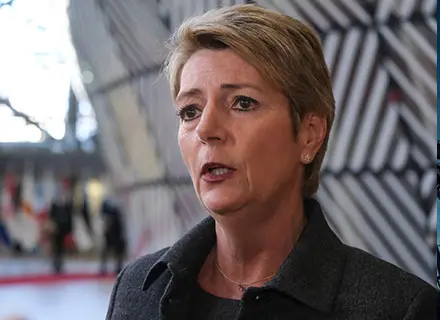

Amid the reports of Switzerland considering a new pitch to soften capital requirements on UBS that would shave billions of dollars off the burden the Swiss bank is facing under a draft law submitted by the government, the European country’s finance minister, Karin Keller-Sutter, has said that requiring the financial biggie to fully back its foreign subsidiaries with core capital is necessary to preserve financial stability.
“We really would like them to have capital requirements that finance fully, especially the subsidiaries in the United States,” she said about UBS, which became Switzerland’s sole global bank when it acquired fallen rival Credit Suisse in 2023.
“Switzerland’s financial center has to be a stable location in the long run, and being well-capitalized can be an advantage for banks. Maybe it’s not Indiana Jones. But I think it is reliable and stable,” Keller-Sutter remarked at a recent banking event in Zurich.
The capital rules have become a major bone of contention between the government and the Swiss banking biggie, with draft legislation submitted to parliament in April that wants to introduce “tougher regulations” to prevent a repeat of the Credit Suisse meltdown. The lawmakers want UBS to fully back its foreign units with Common Equity Tier 1 (CET1) capital.
However, as per the reports, the draft rules have gone through changes, with the latest proposals making it mandatory for UBS, which successfully absorbed its domestic rival Credit Suisse in 2023 through a government-choreographed merger, to back its foreign subsidiaries with around 70% or 80% of CET1 capital instead of the previous requirement of 100%.
Swiss lawmakers earlier floated a separate concession pitch that required at least 50% CET1 backing. The proposal went at the hearing table in May 2026, as top government officials and UBS executives jointly faced parliamentarians in a heated meeting in Bern.
While Switzerland’s efforts to impose tougher capital requirements have weighed on UBS’s share price, it caused friction between Keller-Sutter and the banking biggie, pitting conflicting concerns like Switzerland’s financial stability and the venture’s competitiveness against each other.
In April, during her interaction with the Blick editorial team, Keller-Sutter panned UBS’ lobbying efforts, calling them “unprecedented.”
“You can have differing opinions. However, it is not common practice to challenge our institutions so forcefully. This is a rather new style in how a company interacts with the state. I have seen very intense referendum campaigns in the past, but the behavior of a private actor lobbying with this level of intensity is new,” she said.
The European country’s government estimates its policy roadmap would require UBS to raise about USD 20 billion in additional CET1 capital. An 80% CET1 backing requirement, however, would reduce the figure to roughly USD 15 billion, analysts told Reuters, citing that a 50% CET1 demand could allow UBS to keep operating at current core capital levels.
“To support UBS’s competitiveness, some lawmakers hope to rely partly on less expensive Additional Tier 1 capital alongside CET1. The government sees AT1 as riskier. The proposals now under consideration in parliament envisage varying levels of AT1 entering the mix,” reported Reuters.
Lawmakers could also seek to link a fee UBS must pay for a planned public liquidity backstop—a cash safety net for big banks—to its capital requirements. The upper house committee, currently in charge of the banking bill, is seen as sympathetic to UBS’ argument that costly regulation will hurt its business and the economy. However, another section of lawmakers still wants to see stricter regulation for the bank when the legislation moves to parliament for voting later in 2026.
As per the sources, a compromise between 50% and 100% CET1 backing of UBS’s foreign units could, therefore, emerge from the committee as lawmakers pursue a proposal robust enough to pass a floor vote. However, on June 24, UBS’ CEO, Sergio Ermotti, said Swiss lawmakers will consider competitiveness along with financial stability while drafting new capital rules for big banks.
“The political process and the parliament will focus with cool heads and fewer emotions around what needs to be done to achieve financial stability but also competitiveness,” Ermotti said, adding that competitiveness was vital for job creation.
“Without competitiveness, we will not maintain Switzerland as a global and vibrant financial center in the world,” he added further.