

Elon Musk has spent two years telling investors to stop valuing Tesla as a carmaker. The July 22 second-quarter results made clear what that repositioning now costs, and who is paying for it. The answer, for the moment, is the car business, and the car business is straining.
What the numbers said
The top line was the best Tesla has ever printed. Revenue reached USD 28.24 billion, up 26% on the same quarter a year earlier and ahead of the USD 25.71 billion analysts polled by LSEG had expected, while the core automotive segment brought in USD 20.52 billion, a rise of 23%.
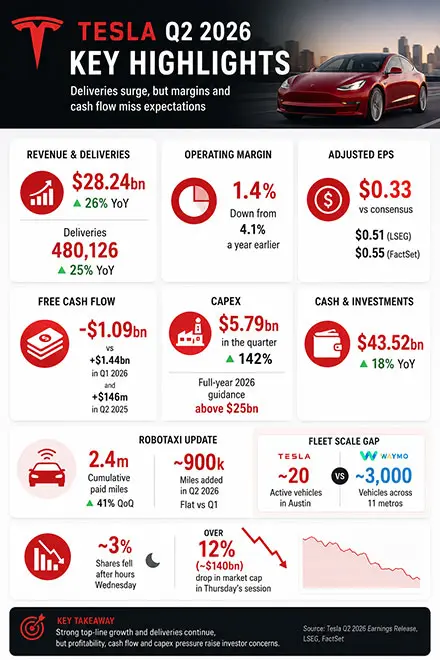 Deliveries hit a record 480,126 vehicles, up 25% year on year, and energy storage deployments reached 13.5 GWh.
Everything below that line moved the other way. Operating income fell 57% to USD 398 million and operating margin sank to 1.4%, down from 4.1% a year earlier, as operating expenses jumped 47% to USD 4.35 billion.
Gross margin slipped to 16.8%, hurt by lower vehicle pricing and a sharp fall in regulatory credit income, a line that once delivered profit without effort.
Adjusted earnings came in at USD 0.33 per share. The size of the miss depends on whose consensus you use. LSEG had USD 0.51. FactSet had USD 0.55. Either way it was a substantial shortfall against a record revenue quarter.
Shares fell around 3% in after-hours trading on Wednesday. The heavier move came in Thursday’s session, when the stock dropped more than 12% and shed over USD 140 billion in market value, with the slide deepening during the earnings call itself.
Why the cash turned negative
The figure that unsettled investors most was free cash flow. Operating cash flow actually rose 85% to USD 4.70 billion, a healthy result. But capital expenditure surged 142% to USD 5.79 billion, producing negative free cash flow of USD 1.09 billion. That compares with positive free cash flow of USD 1.44 billion in the first quarter of 2026 and USD 146 million a year earlier.
It is worth correcting a figure circulating in some coverage. Several outlets have described a USD 3.3 billion cash burn. That number is the sequential increase in capital expenditure, not the cash deficit. The free cash flow shortfall was just over USD 1 billion.
So this is not a demand problem or a manufacturing problem. Tesla is generating more cash from operations than at any comparable point. It is spending faster than it earns, deliberately.
The company has raised its 2026 capital expenditure guidance to more than USD 25 billion, close to three times what it spent in 2025, with the money going towards AI infrastructure, robotics and the Optimus humanoid programme.
Chief financial officer Vaibhav Taneja confirmed the figure on the call, and Musk described 2026 as “a massive capex year,” arguing the investments would deliver strong returns. Musk also indicated capital spending would keep rising over the next two to three years.
A profit worth examining
Tesla reported GAAP net income of USD 1.11 billion, down 5% year on year. Here a caveat is needed. One outlet has reported that roughly USD 750 million of that figure came from a mark-to-market gain on Tesla’s stake in SpaceX, which would mean most of the quarter’s reported profit was a paper gain on a private company Musk controls rather than money earned selling cars or energy.
That claim comes from a single source and has not yet been corroborated against Tesla’s quarterly filing. If it holds, it materially changes how the quarter reads, because operating income was USD 398 million. Anyone relying on the point should check the 10-Q before treating it as settled.
Can the car business carry it?
There are real reasons for optimism on the automotive side. Analysts point to the fully ramped new Model Y, aggressive global pricing, the end of Musk’s DOGE role removing a reputational drag, and what one investor called the end of the EV slump that began in March 2024.
Full Self-Driving subscriptions are also becoming a visible recurring revenue line, though the specific figures cited on the call have so far appeared only in secondary summaries rather than in Tesla’s own materials.
Against that, the margin structure has changed. Tesla operated above 17% margins at the peak of its pricing power in 2022. It is now at 1.4%. The regulatory credit windfall that once flattered results has largely gone.
A business selling more cars than ever at thinner margins, while its subsidy income evaporates, is a weaker platform for funding multi-year moonshots than the same business two years ago.
The robotaxi question
This is where the gap between narrative and delivery matters most. Musk said last year that Tesla would scale its self-driving taxi service rapidly and launch in several US cities by the end of 2025, a target conditioned on regulatory approvals. Progress has been slower than that framing implied, and on Wednesday’s call the executive team took a noticeably more guarded tone.
Tesla now says Robotaxi is live in seven major metros, with several ramping unsupervised and San Francisco running supervised Full Self-Driving under a California permit. Cybercab production and public-road engineering tests began during the quarter, though the company describes these as steps before fleet deployment rather than deployment itself.
The mileage data supports two readings. Cumulative paid Robotaxi miles passed 2.4 million, up roughly 41% on the first quarter, and Tesla added Miami, Orlando and Tampa to its ramping-unsupervised markets, doubling active markets in a quarter.
Broken into quarterly increments, however, the service added roughly 900,000 paid miles in the second quarter, the same as in the first, meaning the quarterly rate held flat rather than accelerating. Both descriptions are accurate. Which one matters depends on whether you are measuring footprint or throughput.
Tesla says it recorded no notable incidents across more than 380,000 unsupervised miles. That is the company’s own figure and has not been independently audited.
On scale, the comparison remains stark. Independent trackers compiling operator disclosures and state filings put Waymo at roughly 3,000 vehicles across 11 US metros, around 500,000 paid rides a week and about four million autonomous miles weekly, while Tesla’s active Austin fleet is reported at around 20 vehicles despite unsupervised service covering the whole metro since June. Tesla’s robotaxi operation remains at an early stage and has yet to generate meaningful revenue.
Optimus, chips and the widening bet
The spending extends well beyond robotaxis. Tesla is pursuing Terafab, a chip manufacturing project shared with SpaceX and xAI, which Musk described as a dependency for Optimus.
The first Optimus production line is under construction, with mass production expected during 2026, though Musk conceded it is the hardest product Tesla has ever attempted to manufacture at scale, with almost every component requiring fresh development and a long capacity ramp ahead.
Tesla also more than doubled its onsite compute in Texas during the first half of 2026, with its Cortex clusters running above 90 MW and 115 MW.
None of these programmes is close to self-funding, and each carries an uncertain payoff date.
The cushion, and its limits
Tesla is not in financial distress, and it is important to say so plainly. It ended the quarter with USD 43.52 billion in cash, cash equivalents and short-term investments, up 18% year on year, with the sequential decline of USD 1.2 billion driven by the capex surge.
The quarter’s cash burn was also far smaller than analysts had feared, coming in at USD 1.09 billion against estimates closer to USD 3.64 billion.
A company with more than USD 43 billion in liquid assets and positive operating cash flow can sustain a USD 25 billion spending year without existential risk. The question is not solvency. It is duration and discipline.
The verdict
Tesla can afford this year. Whether it can afford three or four consecutive years like it, while margins sit near 1% and robotaxi throughput holds flat, is genuinely open.
The bear case is straightforward. The automotive engine is running at its thinnest margins in years, the subsidy income has shrunk, and spending is rising rather than plateauing.
The bull case is equally coherent. Record deliveries, growing subscription revenue, a strong balance sheet and a technological bet that, if it lands, reprices the entire company.
Musk spent much of the call describing Tesla as increasingly intertwined with SpaceX and xAI, citing Grok in the vehicles and Starlink in the Cybercab. Asked directly about a merger, he said there is “more and more overlap” between the companies but declined to discuss combinations on an earnings call.
That may be the most revealing signal of all. If the automotive business cannot indefinitely fund Musk’s AI ambitions alone, a restructuring that pools the capital of his empire starts to look less like speculation and more like a plan.