

Donald Trump says America is reclaiming its place as the minerals superpower. The money has arrived. The refineries, the chemists and the years have not.
He stood in front of more than 200 mining executives, investors, educators and politicians at the State Department on August 7 and declared that America was reclaiming its rightful place as the minerals superpower of the world.
The specifics were not trivial. The Pentagon’s Office of Strategic Capital extended a USD 1.4 billion conditional loan to Sila Nanotechnologies, which makes lithium-ion battery materials, a USD 400 million conditional loan to scandium producer Sunrise Energy Metals and USD 150 million to magnet developer Niron Magnetics.
The theatre was good. The arithmetic beneath it is harder.
The dependence is not about rocks
Start with the scale of the problem, because it is routinely understated. The US Geological Survey’s Mineral Commodity Summaries for 2026 found that the United States was fully import-dependent for 16 non-fuel mineral commodities and more than half dependent for 54 of them, a deterioration on the previous year.
The crucial point is that this is only partly a geology problem. China holds about 44 million tonnes of rare earth reserves, roughly half the world total, so its resource advantage is real.
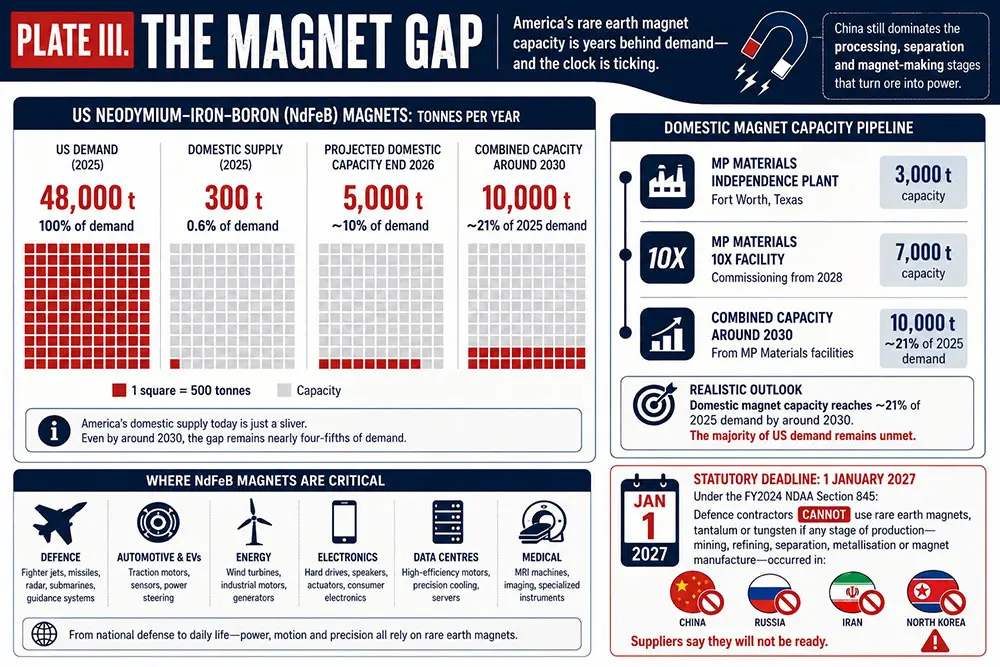
Mine output runs near 69% of the world total against refining capacity near 90%. It also mines close to 80% of the world’s tungsten and just under half its antimony.
So the exposure runs through everything. Fighter jet actuators, missile guidance packages, submarine and radar systems, electric vehicle motors, wind turbines, data centre hardware, fibre optics, medical imaging and the polishing compounds used inside semiconductor fabs all trace back through the same handful of Chinese refineries.
The International Energy Agency modelled full implementation of the suspended controls in July and put USD 6.5 trillion a year of downstream production outside China at risk, with cars, transport and electronics carrying almost 85% of that exposure.
How Beijing turned a licence into a lever
China has never needed an embargo. It needs a licensing desk.
The current phase began in April 2025, when Beijing imposed export controls on seven rare earth elements including samarium, terbium, dysprosium, scandium and yttrium, a direct answer to US tariffs.
In October it widened the list to europium, holmium, erbium, thulium and ytterbium, and introduced extraterritorial provisions asserting authority over foreign-made goods containing Chinese-origin material.
Through 2026 the ratchet has kept turning. Early in the year Beijing aimed dual-use restrictions at Japanese military end-users. In March the State Council issued provisions folding export controls, investment screening and counter-sanctions into a single supply chain security regime.
By 24 July it had blocked shipments to 14 European Union firms. A reporting and reward mechanism for suspected violations took effect on 1 July, shifting the regime from licensing towards active enforcement, and Japanese nationals have already been detained in Dalian over alleged rare earth smuggling.
The market effects are not theoretical. Antimony prices rose 144% in 2025. European carmakers suspended production lines in June and October, and one assessment found magnet licence approval rates falling from above 90% to below a quarter.
A European Chamber survey put the cost to a single member firm above 250 million euros. And the Trump-Xi summit in May 2026 produced no rollback.
What Washington has actually built
To be fair to the administration, the response has been broader than a single announcement.
Executive Order 14241 in March 2025 began accelerating mine permitting. In February 2026 came Project Vault, a roughly USD 12 billion strategic critical minerals reserve funded by a USD 10 billion Export-Import Bank loan, the largest in the bank’s history, plus close to USD 2 billion in private capital.
Two days later the State Department hosted the first Critical Minerals Ministerial, drawing 54 countries. Out of that week came a Mexico action plan, a Democratic Republic of Congo copper and cobalt partnership, and frameworks or memoranda with Argentina, Morocco, Peru, the Philippines, the UAE, Uzbekistan, Guinea and Ecuador. Development finance commitments included USD 565 million for Brazilian rare earth extraction, a letter of intent worth up to USD 700 million for Kazakh tungsten, USD 600 million into the Orion consortium and seed money in Ukraine.
Trade policy has been held in reserve rather than fired. Proclamation 11001 in January 2026 accepted Commerce’s finding that imported processed minerals threaten national security, then declined to impose tariffs, instructing negotiators to extract supply agreements first. The tariff remains loaded.
Domestically, the government has taken equity as well as lending, including the Pentagon’s USD 400 million preferred stake in MP Materials and a USD 725 million loan to Energy Fuels.
Can America actually be the mineral superpower?
Not on this decade’s early timetable, and the numbers say so plainly.
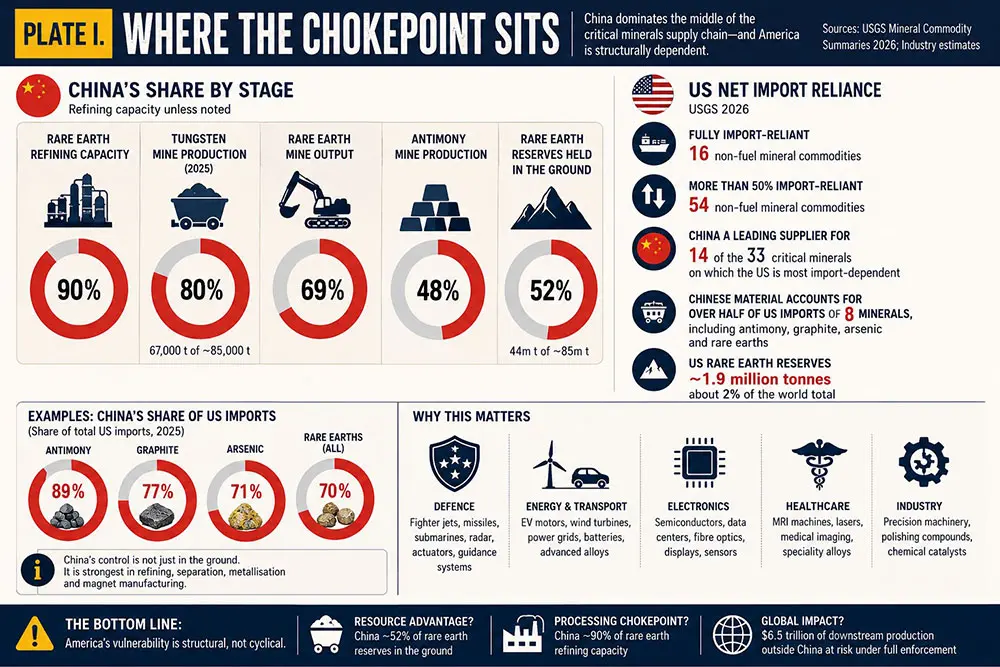
American demand for neodymium-iron-boron magnets reached roughly 48,000 tonnes in 2025. Domestic supply was about 300 tonnes. Even if capacity hits the projected 5,000 tonnes by the end of this year, that is barely a tenth of national demand.
Against that sits a statutory cliff. From January 1 2027, defence contractors cannot use rare earth magnets, tantalum or tungsten if any stage of production, from mining through refining and metallisation, touched China, Russia, Iran or North Korea. Suppliers have said flatly that they will not be ready.
Nor is the domestic effort uniformly disciplined. MP Materials sued USA Rare Earth on 22 May 2026 over alleged theft of magnet formulations, naming a former MP engineer and a third-party firm alongside it, a fight between the two companies Washington needs most.
USA Rare Earth denies every allegation. Congressional Democrats have demanded documents on the equity stakes programme, asking whether government ownership might sway permitting decisions. As one executive put it to the trade press, the 2026 to 2028 narrative is political and the 2030-plus timeline is industrial.
The realistic read is this. Washington can plausibly secure defence-grade volumes by the early 2030s, and Project Vault buys time in the interim.