
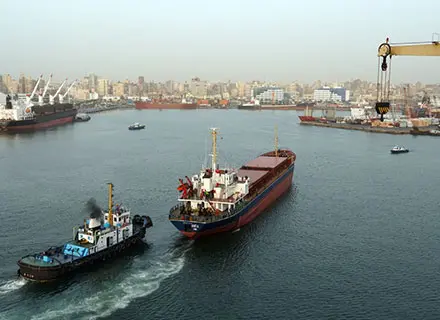

Egypt’s Alexandria Port Authority and the Montenegro Ports Authority signed a memorandum of understanding (MoU) on 20 July, setting up an institutional framework for maritime cooperation and opening the door to a direct shipping link between the two countries’ ports.
The signing came during the first official presidential visit by a Montenegrin head of state to Egypt since the two countries established diplomatic relations, and was witnessed by Egyptian Prime Minister Mostafa Madbouly and Montenegro President Jakov Milatovic.
Rear Admiral Ehab Salah, Chairperson of the Alexandria Port Authority, and Stanko Dretic, Chairperson of the Montenegro Ports Authority, signed the agreement in front of senior officials from both delegations.
The MoU itself is a framework document rather than a shipping contract. It commits both sides to cooperation on port management and operations, expertise exchange, digital transformation, capacity building, and environmental sustainability.
It also commits both authorities to study the establishment of a direct maritime link connecting their ports, a step both governments describe as necessary to support supply chains and expand trade and investment between the two economies.
Egypt and Montenegro sit on opposite ends of a logistics corridor that has, until now, gone largely unused. Alexandria faces the eastern Mediterranean, while Bar, Montenegro’s principal port, opens onto the Adriatic.
Officials on both sides framed this geography as the commercial logic behind the agreement, arguing it gives the two countries a natural role linking European markets with the Middle East and North Africa.
Speaking after the signing, Madbouly went further than the MoU’s own language, confirming that the Egyptian government wants to establish a direct shipping line specifically between Alexandria and Bar.
He described the route as a strategic project that would connect Egypt to the Western Balkans and Central Europe, while giving Montenegro a maritime gateway into Africa and the Middle East.
That characterisation reflects Cairo’s ambition for where the cooperation should lead, though the MoU’s own text commits the two port authorities only to studying the link, not to launching it on a set timeline.
The agreement fits into a broader push by Egypt to build out its port infrastructure and position itself as a regional hub for transport, logistics, and transit trade, a strategy that has run alongside investment in the Suez Canal Economic Zone and other maritime assets over recent years.
Wider talks beyond the ports deal
The maritime MoU was one output of a broader meeting between Madbouly and Milatovic, who arrived with a delegation that included Nikola Camaj, Vice-President of Montenegro’s Parliament, and Tamara Vujovic, Minister of Culture and Media.
The Egyptian side included Foreign Minister Badr Abdelatty, Investment and Foreign Trade Minister Mohamed Farid Saleh, Higher Education Minister Abdelaziz Konsowa, and Industry Minister Khaled Hashem.
Madbouly welcomed Montenegro’s plan to open an embassy in Cairo, calling it a critical step toward a new phase of cooperation, and pressed for full activation of a political consultation mechanism the two countries agreed in 2025, this time with a defined timetable covering infrastructure, ports, trade, investment, culture, religion, and tourism.
On trade, Madbouly acknowledged that commercial exchange between the two countries remains modest relative to the strength of their political ties, despite recent growth, and called for institutional efforts to set concrete targets.
He singled out energy as a promising area, proposing a joint action plan spanning electricity transmission, energy storage, market development, electrical interconnection, renewable energy, and green hydrogen. Tourism also featured prominently, with Madbouly pointing to existing Egyptian investment in Montenegro’s tourism sector as a base to build on.
Milatovic, for his part, said his delegation wants to explore cooperation across parliamentary, investment, commercial, cultural, and educational fields, and described the port MoU as a vital step supporting logistical and commercial ties.
He also raised civil aviation as an area for closer cooperation, aimed at easing travel, trade, and investment flows between the two countries, alongside university exchange programmes in education. He praised Egypt’s role in regional peace and stability efforts in the Middle East.
Other threads discussed included cooperation between Al-Azhar and Montenegro’s Islamic Community on promoting moderation and tolerance, with Egypt offering to expand imam training programmes and scholarships for Montenegrin students, and the formation of the first parliamentary friendship group between the two countries.
Madbouly closed the meeting by directing Abdelatty and Saleh to follow up on the talks with clear implementation timeframes, a signal that Cairo wants the port MoU, and the wider set of commitments made alongside it, to move from framework to concrete action rather than sit as a diplomatic gesture.