


Microsoft, Google, Meta and Canva are paying employees to leave as AI spending climbs to record levels. Are buyouts a kinder way to cut, or a quiet way to fund the data centre race?
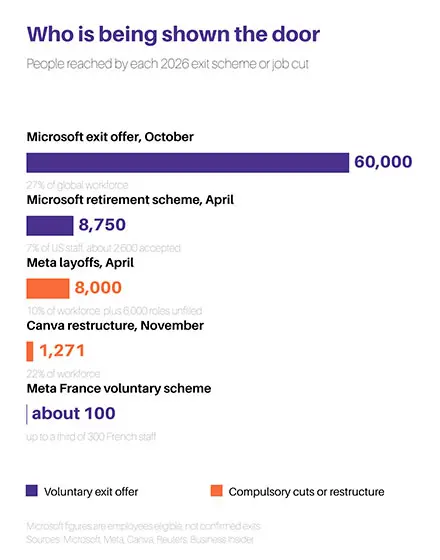
In the space of a fortnight, three of the world’s best-known technology employers asked thousands of their own people whether they would like to leave. On October 26, Microsoft opened a Voluntary Exit Offer to about 60,000 employees, roughly 27% of its global workforce.
Days later, Google confirmed it had extended its voluntary exit programme to staff in Canada, France, Germany, Japan and Switzerland. Meta is finalising a voluntary departure scheme in France that could see up to a third of its roughly 300 French staff leave.
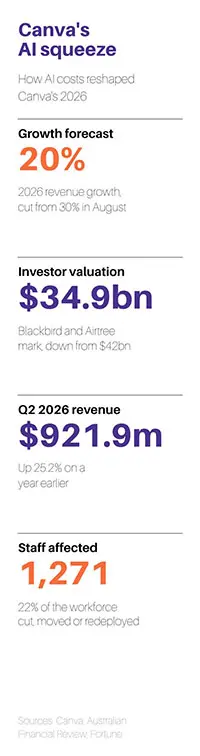
And on November 4, Canva told 1,271 employees, or 22% of its workforce, that their jobs would end, change or move, attaching one of the most generous departure packages the industry has seen.
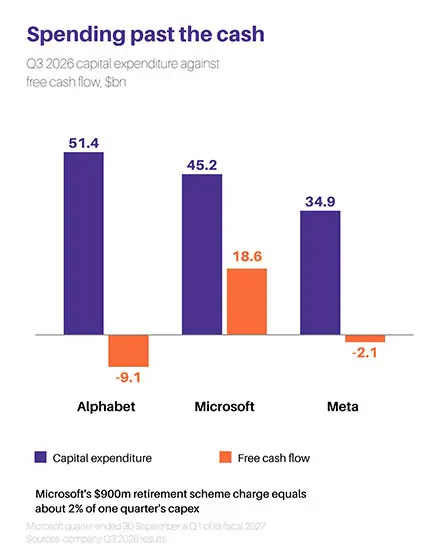
The timing is hard to ignore. In their latest quarterly results, Alphabet, Microsoft and Meta together spent more than USD 131 billion on capital expenditure in a single quarter, most of it on chips, servers and data centres for artificial intelligence.
Two of the three reported negative free cash flow. Are these buyouts a humane way to reshape a workforce, or a softer label for paying the AI bill with jobs?
 What a voluntary buyout is
A voluntary buyout, sometimes called a voluntary exit programme, is an offer of money and benefits to employees who agree to resign. Unlike a layoff, nobody is forced out.
For employers, buyouts hurt morale less, invite fewer legal disputes and avoid the headlines of mass redundancy.
They also let a company shrink without picking names. For employees, a buyout can be a safer exit than waiting for a layoff on worse terms.
The catch, which economists call adverse selection, is that the people most likely to accept are often those with the best options elsewhere. A company can lose the talent it most wanted to keep.
How the four packages compare
Microsoft has run two programmes this year. The first, a Voluntary Retirement Program announced in April, was the first buyout in its 51-year history. It was open to about 8,750 US employees whose age plus years of service reached 70 or more.
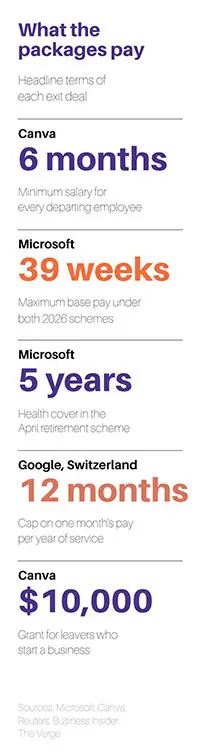
 Those who accepted received one or two weeks of base pay for every six months of service, capped at 39 weeks, six to 12 months of extra stock vesting and company health cover for up to five years, with the first year fully paid.
Roughly 2,600 people took it, and Microsoft initially set aside a USD 900 million charge.
The October Voluntary Exit Offer is broader but plainer. It covers participating teams in the US, UK, Canada and India at internal level 70 and below, with no age or tenure test.
Terms match Microsoft’s standard severance, which in the US means at least eight weeks’ pay and up to 39 weeks, continued stock vesting, healthcare for a fixed period and career support.
Employees must decide by early December and leave on December 31. Teams working on data centres, cybersecurity and quantum computing are reported to be excluded, while Xbox, Windows, Copilot and finance are fully in.
Google has run voluntary exit programmes team by team since 2025, starting in its Platforms and Devices division and reaching the Global Business Organisation in February 2026. In Switzerland, staff who accepted the latest round received one month’s salary per year of service, capped at 12 months.
DeepMind, Google’s AI research unit, has been left out.
Meta’s approach is the bluntest. In April it said it would cut about 8,000 jobs, roughly 10% of its workforce, and leave 6,000 open roles unfilled. Its only voluntary scheme so far is in France, under a mechanism called rupture conventionnelle collective, which needs agreement with employee representatives and guarantees payouts at least equal to statutory redundancy pay. Applications closed on 5 November.
Canva’s programme is not strictly voluntary, but its package has become the one everyone is talking about. Departing staff receive at least six months’ salary wherever they are based, 12 months of continued healthcare where Canva provides it, a year of its employee assistance programme for them and their families, the right to keep equity even if they have not passed the usual one-year vesting cliff, their company MacBooks, and the chance to apply for a USD 10,000 grant to start a business or community project.
The AI bill in numbers
Alphabet expects to spend between USD 195 billion and USD 205 billion on capital expenditure in 2026, more than double its 2025 figure of USD 91.4 billion, and says spending will rise sharply again in 2027. In the third quarter alone it spent USD 51.4 billion, more than its operating cash flow of USD 42.3 billion, leaving free cash flow at minus USD 9.1 billion.
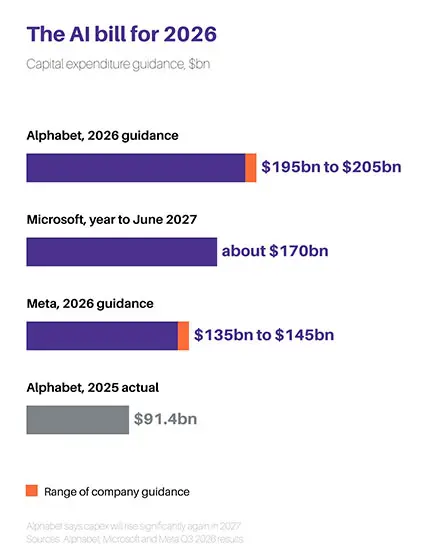 Meta has narrowed its 2026 range to between USD 135 billion and USD 145 billion. Its third-quarter spending of USD 34.9 billion also exceeded the cash its operations generated, producing negative free cash flow of USD 2.1 billion, against a positive USD 10.6 billion a year earlier.
Microsoft spent USD 45.2 billion in its September quarter and expects about USD 170 billion for the fiscal year to June 2027. Unlike the other two, it still generated USD 18.6 billion in free cash flow.
Canva works at a different scale but faces the same arithmetic.
In August it cut its 2026 revenue growth forecast from 30% to 20% after the cost of running its AI features proved far higher than planned.
Two of its investors, Blackbird and Airtree, then marked its value down from USD 42 billion to USD 34.9 billion.
The case for buyouts
Supporters argue that buyouts are the least painful way to do something that has to be done, letting people leave on their own terms with real support.
Microsoft’s experience backs this view. About 30% of those eligible for the spring retirement scheme accepted, and chief people officer Amy Coleman later said the turnout reduced the size of the July layoffs, when the company cut 4,800 jobs.
The cost is also modest next to the stakes. Microsoft’s USD 900 million retirement charge was about 2% of a single quarter’s capital spending, or less than two days of AI investment at its current pace.
Canva’s package has been praised by at least one chief executive, and generous exits protect an employer’s reputation while companies compete hard for AI engineers.
 The case against
Critics read the same facts differently. A buyout invites people to leave, but it does not guarantee the right people leave. Microsoft’s spring scheme targeted long-serving staff, exactly the employees who hold knowledge about systems the company still depends on.
Trust is the second problem. Google’s record of following voluntary offers with layoffs in at least one division suggests a voluntary offer can work as a warning, and employees who decline may wonder whether they are next.
Microsoft’s new offer is also less generous than its spring scheme, which hints that the company is testing how cheaply it can reduce headcount.
Third, buyouts may not shrink these companies at all. Alphabet’s workforce grew to 204,757 at the end of September from 194,668 in March, despite its exit programmes.
The aim looks less like saving money on staff and more like swapping one kind of worker for another.
Is AI spending driving the exits?
Companies rarely draw that line themselves, but the clues are strong. Meta’s chief people officer, Janelle Gale, told staff the April cuts were meant to run the company more efficiently and offset its other investments.
Canva tied its slower growth directly to AI computing costs. And the exclusions tell their own story. Google kept DeepMind out of its programmes, and Microsoft is reported to have protected its data centre and quantum teams.
 The buyouts are aimed at the parts of each business furthest from AI.
Yet the numbers also show the limits of that link. Even if all 60,000 eligible Microsoft employees left, the payroll saved would be small next to a USD 170 billion capital budget. What payroll savings can do is reassure investors that costs are under control as free cash flow turns negative.
Meta’s headcount is down 15% on a year earlier, at 66,775, even as its total expenses for 2026 are forecast at USD 175 billion to USD 179 billion, which shows where the money is going.
There is a second, less comfortable link. The AI tools these companies are building are the same tools they expect to make parts of their own workforces less necessary. Canva cut 10 of its 12 technical writers months after its founders urged staff to use AI wherever possible.
Google’s business unit offered exits to staff uneasy with the pace of its AI push. In that sense, the buyouts are less about paying for AI than about preparing for it.
The verdict
On balance, voluntary buyouts are a better tool than blunt layoffs. They give people a choice, cost relatively little and reduce the human damage of restructuring.
But they should be seen for what they are. These are not companies in trouble, since Alphabet, Microsoft and Meta all grew revenue by between 19% and 26% in their latest quarters. They are companies rebuilding themselves around one very expensive bet.
The packages buy goodwill and flexibility, while the real cost of the AI race is paid in capital budgets that, at Alphabet and Meta, now exceed operating cash and in a quiet redefinition of which workers count as essential.
For the 60,000 Microsoft employees weighing their options before December, the most useful question may be the one career advisers keep repeating. How likely is a layoff if you stay?