

Established by brothers and former SpaceX engineers Karan and Neel Kunjur in 2022, K2 Space has taken on an ambitious task: launching one of the highest-powered spacecraft ever built to demonstrate the required technology for setting up data centres in orbit. The deep tech start-up will send its satellite Gravitas on a SpaceX Falcon 9 rocket by the end of March.
While possessing a weight of two metric tons (with a 40-metre wingspan), Gravitas will be capable of producing 20 kW of electricity for use by its onboard payloads, such as powerful sensors, transceivers, and computers. Interacting with the media, K2 Space CEO Karan Kunjur stated that “the future is higher power” and also informed that the start-up raising USD 450 million. For Kunjur, K2 Space’s satellite launch will be the company’s first step into real space operations.
Mission Gravitas: A Lot Of Things At Stake
According to a TechCrunch report, K2 Space’s Gravitas mission will fly 12 undisclosed payload modules from several customers, including the United States Department of Defence, as well as a 20-kW electric thruster that the start-up expects will be the most powerful ever flown in space. As per Kunjur, the demonstration will be evaluated across several tiers of success, with the prominent ones being: can K2 get the spacecraft deployed and generating power? Can it start running its payloads and test its powerful thruster? And if that goes well, can the deep tech venture use the thruster to raise the spacecraft thousands of kilometres into a higher orbit?
Apart from designing and building 85% of its components in-house, K-2 Space will maximise data collection to feed into the next satellite design. The start-up plans to launch 11 satellites in the next two years in a mix of demonstration and commercial missions. By 2028, Kunjur expects his company to produce satellites for customers to build out commercial networks of high-powered space vehicles.
Satellites power critical infrastructures for lifeline functions like global communication, navigation, financial transactions, and Earth observation. It has created a sort of “Orbital Economy,” which increasingly takes on complex functions like managing supply chains, optimising transportation routes, and enabling high-speed internet access in remote areas. Both K2 Space and Kunjur expect the space-based ecosystem to require more power. More power will mean the requirement for more throughputs, along with a signal less susceptible to jamming (considering geopolitical tensions). As data processing in orbit becomes more important, high-powered satellites will be needed to operate advanced processors.
This presents Kunjur’s venture a unique opportunity: to equip its spacecraft with computing power. And the concept is not new, since Starlink and Amazon LEO, along with hyperscalers, are mulling over introducing orbital compute. In fact, the Pentagon’s plans for a USD 185 billion missile defence system will also feature satellites with more electrical clout. What sets K2 Space apart here is its proactive approach of testing the concept through Gravitas’ deployment.
K2 contends that its spacecraft remains a viable option even if launch costs amount to approximately USD 7.2 million on customer rates for a Falcon 9 rocket, as opposed to USD 600,000 if Starship significantly reduces launch costs for external customers. Kunjur argues that Gravitas offers a price point of USD 15 million, which is more economical than high-powered satellites produced by traditional contractors, while also providing greater capability than smaller spacecraft in a similar price range.
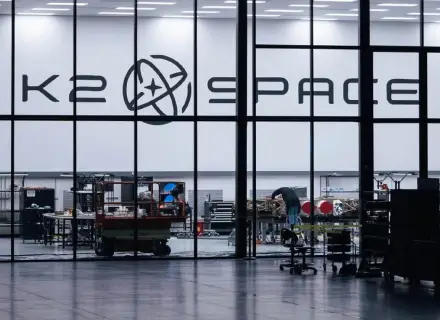
“The thinking is, let’s build all the components that we’re going to need to be a first mover when Starship and New Glenn are available for everybody else,” Kunjur continued, while informing that K2 has designs ready for a 100-kW satellite all taped out on its factory floor, stretching across the entire building.
Unmatched Capability At A Fraction Of Legacy Cost
K2 has tailored its satellite portfolio into two categories: Mega and Giga. While Gravitas will be capable of producing 20 kW of electricity for use by its on-board payloads, the upcoming versions, in their “Mega” format, will produce 30 kW of peak payload power to aid 3,000 kg of available payload mass. The Mega K2 satellite will also have a 3 m x 2.7 m payload deck to host the largest antennas and instruments, while the 20 kW hall effect thrusters will support rapid orbit raise and station-keeping.
Robust thermal control and significant dissipation will ensure the satellite’s stable operations over mission lifetime, with redundancy in elements like computing, sensors, and control systems maximising the system’s reliability, while high throughput with link margins will support demanding missions.
The “Giga” version, under development, will be the start-up’s big gun in orbit, possessing features like 110 kW of array power for the most demanding space applications, 15,000 kg available payload mass, an expanded 6.2 m x 6.2 m payload deck, 4 kW–20 kW hall effect thrusters for orbit transfer and station-keeping, and the highest throughput and link margins.
What is Gravitas’ launch trying to achieve? The spacecraft will deploy the largest solar arrays ever built, paired with high-voltage, radiation-resilient power systems engineered for extreme environments. The satellite will also have the highest-power electric propulsion system ever put in orbit, a 4× leap over the current state-of-the-art counterparts. The launch will also be about achieving autonomy at a constellation scale, with onboard radiation recovery, mission-data processing, and a full in-house autonomy stack validating the technology’s scope.
Further, Gravitas will introduce other industry-firsts like managing double-digit kilowatt systems with extreme heat flux, thermal architectures that safely reject that heat across all Earth orbits and beyond, ultra-stable pointing and attitude control for massive apertures that keep the satellite’s momentum in check even with large deployables, and dispensing systems capable of deploying dozens of satellites per launch, engineered to survive the most punishing deployment dynamics.
Upon the successful deployment of Gravitas, the start-up will concentrate on its next assignment, i.e., deploying integrated satellite networks that span LEO (Low Earth Orbit), MEO (Medium Earth Orbit), GEO (Geostationary Earth Orbit), and cislunar space, with dynamic load balancing and mission-specific routing across the orbital stack. The development stage will also involve constructing autonomous relay networks in cislunar and interplanetary space to form a deep-space data backbone and building high-power observatories from X-ray to far-infrared to detect cosmic events and hunt for exoplanets.
The start-up’s upcoming line-up of satellites will also have heat pumps and massive radiators to solve the hardest thermal problems, in addition to enabling hall thrusters powered by nuclear systems and redefining solar-system travel. The ultimate goal will be to put up high-power computing platforms in orbit that will push processing to the deep-space edge.