

Nasdaq-listed Ericsson has secured one of its more strategically loaded contracts of the year, with NTT DOCOMO selecting the Swedish vendor’s next-generation RAN Compute platform for its networks in Japan, including 5G. Deployment began in July 2026.
The win matters less for its immediate revenue than for what it signals. Japan’s largest mobile operator has committed the processing brain of its radio network to Ericsson’s in-house silicon at precisely the moment the industry is trying to work out how artificial intelligence will reshape mobile traffic. For a company whose core radio business has been shrinking, that is a useful anchor.
What the deal actually covers
RAN Compute is the baseband layer of a mobile network, the computing hardware that sits behind the antennas and handles signal processing, scheduling and the software logic that determines how efficiently spectrum is used. Radios get the attention. Baseband determines what those radios can actually do.
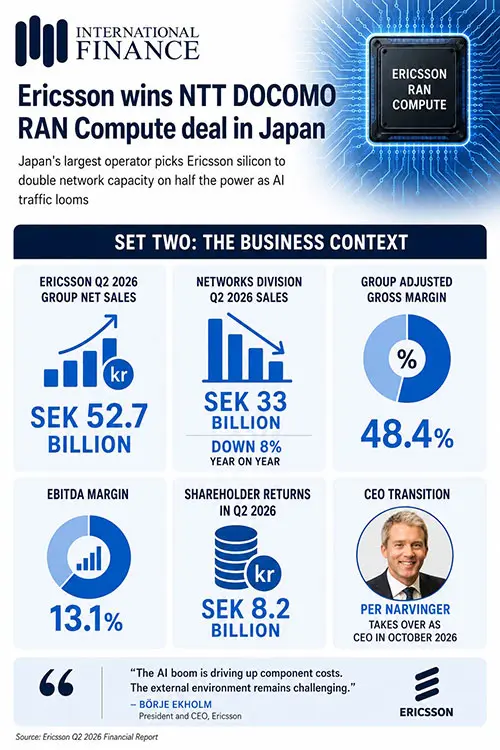 Ericsson says the purpose-built platform uses its latest in-house silicon and is optimised for 4G, 5G and 5G Advanced, as well as for artificial intelligence and machine learning workloads running inside the radio access network. The company describes the result as an AI-native and programmable platform capable of supporting long-term software evolution.
That phrase is doing heavy lifting. It means DOCOMO is buying hardware it expects to keep upgrading through software for years rather than replacing at the next generational step. In an industry where full network swaps are financially painful, longevity is a selling point in its own right.
The numbers behind the pitch
The commercial case rests on two figures. Ericsson claims the platform delivers up to twice the capacity of the previous generation of baseband products while consuming less than half the energy, which it says enables more efficient site operations and lower costs in centralised radio access network deployments where compute units are installed in aggregated fashion.
Both halves of that claim land hard in Japan. The country’s post-Fukushima dependence on imported liquefied natural gas keeps power costs high by international standards, and network energy is one of the few operator expenses that scales directly with traffic growth.
For DOCOMO, that is the difference between capacity expansion funded by capital expenditure and capacity expansion partly funded by efficiency.
A pattern, not a one-off
This is the second significant Ericsson placement in DOCOMO’s network in seven months. In December 2025, the vendor began commercial deployment of its 4.5GHz massive MIMO radio, the AIR 3255, in DOCOMO’s 5G network.
Radios first, then the compute layer, then architecture co-development is a recognisable vendor progression. Each step raises switching costs and deepens the technical entanglement between supplier and operator.
Masafumi Masuda, senior vice president and general manager of DOCOMO’s radio access network design department, said the operator is expanding processing capacity to protect communication quality against rising traffic demand, and that Ericsson’s platform will support its infrastructure strategy through high processing performance.
Yukiko Sato, board director and head of the NTT Group customer unit at Ericsson Japan, put the commercial and environmental case.
“The RAN Compute platform will not only address DOCOMO’s network traffic needs but also enhance environmental sustainability and reduce operating costs,” she said.
Why the AI framing is not just marketing
Mobile networks were built on the assumption that people download far more than they upload. AI is quietly undermining that. Video calls into models, live camera feeds, agentic devices reporting continuously, and machine-to-machine traffic all push demand towards the uplink, which is historically the constrained direction in cellular design.
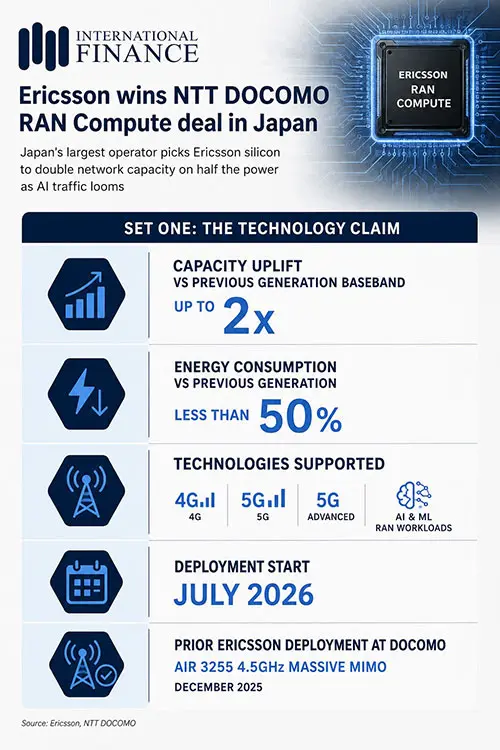 Ericsson’s own leadership has flagged this. Speaking on the company’s second-quarter earnings call, chief executive Borje Ekholm said, “In this world, connectivity will be more important and uplink will dimension mobile networks. We will also see increasing demand of low latency. Actually, this is what 5G was designed for.”
That tension explains the DOCOMO deal neatly. Nobody is certain when AI traffic arrives at scale. Everyone wants to be provisioned when it does. Buying programmable compute now is a hedge that costs less than being caught short later.
What it means for Ericsson’s business
The context is unflattering. Ericsson’s Networks division, its largest business, reported second-quarter sales of SEK 33 billion, an 8% decline year on year, with organic sales down 4%.
Against a flat global RAN market, share gains and high-value replacement cycles are the only real growth levers left. Japan supplies both.
The timing is also political. Per Narvinger, currently head of Networks, takes over as chief executive in October. A flagship Japanese contract secured under his division strengthens the argument that the silicon strategy is producing commercial results rather than just technical bragging rights.
The broader signal
The deeper story here is about vertical integration. Ericsson designs its own chips. Rivals leaning on merchant silicon and general-purpose servers, the architecture underpinning much of the Open RAN movement, have argued that openness beats bespoke design. DOCOMO, notably, has been among the most vocal Open RAN champions in the industry.
That an operator with that history is buying purpose-built proprietary compute for its AI-era network is a data point worth noting. Performance per watt, at scale, is winning the argument for now.