


Jio Platforms, the digital and telecom arm of Reliance Industries, opens its initial public offering (IPO) on Wednesday October 21.
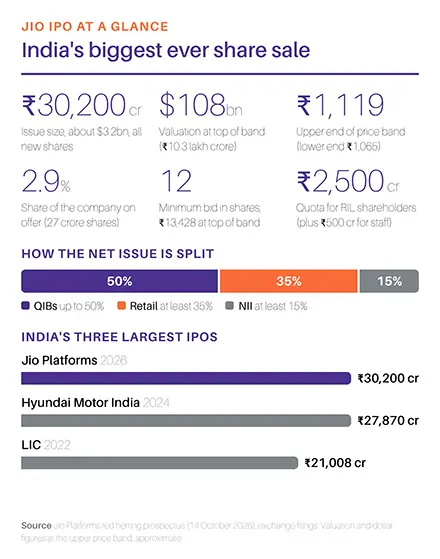
At the top of its price band, the issue will raise about ₹30,200 crore (USD 3.2 billion) and value the company at roughly ₹10.3 lakh crore (USD 108 billion).
That makes it the largest share sale in Indian history, ahead of Hyundai Motor India’s ₹27,870 crore offering in 2024 and the ₹21,008 crore raised by Life Insurance Corporation of India (LIC) in 2022.
The timing could hardly be more dramatic.
Over the past fortnight, Elon Musk has used popular micro-blogging platform X (formerly Twitter) to accuse Ambani of keeping Starlink out of India, at one point mockingly calling him “Prime Minister Ambani”.
A landmark domestic listing has become one of the most closely watched market debuts in the world this year.
Jio Platforms is the holding company for Reliance Jio Infocomm, the mobile operator that launched in 2016 with free calls and rock-bottom data prices and quickly upended Indian telecoms. It ended June 2026 with more than 533 million subscribers, around 285 million of them on 5G, along with 28.6 million home broadband connections.
The group also runs cloud, enterprise, Internet of Things and artificial intelligence businesses.
In 2020, at the height of the pandemic, Jio Platforms raised more than $20 billion from investors including Meta, Google, KKR, Silver Lake and Saudi Arabia’s Public Investment Fund, at a valuation of around $65 billion. The IPO gives all of them, and Reliance itself, a public market price for the first time.
What is Jio trying to achieve?
Jio wants three things from its listing.
The first is a lighter debt load. This is a pure fresh issue, meaning every rupee raised goes into the company rather than to existing shareholders.
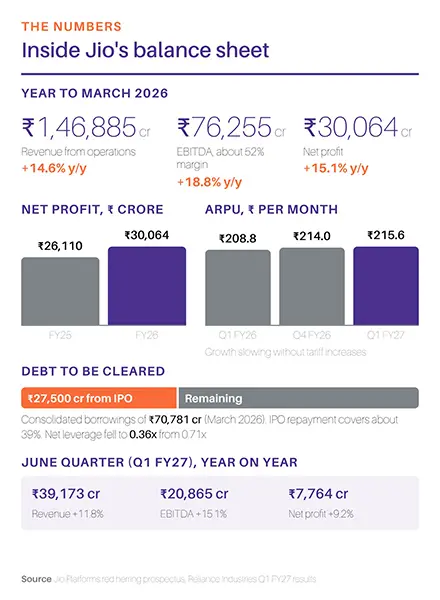
Up to ₹27,500 crore, roughly 91% of the money, will be used to repay or prepay borrowings at Reliance Jio Infocomm.
Consolidated borrowings stood at about ₹70,781 crore at the end of March 2026, so the IPO could clear close to two-fifths of that in one go, cutting interest costs and freeing up cash.
The second is a transparent valuation. Reliance’s sprawling mix of oil refining, retail and telecoms is hard to value, and a separately traded Jio gives the market a daily price for the group’s crown jewel.
The third is a platform for bigger ambitions. Ambani wants Jio to be seen as a technology company rather than a phone network.
He has pledged ₹10 lakh crore (about USD 105 billion) of AI investment by Reliance and Jio over seven years, and Jio is planning its own constellation of around 1,600 low Earth orbit satellites, with a test flight targeted for September 2027.
A listed Jio with a cleaner balance sheet is better placed to fund such plans.
Jio is offering up to 27 crore new shares with a face value of ₹10 each, in a price band of ₹1,065 to ₹1,119.
That is only about 2.9% of the enlarged company.
Investors must bid for a minimum of 12 shares, which costs ₹13,428 at the top of the band.
Up to half of the net issue is set aside for qualified institutional buyers such as mutual funds and foreign funds, at least 35% for retail investors bidding up to ₹2 lakh, and at least 15% for wealthy individuals and other non-institutional investors.
Up to ₹500 crore of shares is reserved for eligible employees, who get a ₹54 discount per share, and a further ₹2,500 crore for individual Reliance Industries shareholders who held at least one share on 14 October, the day the red herring prospectus was filed.
Nineteen investment banks, including Kotak Mahindra Capital, Morgan Stanley and BofA Securities, are running the book.
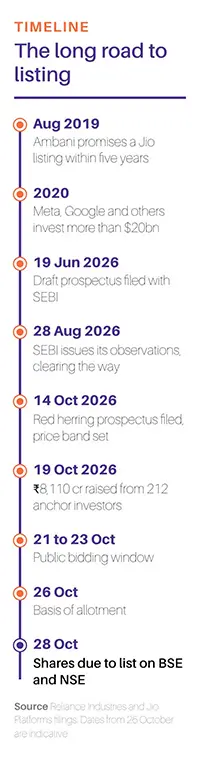
Bidding closes on October 23 October, allotment is expected on October 26 and the shares are due to list on the BSE and the National Stock Exchange on or around October 28.
A valuation priced to sell
 The final price is noticeably more modest than early chatter suggested. Reports before the prospectus spoke of a ₹37,700 crore raise and a price band as high as ₹1,220, implying a valuation of USD 120 billion or more. Brokerage estimates also sit higher, with ICICI Securities projecting USD 148 billion, Motilal Oswal USD 115 billion to USD 118 billion and Dolat Capital about USD 110 billion.
Pricing below those figures in a difficult year for Indian equities, with oil prices pushed up by conflict in the Middle East, looks deliberate. It leaves room for gains after listing, which helps a deal of this size get done.
The early signs suggest it has worked. On October 19, Jio raised ₹8,110 crore from 212 anchor investors at the top of the band, after institutional demand topped ₹2.5 lakh crore, more than 30 times the shares on offer.
LIC took the largest allocation of nearly ₹500 crore, alongside the Government of Singapore, Norges Bank and the Abu Dhabi Investment Authority.
Unofficial grey market trading points to a premium of around 20% over the issue price, though such figures are notoriously unreliable.
Jio’s numbers are those of a mature, highly profitable business.
In the year to March 2026, revenue from operations rose 14.6% to ₹1,46,885 crore (USD 15.4 billion).
Earnings before interest, tax, depreciation and amortisation (EBITDA) climbed 18.8% to ₹76,255 crore, a margin of about 52%, while net profit increased 15.1% to ₹30,064 crore (USD 3.2 billion).
Net leverage fell to 0.36 times from 0.71 times a year earlier.
The June quarter kept that momentum going. Revenue from operations rose 11.8% to ₹39,173 crore, EBITDA grew 15.1% to ₹20,865 crore and net profit rose 9.2% to ₹7,764 crore. Average revenue per user (ARPU), the key telecom yardstick, edged up to ₹215.6 a month from ₹208.8 a year earlier.
There are softer spots. ARPU growth has slowed without fresh tariff increases, and profit is growing more slowly than EBITDA as the cost of building India’s largest 5G network works through depreciation and interest.
Net profit in the June quarter was 2.2% lower than in the previous three months, and rival Bharti Airtel still earns more per user.
What is in it for shareholders and investors?
For retail investors, this is a chance to own a direct slice of a business with more than half a billion customers.
If the retail portion is oversubscribed, as widely expected, allotment will be decided by lottery.
Reliance shareholders get an extra route in through their dedicated ₹2,500 crore quota, a separate pool that should improve their odds.
They also benefit indirectly.
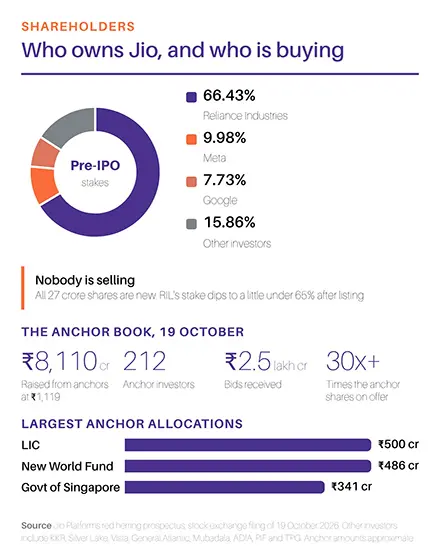 Reliance will keep a stake of a little under 65% after the issue, down from 66.43% today, and Motilal Oswal estimates that holding is worth ₹481 to ₹506 per Reliance share, or 41% to 43% of the parent’s share price.
Meta (9.98%) and Google (7.73%) are not selling, and neither are the financial investors who came in during 2020.
At the IPO price, their positions are worth at least two-thirds more than they paid.
There are risks too. The tiny free float could make the shares volatile, Reliance retains firm control, and Jio’s fortunes remain tied to regulation, spectrum costs and the willingness of Indian consumers to accept higher tariffs.
Enter Elon Musk
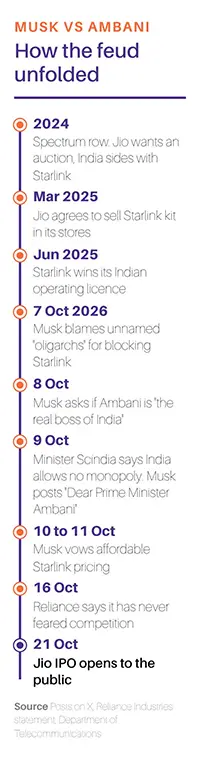 The two billionaires first clashed in 2024 over how India should hand out satellite airwaves.
Jio wanted an auction, Starlink wanted administrative allocation, and the government sided with Musk.
Starlink won its operating licence in June 2025 but is still waiting for security clearance and spectrum.
Telecom minister Jyotiraditya Scindia hit back that India does not allow a monopoly in any sector, and the government said all three licensed satellite operators, Starlink, Jio’s satellite venture and Eutelsat OneWeb, were at broadly the same stage.
Musk then posted his “Dear Prime Minister Ambani” message and promised to price Starlink affordably, conceding that Ambani’s profits would fall but insisting he would not go out of business.
Reliance broke its silence on October 16. Without naming Musk, it said it had never feared competition, welcomed Starlink and pointed out that Jio’s own satellite service was also awaiting clearance.
Why the feud matters
In the short term, Starlink poses little threat to Jio’s core mobile business, since satellite broadband is pricier and aimed largely at remote areas.
But the row matters in three ways. It shines a global spotlight on Jio’s dominant market position just as foreign investors are being asked to buy in.
 It underlines how much Jio’s future depends on regulators in New Delhi.
And it sets up a genuine contest in satellite internet, a market Jio plans to enter in earnest from 2028.
The subscription figures from October 21 to 23 will reveal whether retail and wealthy investors share the institutions’ enthusiasm.
The listing on October 28 will then deliver the market’s verdict on a question that has hung over Jio for years.