
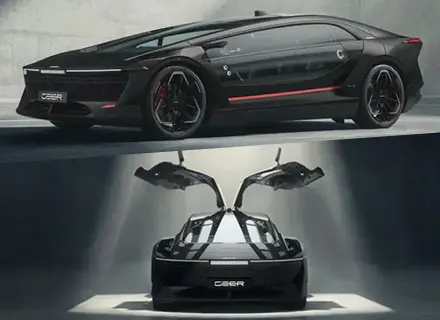

Saudi automobile startup Ceer has made public its first two fully electric vehicle models, while stating that it will launch five more models by 2030 as part of the Kingdom’s goal to create a viable auto industry to curb the Gulf major’s dependence on oil.
Called Exobot, the futuristic premium electric sedan and SUV will start sales in the Kingdom in early 2027.
The cars have arrived with the looks heavily inspired by the sci-fi thriller “Tron.”
Both the sedan and SUV versions of the Exobot possess “gullwing” doors that open upward.
“Ceer has also removed the pillars normally found between a car’s front and rear seats and relies instead on high-strength materials to provide structural support,” CEO Jim DeLuca said.
“We wanted to make sure the world could see what Saudi Arabia is capable of,” he added further.
Ceer’s arrival in the global automotive scene also coincides with the industry’s biggest course correction, in which Chinese automakers, armed with feature-laden yet cost-effective cars, are creating their positions around the world, challenging established ecosystems like the ones in Germany, Japan, and the rest.
Ceer is a joint venture between Saudi Arabia’s sovereign wealth fund, the Public Investment Fund (PIF), and Taiwanese contract electronics manufacturer Foxconn.
While the Kingdom’s energy wealth is there to back up the company’s R&D efforts, the Saudi economy in 2026 has been facing logistics and inflationary problems due to the Iran war.
The sedan version of the vehicle has an estimated range of 670 km, while the charging time will take some 30 minutes to reach the 80% threshold. Acceleration speed (reaching 0-100 km/h) will take 2.6 seconds, with a maximum horsepower of 850 hp.
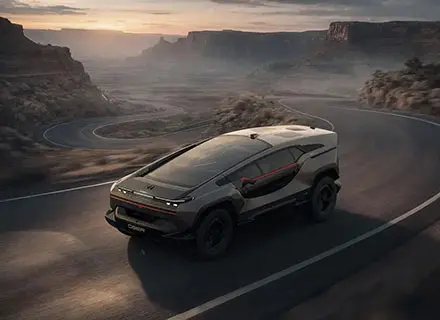 The SUV variant will have an estimated range of 560km, while the acceleration to 100km/h will take 2.9 seconds. Horsepower and charging time will remain like the sedan version.
Talking about Saudi Arabia’s efforts to become an automotive major, the Kingdom tried to host a Jaguar Land Rover factory on its soil in the last decade, which ultimately got abandoned.
Toyota declined a similar deal in 2019, citing high labour costs and a lack of local suppliers.
Taking lessons from those failures, Ceer has taken a broader approach, leaning on global partners, apart from building up a local network to keep the supply of spare parts flowing.
Foxconn has provided the electrical architecture for the Exobots, while German premium automaker BMW acted as the engineering brain.
“Originally set up as a pure EV maker, Ceer’s full lineup will include plug-in hybrids and combustion-engine models to react to shifting market demand,” DeLuca said.
Following the Exobot’s launch, Ceer will launch five mainstream models between 2028 and 2030.
Ceer will also be customizing its vehicles to meet regulatory and customer requirements set at various automobile hubs.
As per DeLuca, the company aims to expand carefully through 2034. It will first target its neighbouring Gulf and North African markets, followed by global expansion.
“We want to make sure we move very methodically. It only takes one mistake and you can kill a startup,” DeLuca told Reuters.
Image Courtesy: Ceer