
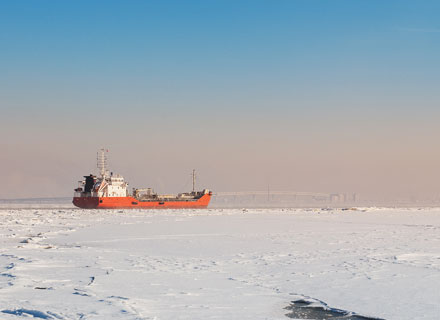

Imagine a shipping lane that cuts the distance between China and Europe almost in half. No pirate-infested waters, no clogged canals, no geopolitical minefields in the Middle East. Just a straight shot across the top of the world. That is the pitch for the Northern Sea Route, a 5,600-kilometre corridor running along Russia’s Arctic coastline from the Kara Strait in the west to the Bering Strait in the east.
In 2025 and 2026, this route has generated enormous excitement. Record numbers of ships are making the crossing. Chinese container vessels are completing the journey in under three weeks. India is signing mineral deals with Russia that could send a new category of cargo through the frozen north. On paper, the Arctic is open for business.
But the full picture is considerably more complicated, and considerably less flattering. While one set of numbers is climbing, another is falling. The route is simultaneously booming and contracting, expanding in one narrow slice while collapsing in the far larger slice that actually matters. Understanding why requires separating two very different things that often get confused in the headlines.
Two Routes in One
When analysts talk about the Northern Sea Route, they are actually describing two distinct corridors that happen to share the same geography.
The first is a domestic Russian export pipeline. Giant tankers loaded with liquefied natural gas and crude oil depart from Russian Arctic ports and sail to customers in Asia. This traffic makes up roughly 82% of everything that moves on the route. It is not international trade in the conventional sense. It is Russia shipping its own natural resources to paying customers.
The second is genuine international transit, where a ship travels the full length of the route from one end to the other without stopping at Russian ports. Think of a Chinese container ship loading goods in Shanghai and sailing them all the way through Arctic waters to a port in Germany. This is the category that is genuinely booming, and it is also the far smaller of the two.
In 2025, the total cargo moved along the Northern Sea Route fell for the second year in a row, dropping to 37.02 million metric tonnes, roughly 870,000 tonnes less than in 2024. This reverses years of growth and sits quite far from the Russian government’s official targets of 80 million tonnes by 2024, and 200 million tonnes by 2030.
At the same time, the number of international transit voyages reached a record 103 in 2025, up from 97 the year before. Those voyages moved approximately 3.2 million tonnes of cargo. So, the transit boom is real, but it is also responsible for less than 9% of the route’s total traffic.
Peter Sand, Chief Analyst at freight intelligence platform Xeneta, put the scale of the transit trade in stark perspective. “The number of ships transiting the Northern Sea Route last year was a record high. But we counted 15 ships, so that’s what a record high looks like,” he said. On the economics, Sand was equally direct: “Shorter distance is clearly attractive. But you still have to factor in expensive transit costs.”
Why Container Ships Are Coming
The surge in container transits is not happening because the Arctic route has suddenly become easy or cheap. It is happening because the alternative routes have become painful.
Since late 2023, militant groups in Yemen have been attacking cargo ships in the Red Sea near the Bab al-Mandab strait, one of the world’s busiest waterways. In response, most major shipping lines diverted their vessels around the southern tip of Africa via the Cape of Good Hope. By mid-2024, traffic through the Suez Canal had fallen by roughly 70%, costing Egypt an estimated $800 million a month in lost revenue.
For a Chinese exporter, rerouting around Africa adds enormous distance, time, and fuel cost to every shipment. In that context, the Arctic option began to look less like a gamble and more like a reasonable hedge. Chinese operators, primarily NewNew Shipping Line and Sea Legend, moved roughly 400,000 tonnes of container cargo through the Arctic in 2025, a 2.6-fold increase on the previous year. Not everyone is convinced.
Søren Toft, Chief Executive of Mediterranean Shipping Company, the world’s largest container line, was categorical: “The debate around the Arctic is intensifying, and commercial shipping is part of that discussion. Our position at MSC is clear. We do not, and will not use the Northern Sea Route.”
The route’s possibilities were demonstrated dramatically when the container ship Istanbul Bridge completed the first direct container connection between China and the United Kingdom via the Northern Sea Route, finishing the crossing in a record 20 days at an average speed of 16.7 knots. The same season, the vessel Newnew Polar Bear departed Shanghai on July 16 and arrived at the Russian port of Arkhangelsk in under a month, delivering 497 containers carrying auto parts, PVC film, and steel before loading Russian timber for the return leg.
South Korea is watching closely. Its Ministry of Oceans and Fisheries scheduled a September 2026 container transit to evaluate whether it could replicate China’s Arctic logistics model. South Korean shipyards already lead the world in building large ice-capable commercial vessels, and Japan has deep expertise in research icebreakers. Between them, the two countries could form a powerful North Pacific logistics network feeding into the Arctic corridor.
What Actually Drives the Route
For all the excitement about containers, the Northern Sea Route’s economic engine runs almost entirely on fossil fuels. Energy cargoes make up 83% of all traffic. Liquefied natural gas alone accounts for 58% of total volumes, crude oil for 21%, and gas condensate for roughly 4%. The port of Sabetta, the main export terminal for the massive Yamal LNG project in Siberia, handled about 90% of the route’s entire cargo turnover in 2025, moving 29.1 million tonnes.
The volume contraction in 2025 is happening precisely because these fossil fuel operations are running into serious trouble. LNG shipments fell 2.7% due to maintenance shutdowns at the Yamal plant and a shortage of the specialised ice-capable vessels needed to run them. Crude oil exports from Gazprom’s Novoportovskoye field are, in what officials diplomatically call, a ‘smooth decline’, which is a polite way of saying the oil field is running dry. Coal shipments through the route collapsed by nearly 29%.
The route’s future growth was supposed to come from two enormous new projects. Novatek’s Arctic LNG 2 was designed to produce nearly 20 million tonnes of gas a year from three production trains. Rosneft’s Vostok Oil was described as the largest new oil development on earth in two decades, holding an estimated 45 billion barrels of reserves with a target output of 115 million tonnes a year by 2033. Between them, these two projects were supposed to deliver the volumes that would justify Moscow’s infrastructure investment and its ambitious shipping targets.
Neither is producing anywhere near what was planned.
How Sanctions Broke the Dream
Western sanctions imposed following Russia’s invasion of Ukraine have created a chokepoint that no icebreaker can smash through.
Arctic LNG 2 depends on a fleet of approximately 21 highly specialised Arc7 ice-class LNG carriers. These are not ordinary tankers. They are purpose-built vessels capable of navigating independently through thick Arctic ice. Russia ordered 15 of them from its domestic Zvezda shipyard. By early 2026, exactly one had been delivered. The rest of the construction programme is frozen because the shipyard cannot access the imported marine equipment, specialised cryogenic containment systems, and international financing it needs. The alternative, building them at South Korean yards, which are the world’s leading builders of such vessels, is entirely blocked by sanctions.
Four Arc4 LNG carriers were actually completed in 2024 at Hanwha Ocean in South Korea, but they are currently sitting idle off the coasts of Indonesia and Europe. Even though the European Union removed several of these vessels from its sanctions lists in July 2025, no international operator will charter them. The reputational risk and the fear of secondary sanctions are simply too great.
Arctic LNG 2 did manage to export 16 gas cargoes in late 2025, but it is operating only its first production train at a fraction of its designed capacity, often selling gas at steep discounts to Asian buyers because it has no other options. Novatek has now put all three successor projects, Arctic LNG 1, Arctic LNG 3, and Ob LNG, on indefinite hold.
Vostok Oil has not shipped a single commercial cargo.
Transporting the cargo requires a 770-kilometre pipeline to the Kara Sea, a deep-water port called Sever Bay, and a fleet of up to 50 vessels, including at least 10 Arc7 tankers. As of 2026, the pipeline is less than half built, the port is under construction, and the specialised fleet does not exist. US sanctions imposed on the project’s operator, RN-Vankor, in January 2025 further restricted access to the technology needed to move forward.
On January 1, 2027, the European Union’s ban on Russian LNG imports takes effect. In February 2026, 100% of Yamal LNG exports were still flowing into EU ports, totalling over 1.5 million tonnes in that month alone. Europe is not just a customer. It provides transshipment facilities, vessel maintenance, crew changes, and insurance services for the 14 specialised Yamalmax Arc7 carriers that run the Yamal operation. Replacing those services for Asian routes would require Novatek to source an estimated 32 to 40 additional conventional LNG carriers. Under the current sanctions environment, that is essentially impossible.
The Shadow Fleet and NATO’s Response
Russia’s workaround for the sanctions blockade has been to build a ‘shadow fleet’, a collection of ageing, poorly maintained tankers operating under obscure ownership structures, frequently flying flags of convenience, and regularly switching off or spoofing their tracking systems to hide where they are going, and where they have been.
Shadow fleets are nothing new. Iran and Venezuela have used similar arrangements to keep their oil moving. But the Arctic amplifies the risks to an entirely different level. A mechanical failure in the Mediterranean can be handled with tugs and salvage crews. The same failure in the Barents Sea, hundreds of kilometres from the nearest port, in temperatures that can kill an exposed person in minutes, is a potential catastrophe.
An oil spill from an uninsured, structurally substandard tanker in Arctic waters would be an environmental disaster on a scale that would take decades to address.
Malte Humpert, founder of The Arctic Institute, has been direct about the trajectory. “It’s not a question of if, just a matter of when,” he said of a major accident or spill.
Research shows that pollution concentrations along sections of the route are exceeding maximum permissible limits.
European nations have responded aggressively. In January 2026, fourteen European countries issued a joint declaration warning that shadow fleet tankers without valid safety documents and internationally recognised insurance would be classified as stateless vessels under international maritime law, giving coastal states the legal authority to intercept and detain them. That rhetoric quickly became action.
Belgian and French forces boarded the tanker Ethera in the North Sea on suspicion of false flagging and forged documents. French naval commandos boarded the Grinch, a crude oil tanker owned by a Moscow-based company but flying a Comoros flag, in the Alboran Sea, and escorted it to Marseille. Swedish coast guards took control of the cargo vessel Caffa in the Baltic Sea to inspect its documents and seaworthiness. These interceptions were in European waters, but they establish the legal precedent and the operational willingness to police the routes that Russian Arctic oil must use to reach global markets.
The Ice Problem Is Getting Worse, Not Better
A widely repeated assumption about Arctic shipping is that climate change is steadily melting the ice and making the route easier to navigate every year. The reality is far more dangerous.
The overall Arctic sea ice maximum in winter 2026 reached 14.278 million square kilometres in March, tying the 2025 record as the lowest ever recorded in 47 years of satellite data. But within that global picture, regional behaviour was violent and unpredictable. A persistent, unstable polar jet stream drove fierce Arctic winds that expanded sea ice in the eastern Bering Sea by 60% in just two weeks.
The ice pushed abnormally far south, blocking the False Pass shipping channel in the Aleutians, and extending down to within 30 miles of Unimak Pass, a vital route for westbound commercial vessels heading into the Pacific.
Ships facing this kind of ice do not just risk damage from the ice itself. Wind-driven sea spray at near-freezing temperatures instantly freezes onto a vessel’s hull and superstructure, building up hundreds of tons of ice that can alter the ship’s centre of gravity, and capsize it.
The logistical consequences were severe. AIS tracking data from March 2026 showed that commercial vessels entirely abandoned the ice-choked Unimak Pass. Traffic through the alternative Amukta Pass surged by 800% year-on-year. Routes plotted entirely south of the Aleutian Islands saw an 88% increase in traffic as shipmasters chose longer journeys to guarantee they would arrive at all.
This matters enormously for the viability of the Northern Sea Route as a container shipping corridor. Modern container logistics depend on precision scheduling, with arrival times calculated to the hour. A route capable of generating a 60% ice expansion across a critical chokepoint in a fortnight is fundamentally incompatible with the reliability that global supply chains require. Research has also identified a correlation between ocean heat flowing into the Arctic through the Bering Strait and sea ice conditions across the following summer, meaning that conditions a year ahead remain difficult to predict with confidence.
Why the Maths Still Does Not Work for Containers
Even setting aside the ice anomalies and the geopolitics, the basic economics of running container ships through the Arctic are extremely challenging.
The route is shorter, there is no question about that. Rotterdam to Yokohama via the Suez Canal is roughly 12,840 nautical miles. Via the Northern Sea Route it is about 5,770 nautical miles. At 16 knots, the Suez voyage takes around 33 days; the Arctic crossing takes around 15. That is a significant saving in fuel and time.
But the savings are eaten up by a cost stack that applies to every Arctic voyage, and has no equivalent on southern routes. Mandatory icebreaker escorts charged by Russia’s state nuclear fleet operator, Rosatomflot, can easily reach $180,000 per voyage even during relatively mild autumn conditions. Insurance premiums for Arctic operations are routinely $40,000 to $50,000 higher per voyage than equivalent Suez coverage.
Bureaucratic friction adds further cost. The Suez Canal requires 48 hours’ advance notice for transit, while the Russian administration requires permit applications up to four months in advance, making it impossible to respond to the spot-market conditions that modern shipping alliances depend on. Basic permits and compliance add another $20,000 per voyage.
The per-container economics are similarly unflattering. Based on standard calculations for a vessel travelling at 16 knots and consuming 45 tonnes of fuel per day at $650 per tonne, the cost of shipping one empty container unit via the Arctic works out to roughly $648. On filled containers, factoring in directional imbalances, costs can double.
Humpert, of The Arctic Institute, sees the imbalance as structural. “The NSR will exist only as a transport route with mostly one-directional traffic,” he said. “Outside factors, such as unfavorable market conditions, varying ice levels and the lack of available Russian icebreakers, may yet dash Mr Putin’s hope to establish the route as a northern export highway.”
There is also a fundamental size problem. The Suez Canal regularly accommodates vessels carrying 24,000 containers or more. The shallow straits and narrow icebreaker-cleared channels of the Arctic limit viable vessels to roughly 2,000 to 4,000 containers. The fuel savings of a shorter journey are essentially cancelled out because the same cargo requires five or six smaller ships instead of one large one.
The Suez route also generates revenue at multiple intermediate ports along the way, places like Singapore, Colombo, Jeddah, and Piraeus, while the Arctic offers no commercial stops at all across thousands of kilometres of uninhabited coastline.
The Bigger Strategic Picture
Russia’s control of the Northern Sea Route is not purely economic. Moscow treats the route as internal national waters, requiring foreign vessels to obtain advance permission, carry Russian pilots, and pay Russian icebreaker fees. This gives Russia surveillance of foreign ships near sensitive military installations and allows its Northern and Pacific naval fleets to move without transiting NATO-monitored straits.
Russia’s official position is bullish. Vladimir Panov, Special Representative for Arctic Development at Rosatom, described a corridor in ascent: “The Northern Sea Route is developing rapidly, becoming a viable and efficient global logistics route. This is facilitated by various factors, including the development of advanced technologies, the construction of new-generation nuclear icebreakers, and growing interest from international shippers.”
Western allies have begun pushing back directly. In early 2026, the United States, Canada, and Finland launched the ICE Pact, a collaborative programme to jointly build allied icebreakers. The strategic intent is to create an escort capability that does not depend on Russian assets, allowing allied nations to accompany commercial vessels through the Northern Sea Route under international maritime law without paying Russian tariffs.
NATO simultaneously launched the Arctic Sentry framework in February 2026, integrating surveillance systems from Nordic allies to create continuous monitoring from the Baltic to the Arctic Ocean, tracking Russian military movements and providing independent navigational intelligence to commercial operators.
The Suez Canal, meanwhile, is recovering. Since the beginning of 2026 it has processed 1,315 vessels carrying a total of 56 million tonnes, generating $449 million in revenue, a marked improvement on the equivalent period a year earlier. Major carriers, including CMA CGM and Maersk, have reaffirmed their commitment to the route. As CMA CGM’s CEO put it plainly, there is no alternative to the Suez Canal.
The Northern Sea Route will continue to grow in specific, narrow circumstances for Chinese state-aligned operators willing to pay premium costs for geopolitical insulation, for Indian mineral supply chains being built outside Western and Chinese control, and for Russia’s own hydrocarbon exports when its projects eventually come back online. But the idea of the route as the next great artery of global trade remains, for now, a story about what might one day be possible rather than what is actually happening.