
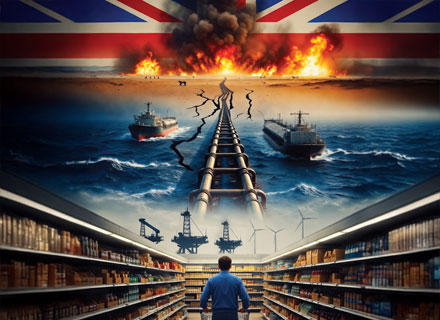

Something has changed in the United Kingdom after February 2026. Petrol is markedly more expensive, and supermarket prices are soaring. The words “stagflation” and “recession risk” are coming up in the news more frequently, and everyone’s saying that the reason for all of this is a war that has broken out far away from British shores.
The military conflict involving the United States, Israel, and Iran began on February 28, 2026. It was not just a geopolitical event, but the beginning of an economic crisis reshaping the daily lives of millions of people in the United Kingdom.
This article is an attempt to explain what is happening, why it matters, and what it means for ordinary British workers, families, and businesses.
Distant war and British utility bills
The worst part of the Middle East conflict has been the blockade of the Strait of Hormuz, which passes one-fifth of all oil and LNG. Both Iran and the United States tried to play hardball with the maritime chokepoint to get the better of each other at the negotiation table in Islamabad. The biggest victim of the geopolitical power play has been global energy security.
Before the war, a barrel of Brent crude oil traded at $70-$72, but within weeks, future prices shot up to $119 per barrel. The prices that buyers were actually paying on the spot market (where oil is bought and sold for immediate delivery) reached $150 at the time, driven by intense panic buying and shortage fears.
The shock was specifically compounded for the United Kingdom, as the European country imports a large portion of its energy. Net import dependency stood at 43.8% in 2024, which means that when global energy prices spike, the UK does not have enough domestic supply to shield itself.
Wholesale gas prices inside the UK surged from 78 pence per therm at the end of February to 171 pence per therm in the weeks that followed. That is more than double in a matter of weeks.
The International Energy Agency (IEA) described what happened as the single most significant supply disruption in the history of the global oil market. Global oil supply fell by over 10 million barrels per day in March 2026 alone.
The ripple effects were felt almost immediately at petrol stations across the UK. The average price of petrol rose from 131.6 pence per litre to 140.2 pence per litre. Diesel jumped from 141.1 pence to 158.7 pence per litre. These were not gradual, creeping increases. They happened within a month.
Inflation is back, and it is stubborn
The official measure of inflation in the UK, known as the Consumer Price Index (CPI), rose to 3.3% in March 2026. That sounds like a modest number until you consider that just two months earlier, the Bank of England (BoE) had been close to hitting its 2% target and was preparing to start cutting interest rates. Those plans are now on hold indefinitely.
The largest driver of the March inflation rise was motor fuel, which went up by 8.7% in a single month. The last time fuel prices rose that sharply in a single month was during the early period of the Ukraine war. Food inflation is expected to follow.
The Food and Drink Federation has warned that food prices could rise by as much as 9% by the end of 2026 if supply disruptions continue. Part of the reason is fertiliser. Producing nitrogen fertiliser requires enormous amounts of natural gas, and many fertiliser suppliers in the Gulf and Egypt can no longer export their products because of the maritime blockade.
British farmers are facing doubled fertiliser costs, and many have decided it is simply not worth planting crops this year. Less domestic food production means more imports. More reliance on imports, in a disrupted global market, means higher prices at checkout.
There is also an unusual and little-discussed risk around carbon dioxide gas, which the food industry depends on for slaughtering livestock humanely, carbonating drinks, and preserving packaged goods.
The government has already invested 100 million pounds to reopen an industrial plant on Teesside specifically to ensure a domestic carbon dioxide supply. Major retailers like Tesco say shortages have not yet reached shelves, but the Food and Drink Federation is not ruling out significant gaps in availability by the summer if the Strait remains closed.
Growth has stalled
Britain’s economy was beginning to recover early in 2026. GDP grew by 0.5% in February, which was a small but encouraging sign. That momentum has now been cut short. The EY Item Club, one of the UK’s most respected economic forecasting bodies, now expects the economy to grow by zero in both the second and third quarters of the year. For the full year of 2026, it has cut its growth forecast from 1.4% down to 0.7%.
Matt Swannell, the Chief Economic Adviser to the EY Item Club, warns that the labour market is entering a period of severe distress. Matt remarked, “Spiralling energy costs and disruption to supply chains will push the UK to the brink of a technical recession… The heightened energy prices from the war are also set to deliver the ‘biggest hit since the pandemic’ to the jobs market, with the jobless rate projected to peak at 5.8% by the middle of 2027.”
The International Monetary Fund has gone further in some respects. It identified the United Kingdom as the country that suffered the biggest downward revision to its growth forecast among wealthy nations in its spring 2026 outlook. The IMF now expects UK GDP to grow by just 0.8% in 2026, compared to 1.3% predicted earlier.
The OECD, another major international economic body, expects Britain to have the second-lowest growth rate and the second-highest inflation rate among G7 nations. The United States, by contrast, is expected to grow by 2.3%. The gap is stark.
Why is Britain being hit harder than most? Several reasons compound each other. The UK is a net importer of gas. It has very limited gas storage, estimated at just two days of supply at the peak of the crisis. Its economy is highly integrated with international trade and supply chains. And its growth was already sluggish entering 2026, leaving very little buffer when the shock arrived.
The word economists are reaching for to describe this situation is stagflation. That is what happens when an economy stops growing, but prices keep rising. It is the worst of both worlds, and it is the same condition that devastated many Western economies in the 1970s during the oil embargo. The last thing any government wants to see return.
Jobs are being lost
Behind the big numbers are real people losing real work. British employers cut 11,000 jobs in March 2026, the first clear month where the economic fallout from the Iran conflict showed up directly in employment figures. Analysts from EY Item Club estimate that approximately 250,000 jobs could be lost by mid-2027 if current conditions persist.
The unemployment rate stood at 5.2% at the start of 2026. Forecasters now expect it to rise to 5.8% by mid-2027, which would mean over 2.1 million people looking for work. That would be the highest level of unemployment in more than a decade.
The sectors bearing the brunt are those that depend heavily on energy or on consumer spending. Manufacturing, hospitality, logistics and construction are all under severe pressure. Businesses that were already operating on thin margins are finding that rising energy costs, supply chain delays, and weakening customer demand are simply too much to absorb simultaneously.
Many companies are moving into what economists call a defensive posture. Instead of hiring, investing, or expanding, they are cutting costs and building cash reserves to survive the uncertainty.
The Deloitte CFO Survey, which measures confidence among finance directors at major British companies, recorded a collapse in sentiment to a net figure of minus 57% in late March. That is the most pessimistic reading since the height of the COVID-19 pandemic.
Consumers are pulling back
Ordinary households are responding to the situation predictably. When things feel financially uncertain and prices are rising, people spend less. Consumer confidence, as measured by the Deloitte Consumer Tracker, fell to minus 14.1% in the first quarter of 2026, its lowest level since 2023.
Spending power is expected to fall by 0.3% across the year for the average household. People are cutting back on things they do not consider essential. Travel has taken a particularly sharp hit. Spending on travel fell by 3.3% in March 2026, the first such decline recorded by Barclays in five years.
Jet fuel prices have more than doubled since the conflict began, and airlines are passing those costs on to passengers. International holidays are being postponed. People are choosing domestic breaks instead, or simply staying home.
The hospitality sector, which was already struggling with the April 2026 increase in the minimum wage and higher business rates, is now facing what industry figures are calling a summer of shortages. Breweries are worried about carbon dioxide availability ahead of the football World Cup in June, usually one of the most commercially important periods in the calendar.
What the government is doing
Chancellor Rachel Reeves has been walking a difficult line. On one side, there is enormous pressure to protect households and businesses from rising costs. On the other hand, the government is painfully aware that uncontrolled spending could damage Britain’s fiscal reputation and push up borrowing costs, as happened during the 2022 mini-budget crisis.
“This is not our war, but it is pushing up bills for families and businesses. That’s why it’s my number one priority to keep costs down… Obviously, no sensible person is a supporter of the Iranian regime, but to start a conflict without being clear what the objectives are… I do think that is a folly and it is one that is affecting families here in the UK,” The Chancellor said.
The approach taken has been cautious and targeted. Rather than offering blanket support to everyone, the government has focused on the most vulnerable. It has extended the existing 5 pence cut in fuel duty, saving the average driver around 90 pounds per year. It is also working on contingency plans for further energy bill support in the autumn, when demand for gas heating typically rises sharply.
To fund these measures, the government has expanded the windfall tax on electricity generators. Companies that generate electricity from gas-linked sources are currently making exceptional profits because of how electricity pricing works in the UK market.
The government has raised the Electricity Generator Levy from 45% to 55%, capturing more of those windfall profits and redirecting them toward household support. This levy has also been extended beyond its original 2028 end date.
The government has explicitly said it cannot absorb every price rise on behalf of the population. It is a difficult message to deliver, but it reflects the reality that with national debt on track to reach 100% of GDP by 2029, the room for large unplanned spending is very limited.
Internationally, Reeves has been vocal in criticising the war itself. She has called it a mistake and a folly, language that puts her at odds with US Treasury Secretary Scott Bessent, who has defended the conflict as a necessary cost for long-term global security.
Reeves led a joint statement signed by finance ministers from 11 countries, including Japan, Australia, Spain, and the Netherlands, calling for a negotiated resolution and the reopening of the Strait of Hormuz. The diplomatic tension with Washington adds another layer of uncertainty to the UK’s economic relationships.
BoE is stuck
Normally, when inflation rises sharply, a central bank’s response is to raise interest rates. Higher rates make borrowing more expensive, which cools spending and helps bring prices down. But the Bank of England (BoE) is in an unusual bind.
Before the Iran conflict, financial markets expected the Bank to start cutting its main interest rate in April 2026, as inflation had been falling toward the 2% target. Now, with inflation at 3.3% and rising, those cuts have been shelved. But the Bank is not raising rates either.
The reason is that the economy is simultaneously weakening. Raising rates aggressively into a slowing economy risks causing a deeper recession. The Monetary Policy Committee has held the rate at 3.75% and is expected to keep it there for some time.
Economists describe this as an unenviable balancing act. If the Bank holds firm, inflation may become entrenched, especially if workers begin demanding higher wages to keep up with rising petrol and food costs. If it cuts rates, it risks fueling inflation further. The most likely outcome, according to analysts, is that rates stay on hold until around mid-2027, when inflation is expected to gradually return closer to target.
For homeowners approaching the end of fixed-rate mortgage deals, this is unwelcome news. Over a million British households are expected to face higher mortgage payments in the coming months as their fixed deals expire, adding to the broader pressure on household budgets.
Industry under pressure
Some of the starkest stories from the current crisis involve British manufacturers. Energy-intensive industries (those that need enormous amounts of gas or electricity to operate) are in genuine difficulty. Steel, chemicals, glass, ceramics, cement, and paper are all facing input cost increases that many cannot absorb or pass on.
The British Plastics Federation has reported that 58% of its member companies are experiencing severe or significant operational impacts. Almost all of its members are reporting rising raw material and energy costs.
Some firms have added surcharges of up to 30% to their prices, which risks sending customers to overseas competitors, particularly American ones, who benefit from access to cheap domestic natural gas and are insulated from the Hormuz disruption.
The construction sector is also struggling. Output had already fallen by 2% in the three months to February 2026, with private housebuilding dropping 6.5%. The conflict has made things worse through supply chain delays and surging material costs.
Bricks, cement, asphalt, and insulation are all more expensive to produce when energy costs are this high. Construction experts have warned that many projects are moving from commercially challenging to commercially unviable.
One of the most unexpected consequences involves renewable energy. Two major offshore wind projects off the Norfolk coast are facing delays because key components, specifically steel turbine foundations and offshore substations, were ordered from suppliers in the UAE. Those components cannot currently be shipped through the Strait of Hormuz. The conflict that is driving demand for cleaner energy is simultaneously delaying the infrastructure needed to deliver it.
Where things stand
Growth has stalled. Inflation is rising. Jobs are being lost. Businesses are pulling back. Consumers are cutting spending. And the root cause of all of it, the blockade of a narrow waterway seven thousand kilometres away, shows no immediate sign of resolution.
What makes the situation particularly difficult is that even a ceasefire would not instantly fix things. Energy infrastructure that has been damaged takes time to rebuild. Supply chains that have been disrupted take months to restore. And business confidence, once lost, is slow to return.
Britain’s vulnerability at this moment reflects structural issues that existed long before the conflict began. The country is too dependent on imported energy. Its gas storage is inadequate. Its industrial base has been gradually hollowing out for decades. The current crisis has exposed all of that with uncomfortable clarity.
The months ahead will be tough, particularly for lower-income households, energy-intensive industries, and anyone whose livelihood depends on consumer spending. The government and the Bank of England are trying to prevent the worst outcomes. But the margin for error is small, and the decisions being made in Washington, Tehran, and on the waters of the Persian Gulf will matter as much as anything decided in Downing Street or Threadneedle Street.