
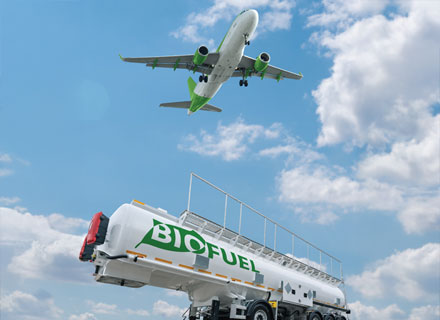

Europe’s aviation sector is buzzing, with airlines reportedly preparing to challenge European Union’s rules requiring the use of synthetic sustainable aviation fuel (eSAF) from 2030, over concerns like high costs and scarce supply.
Trade group Airlines for Europe (A4E) has taken an adversarial stand against the SAF norms. Calling eSAF a ’nascent technology,’ A4E said projects would only produce 0.7% of volumes needed to meet the climate targets set by EU for the industry.
The use of eSAF falls under the “ReFuelEU Aviation” initiative, that sets requirements for aviation fuel suppliers to gradually increase the share of SAF blended into the conventional aviation fuel supplied at EU airports. The rule made it mandatory for regional airports to have 2% SAF in their overall fuel mix, a ratio which must rise to 6% in 2030. By 2050, every European airport should have 70% SAF in their fuel mix.
Hurdles to eSAF
As per the aviation industry, the supply of synthetic jet fuel is not abundant, and the planned production facilities won’t come online any time soon to meet the mandate.
While cooking oil and animal waste have been the preferable raw materials for the fuel, the resultant SAF costs three to five times more than traditional jet fuel, while making up a paltry 0.3% of global jet fuel supply. The synthetic version (eSAF) is made from renewable energy sources, like captured carbon dioxide or green hydrogen, which too are expensive.
Another vocal critic has been the European Regions Airline Association (ERA). In October 2025, ERA stated that the policy’s implementation would create structural disadvantages for smaller regional carriers. The association revealed that the SAF’s supply is massively concentrated at the major European aviation hubs, leaving smaller, regional airports without access, thereby exposing Europe’s most remote communities to rising costs, complex compliance burdens, and the risk of reduced connectivity.
Even the International Air Transport Association (IATA), the industry’s apex trade association, is not impressed by ’ReFuelEU Aviation’. Willie Walsh, the Director-General, publicly panned the policy, by stating, “SAF production growth fell short of expectations as poorly designed mandates stalled momentum in the fledgling SAF industry. If the objective is to increase SAF production to further the decarbonisation of aviation, then they need to learn from failure and work with the airline industry to design incentives that will work.”
“Fuel costs remains a key driver of airline profitability, accounting for roughly 30% of operating expenses. Any increase, whether linked to SAF or other factors, naturally draws close attention. The recent Iran crisis is a good illustration of how sensitive airlines are to fuel price fluctuations. A4E recently pointed out that scaling SAF successfully will require not just higher production volumes, but also lower production costs and thus lower prices. For the EU’s ambitions to materialise, attracting private investment will be essential, which in turn depends on clear and stable market conditions for project developers,” according to Catherine Galano, Executive Director at Frontier Economics, and Stefan Rohm, Senior Principal at Frontier Economics.
Free carbon permits effectively mean that using fossil fuels carries no additional cost. As these permits are phased out, the cost of inaction increases.
This changes the equation: the cost gap between fossil jet fuel and SAF narrows, which can support SAF uptake. Over time, rising carbon prices combined with more efficient SAF production could even make fossil fuels more expensive than their decarbonised alternatives.
That said, this does not fully address competitiveness concerns. Policy measures need to be designed as part of a coherent and consistent overall framework.
Dishing out the mathematics
As per the IATA’s updated estimates for Sustainable Aviation Fuel (SAF) production, in 2025, SAF output was expected to reach 1.9 million tonnes (2.4 billion litres), nearly double the 1 million tonnes produced in 2024. In 2026, production growth is projected to slow, reaching 2.4 million tonnes.
Despite this increase from the 2024 tally, SAF will account for only 0.6% of total jet fuel consumption in 2025, rising to 0.8% in 2026. At current prices, the SAF premium was estimated to add approximately $3.6 billion in fuel costs for the airline industry in 2025.
“Mandates in the EU and UK have failed to accelerate SAF production and adoption. In Europe, ReFuelEU Aviation has sharply increased costs amid limited SAF capacity and oligopolistic supply chains. Fuel suppliers have raised profit margins so that airlines pay up to five times the price of conventional jet fuel and double the market price of SAF, without guaranteeing supply or consistent documentation. In the UK, SAF mandates have also triggered price spikes, forcing airlines to absorb significant costs. In total, airlines paid a premium of $2.9 billion for the limited 1.9 million tonnes of SAF available in 2025,” according to the report.
“Competitiveness is a legitimate concern for European carriers, especially when compared with airlines based outside Europe. This is at the core of arguments that SAF rules risk creating an uneven playing field. That said, it is important to consider what alternative Net Zero policies may be and wider implications for the sector. We find that alternative narrative oftentimes rely on the reduction of demand as a decarbonisation lever, which would ultimately harm the entire sector, including passengers. From an economic perspective, incentives matter. Penalties can encourage faster investment in SAF, fleet renewal, or innovative business models. In that sense, they can also create an opportunity for European carriers to be trailblazers, as suggested in the Draghi report. This does not mean regulatory distortions disappear. There is still a strong case for funding mechanisms to support the SAF value chain and for continued R&D in aeronautics. These tools can help share risks and sustain competitiveness over the medium to long term,” according to Catherine Galano and Stefan Rohm of Frontier Economics.
“In the EU, a lack of financial support, specifically for more nascent technologies like those used to produce cellulosic SAF and e-fuels is limiting SAF supply. We call these nascent technology fuel pathways ’advanced SAF’. In a 2025 study, we find that lack of revenue certainty is the primary barrier for advanced SAF production coming online in the EU. High upfront capital costs and market uncertainties continue to delay final investment decisions,” Chelsea Baldino, Fuels Program Lead at The International Council on Clean Transportation, told while speaking with International Finance.
Airlines also have a role to play. In that respect, it is encouraging that A4E has not ultimately challenged the 6% mandate as strongly as initially feared. Walsh sees a SAF supply shortfall, and that, in his opinion, will force airlines to review their 2030 SAF commitments.
“Regrettably, many airlines that have committed to use 10% SAF by 2030 will be forced to re-evaluate these commitments. SAF is not being produced in sufficient amounts to enable these airlines to achieve their ambition. These commitments were made in good faith, but simply cannot be delivered,” he observed.
Walsh also said that transporting SAF to Europe could increase its overall carbon footprint.
On this, Catherine and Stefan told International Finance, “From an economic perspective, SAF should be produced where it is most cost-effective and abundant, considering the footprint of logistics as well as the decarbonisation performance of various fuel types. For instance, importing competitively priced eSAF with higher emissions reduction potential could, in some cases, deliver greater overall benefits than relying on alternatives such as HEFA produced locally.”
“That said, the carbon footprint of imports does support the case for developing a European SAF value chain. More broadly, energy sovereignty and security, highlighted by the Ukraine and Iran conflicts, also strengthen the argument for domestic production,” they remarked.
Also, EU is reportedly mulling over completely phasing out free carbon emissions allowances for the aviation sector, moving to full auctioning by 2026 to align with climate goals.
SAF production: A Bumpy Ride
A study from the International Council of Clean Transportation (ICCT), published in October 2025, found SAF costing between two to five times more than fossil jet fuel, with mechanisms like public and private investment and cost sharing being crucial for building a deep ecosystem, that will in turn make airlines’ green transition a budget-friendly one.
“Although SAF can be made from many different materials and conversion processes, all of them are currently costlier than fossil jet fuel. The European Union Aviation Safety Agency estimated that the average production cost of SAF in 2024 ranged from €1,461 per tonne (for biofuels) to €7,695 per tonne (for e-fuels). We calculate that this is a cost premium of 2.1–10.6x compared with fossil jet fuel by converting fossil jet production costs from the International Energy Agency, reported in US dollars per litre, into equivalent units,” according to the report.
“Meeting EU targets will require what could be described as an ‘investment shock’ to scale production capacity. Today’s SAF output, despite exceeding the EU’s 2% mandate in 2025, is largely based on biofuels such as HEFA, which face feedstock limitations and are unlikely to cover more than about 10% of global demand even under optimistic assumptions. Given the scale of investment needed, attracting private capital is critical. But investors need long-term visibility on demand and revenues. This is precisely what mandates and penalties are designed to provide. The current slow growth could mean that the signal from mandates is still too weak. But it may also reflect uncertainty about how firmly these policies will be enforced. This highlights the importance of regulatory stability, alongside targeted support mechanisms to improve project financeability,” Catherine and Stefan told the International Finance.
Investigating the reason behind SAF’s high price, ICCT found a correlation with high value of feedstocks that power the production. Virgin vegetable oil is more expensive than kerosene. Making waste-based SAF, on the other hand, with high cellulosic content is expensive due to inefficient supply chains for sourcing raw material and the enzymes needed to break down feedstocks into “’drop-in’” fuel.
eSAF requires high quantities of renewable electricity to produce renewable hydrogen (i.e., hydrogen produced via electrolysis using 100% renewable electricity) and extract diluted carbon dioxide from the atmosphere.
Then add the project mismanagement. As per ICCT, SAF projects take minimum five years to reach final investment decision (a critical stage during project development that indicates whether projects are ready to move forward to construction), and many projects fail before reaching this stage. The ratio of SAF projects reaching final investment decision, as per consulting group BCG, was at dismal 30% in 2025.
Noting that helping advanced SAF producers reach financial investment decision in the EU is an urgent priority for the bloc’s policymakers, Baldino remarked, “The EU’s Sustainable Transport Investment Plan (STIP) announced several measures the EU is taking to address economic issues. The Commission will launch pilot projects, including one that sets up a double-sided auction for e-SAF. This double-sided auction will establish a “’market intermediary’” that connects SAF suppliers and consumers, offering long-term contracts to provide revenue certainty to fuel producers as well as short-term contracts on the offtake side. The Commission also commits to assessing the feasibility of an EU-wide double auction to support both aviation and marine sustainable fuels. If designed and implemented quickly, such measures could provide the certainty needed to get today’s advanced SAF projects off the ground and accelerate progress toward fulfilling ReFuelEU SAF targets.”
While the ICCT study validated IAF’s apprehensions about SAF shortfall, Boston Consulting Group’s March 2026 estimates couldn’t promise a better future either.
The report, prepared after interviewing more than 500 executives at about 200 aviation-related companies, found that airlines and airports are investing only 1% to 3% of revenue or budget allocation to SAF, with high production costs and fuel prices remaining the major challenges to adoption.
“While SAF supply increased 1,150% worldwide over the last three years, announcements for new production facilities fell by 50% to 70% from 2022 to 2023, largely due to economic uncertainty, and higher energy and operating costs,” BCG stated, while projecting the fuel’s supply to fall 30% to 45% short of commercial aviation’s 2030 targets.
Giving their take on the BCG report, Catherine and Stefan said, “Airlines are only one part of the investment landscape. Aircraft and engine manufacturers, airport operators, and private investors are also contributing. Public funding – through EU instruments like the Hydrogen Bank or national programmes – already plays a role as well. Beyond reducing uncertainty, the key challenge is how to allocate risk efficiently across all these stakeholders. Incentives and risk-bearing capacities differ along the value chain. Airlines are central because they ultimately drive demand, but they are not the only actors that matter.”
All the studies had one thing common: they pointed out the massive cost of E-kerosene and other SAF raw materials.
Baldino answered, “There are several options for the EU to address these economic concerns. First, the ETS includes a mechanism where 20 million allowances from the ETS go towards reimbursing airlines to cover a percentage of the price gap between SAF and fossil fuels between 2024 and 2030. Assuming an EU-ETS price of 80 €/tCO2e, the total subsidy fund would come to €1.6 billion. However, given that the vast majority of SAF on the market is commercial Hydro processed Esthers and Fatty Acid (HEFA), and the programme only runs until 2030, it is likely that most, if not all, of this ETS funding will not help close the cost gap for advanced SAF. The ETS is currently under review, though, so the Commission has an opportunity to expand the SAF allowances programme and earmark some of the SAF allowances for advanced SAF pathways.”
EU presses ahead
Despite industry concerns, it seems that EU is in mood to slow down on its SAF game. It has already launched the “’eSAF Early Movers Coalition’,” bringing together member states that have committed to scaling up the fuel’s production. Austria, Finland, France, Germany, Luxembourg, Netherlands, Portugal and Spain have so far announced their participation, with the goal of mobilising at least €500 million ($580 million) for large-scale eSAF projects.
In December 2025, one of Europe’s leading SAF innovators, Metafuels, awarded construction firm McDermott a contract for its eSAF plant in Rotterdam. Metafuels will construct the plant at the Evos terminal in the Port of Rotterdam. It will utilise Metafuels’ high-yield methanol-to-jet technology, “’aerobrew’,” and serve as a blueprint for large-scale eSAF production across Europe.
Finnish venture Liquid Sun too launched what it claims is Europe’s eSAF pilot plant in Espoo. The unit will convert biogenic carbon dioxide and hydrogen produced with renewable electricity into synthetic crude oil, which will be then refined into eSAF.
Yes, the continent is scaling up its eSAF efforts. But, two questions remain: Will enough eSAF be available to each and every European airport by 2030? Will the green journey be budget-friendly for both airlines and the passengers?
The immediate priority for the EU will be to take the aviation sector stakeholders into confidence, and make sure that the journey to a carbon-free future remains on track.