

The modern digital economy often seems intangible. None of the software we use (websites, apps, social media, videos, and AI) is tactile. As science fiction writers like to put it, we are dealing with ghosts.
Even the words we use (like cloud computing, artificial intelligence, and wireless networks) suggest that they exist in a world untethered from physical constraints.
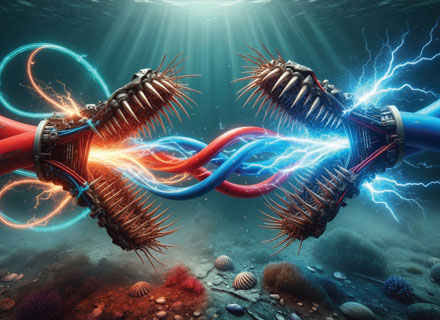
In actuality, the global internet is real and physical. It is anchored to the ocean floor by a web of fibre-optic cables, which function much like the human central nervous system.
These subsea systems transport about 95% of all international digital communication and carry around 64,000 terabytes per second of global data. They also make possible $10 trillion worth of daily financial transactions.
Due to the tremendous demand for AI and the geopolitical rivalry between the US and China, the submarine cable industry has become a highly contested geostrategic front. The global subsea market is projected to reach $32.8 billion by 2026, with some estimates suggesting it could grow to $60.5 billion by 2036. This expansion is closely linked to the generative AI boom, which is driving significant growth; consequently, required bandwidth is projected to triple between 2022 and 2027, while overall demand for international bandwidth is expected to double every two years.
Satellite internet is expensive and can cause higher latency. However, submarine cables provide high-throughput, low-latency connectivity, which AI and training workloads demand. Therefore, the industry is predicting $13 billion in new undersea cable investments between 2025 and 2027. The projected capital expenditure has doubled from that of the preceding three years.
The hyperscaler era
There has been a shift within the subsea market as it’s changed from a carrier-led consortium to private ownership dominated by a few technology hyperscalers, such as Google, Meta, Amazon, and Microsoft.
These companies are constructing proprietary networks to control their data pathways directly. They already control the vast majority of bandwidth demand on the core trans-Pacific, trans-Atlantic, and intra-Asia routes, and are responsible for almost half of all new cables built since 2021.
The vertical integration into physical infrastructure helps hyperscalers reduce costs and expand capacity. They can dictate landing points to bypass congested or geopolitically sensitive nodes and implement bespoke optical switching technologies to optimise their global data centre interconnects.
Meta launched Project Waterworth, which is set to be the world’s largest private subsea cable system. At 50,000 kilometres in length, it is designed to connect the United States, India, Brazil, and South Africa.
Waterworth is rapidly expanding digital economies across the global South by utilising up to 24 fibre pairs to maximise data throughput via spatial division multiplexing. Interestingly, the project sidelines Europe-centric corridors, signalling that Meta is betting big on the global South as a core growth region for AI-driven connectivity.
FASTNET, the flagship cable of Amazon Web Services (AWS), is a transatlantic system from Maryland to County Cork, Ireland. Scheduled for 2028, it is designed to deliver over 320 Tbps of capacity. This is a bid to meet the unique demands of modern AI, which must balance the asymmetry between US-based model training and European data residency laws. Achieving this requires high capacity, low latency, and an ability to route around traditional choke points.
FASTNET avoids legacy cable clusters in the US Northeast and the UK. It also incorporates advanced optical switching technology that allows AWS to redirect data to future landing points as AI workloads evolve.
Then there is the whale among them. As the heaviest investor in privately owned submarine cable systems and the largest owner of submarine cable networks, Google owns significant subsea cables such as Dunant, which provides 250 Tbps, Grace Hopper at 352 Tbps, and Equiano. Additional systems like TPU, Nuvem, and Firmina are scheduled to come online in 2026. By creating alternate routes that isolate infrastructure from carrier-dependent nodes, Google has established a gold standard for hyperscaler infrastructure planning.
Infrastructure fragility and the Red Sea chokepoint
Hyperscalers can avoid certain geographic hurdles, but all global data traffic has a few specific maritime choke points. There is nothing more vulnerable and more critical to the internet than the Red Sea.
Around 70% of all global internet traffic and 90% of Europe-Asia data communication is believed to pass through a narrow corridor called the Bab al-Mandab Strait, which is just 26 kilometres (16 miles) wide. This concentration, this choke point, can become a catastrophic point of failure if left undefended.
In March 2024, the region’s fragility was highlighted when four undersea cable systems were severed, disrupting an estimated 25% of all data traffic between Asia, Europe, and the Middle East.
This issue re-emerged when the SMW4 and IMEWE systems near Jeddah in Saudi Arabia failed simultaneously, leading to significant latency spikes and degraded connectivity across the Middle East and South Asia. While Microsoft acknowledged the resulting traffic latency, Pakistan, India, and the UAE were forced to scramble to reroute data through secondary paths.
Repairing these essential assets in conflict-affected waters presents significant challenges. Insurance premiums for repair vessels have skyrocketed due to the presence of Houthi militants and Somalian pirates, leading to situations where cable breaks remain unrepaired for several months. A notable example of this occurred in March 2025, when the PEACE cable broke and remained offline for months on end.
These chronic vulnerabilities are now incentivising the development of new routes to ensure better stability. Key initiatives include Google’s Blue-Raman cable, which is designed to travel overland through Israel, and projects like Africa-1, which aim to bypass the Middle East altogether by utilising a route around South Africa.
China’s Digital Silk Road and the fibre-optic cold war
On one side, there are physical vulnerabilities for these subsea networks, while on the other, a macro-level geopolitical struggle exists for control over the cables. In 2015, China launched the Digital Silk Road (DSR) to export Chinese digital infrastructure to the Indo-Pacific and the Global South, leveraging financing to secure diplomatic alignment. The initial foray was conducted by Huawei Marine Networks, which successfully captured approximately 15% of the global market by 2019.
Following US sanctions, the entity was rebranded as HMN Technologies, and Hengtong Optic-Electric acquired an 81% stake in the company by late 2025. Hengtong has since become one of the top three global optical fibre manufacturers, controlling over 25% of the domestic Chinese market and 15% of the international market. The dominant market position is further strengthened by end-to-end vertical integration and a portfolio of over 5,000 patents.
The Chinese claim that they are trying to ensure stability so that trade happens seamlessly. However, a team of marine engineers from Lishui University (in Zhenjiang province across the coast of Taiwan) applied for a patent for ’a dragging type submarine cable cutting device’ in 2020. According to Newsweek, which inspected the patent, it was described as an ’ocean towing type cutting device’.
The Lishui University authors explicitly wrote: “With the development of science and technology, more and more submarine cables and communication cables are laid on the seabed in all parts of the world, and in some emergency situations, the cables need to be cut.”
Scientists Zhang Shusen, Dai Ying, Fu Changrong, Gao Zikun, Li Xuping and Ji Guangyao co-authored the document.
The patent was either rejected or retracted later, without providing an explanation.
The US responded to Chinese advancements through a comprehensive campaign to excise Chinese state-linked firms from the global subsea ecosystem.
Marsha Blackburn, a Republican Senator, said, “Undersea cables are a critical component of our digital economy and national security. If we let hostile actors control or threaten that infrastructure, we are effectively surrendering a key lever of global influence.”
Washington systematically dismissed Sino-American cable partnerships. The Pacific Light Cable Network (PLCN) was forced to drop its Hong Kong-linked leg and reroute capacity via Taiwan and the Philippines. Regulators in the US had warned that the original configuration could place sensitive data under Chinese jurisdiction. The GAP-1 system, a trans-Pacific cable involving Amazon, Meta, and China Mobile, was effectively shelved in 2023. This left hundreds of millions in construction costs stranded after China Mobile withdrew amid geopolitical pressure.
The confrontation with the most consequences happened with the SeaMeWe-6, a 19,000-kilometre system which links Western Europe and Southeast Asia. HMN Technologies made a bid that was three times cheaper than Western competitors.
However, the US State Department used diplomatic pressure and warned of serious sanctions and a ban on American purchasing capacity on the line if HMN won the contract. The US Trade and Development Agency offered financial incentives to steer countries towards American suppliers.
The pressure succeeded, and the contract was awarded to SubCom for $600 million (about $130 million more than HMN’s bid).
China retaliated and withdrew its 20% funding from SMW6, and announced a parallel Europe-Middle East Asia cable that mirrored the same route but was built exclusively by Huawei. Now there is a structural bifurcation with the US suppressing Huawei’s share of planned global cable contracts to around 10%. This is far behind France’s Alcatel Submarine Networks at 41% and SubCom at 21%.
Huawei has been excluded from many Western consortia, and Chinese firms are systematically building parallel networks with China, Russia, Pakistan, and allied African and Middle Eastern states. Analysts have found that this fragmentation and decoupling between great powers is leading to the fragmentation of the internet into eastern and western blocs, creating a techno-nationalist paradigm where political alliances are more important than network efficiency.
India’s ascension and the Question of resilience
The biggest winner in this geopolitical conflict is India, which is slowly becoming a global hub for data. All the rerouted traffic coming away from the South China Sea and the Red Sea is finding itself in India.
India has 950 million internet users, and its digital economy is expected to reach 20% of GDP by 2027. Anil Kumar Lahoti, Chairman, Telecom Regulatory Authority of India (TRAI), said, “India’s data transmission capacity is set to quadruple with new undersea systems, turning the country into a critical junction between Europe, the Middle East, and Asia.”
Without this cable overhaul, India cannot anchor the AI driven workloads of the next decade.
Reliance Jio’s India-Asia-Express (IAX) and India-Europe-Express (IEX) systems are contributing over 200 Tbps to this growth. Mumbai hosts at least 14 cable landing stations.
Despite all the money that’s been poured into these projects, they are still dangerously vulnerable. Over 80% of all cable faults occur in shallow waters because of commercial fishing trawlers and anchoring, or mundane accidents with devastating consequences.
In an era of heightened tensions, accidents and deliberate attacks are in a grey zone. Anchor dragging by state-aligned vessels has disrupted cables in the Baltic Sea and near Taiwan, though it is hard to prove that it was done deliberately.
There is also a shortage of dedicated repair vessels around the world, which makes the threat even worse. Most repair vessels are Chinese-owned, and there are fewer trusted Western ships, which makes Americans and Europeans wary.
Security analysts worry that passive data extraction devices could theoretically be inserted into cables. Even if such an event were to happen, no one would know.
The great bifurcation
The global submarine cable market is now a logistical necessity for the telecommunications industry. Hyperscalers are internalising the internet’s physical layer to feed the insatiable data requirements of artificial intelligence, fundamentally altering the economics of global bandwidth.
In 21st-century geopolitics, physical choke points (like the Red Sea) have demonstrated how asymmetric threats are and how ill-equipped repair fleets can be, to the detriment of intercontinental connectivity. Washington has been campaigning to block Chinese firms from Western networks, and has been trying its best to stop the Digital Silk Road.
But this has structural costs. As the bifurcation of the subsea architecture into politically aligned spheres continues. The physical cables that once supported the globe are now being instrumentalised to divide it.