
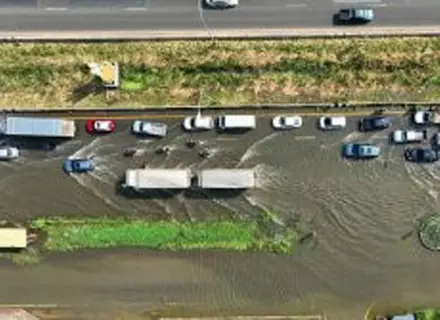

Roads, railways, ports and airports across Europe, Central Asia and North America will face far harsher weather conditions in the coming decades, according to a new report from the United Nations Economic Commission for Europe (UNECE). Released on 30th June 2026, the study warns that flooding, extreme heat, vanishing snow and ice, and rising seas will all put growing strain on the infrastructure that keeps goods and people moving.
The numbers are striking. Transport systems in the region could see between 10 and 50 extra days a year above 25°C, with some areas facing up to 200 such days annually. That kind of heat damages road surfaces, warps bridge joints and even bends rail tracks. Flooding is an even bigger threat, accounting for roughly 73% of expected annual damage worldwide, with about 7.5% of all transport assets exposed to a “1 in 100 years” flood event.
The report also points to the huge financial cost of extreme weather already being felt. The 2024 Atlantic hurricane season alone caused an estimated USD 232 billion in damage, and ports worldwide face around USD 7.5 billion in losses every year from storms and flooding.
Four major risks stand out. Heavier rainfall threatens river basins around Europe’s Danube, Rhine, Elbe and Volga, raising the odds of landslides and washed-out roads. Rising heat could bring an extra 10 days above 25°C a year to 90% of Europe’s rail network by 2050-2080, risking rail deformation and signal failures. Melting snow, ice and thawing permafrost could put 70% of Arctic infrastructure at risk by 2050, though early action could halve the cost of fixing it. And rising seas could leave 71% to 89% of the world’s ports vulnerable to extreme storms by 2100, with around five million Europeans facing near-annual coastal flooding by then.
UNECE Executive Secretary Tatiana Molcean said transport systems are essential to how societies and economies function and that disruptions carry heavy human and financial costs. She stressed that adapting infrastructure to climate risk is no longer optional, since extreme weather is already a present-day reality rather than a distant threat.
The report highlights examples of countries already adapting. Portugal has built flood- and wildfire-resilient measures into a new bus network, France is preparing its road and rail systems for a 3°C temperature rise, Germany is mapping landslide risks after a rockfall shut a key freight line for seven weeks, and Denmark is using sensors to detect unstable rail embankments before they fail.
The report argues the payoff is clear. Citing the World Resources Institute, it notes that every dollar spent on climate adaptation can generate more than ten dollars in economic and social benefits. UNECE is now setting up a new “Technical Body on Inland Transport Climate Resilience”, due to hold its first meeting in November 2026, to carry this work forward.
Image Credit: UNECE