
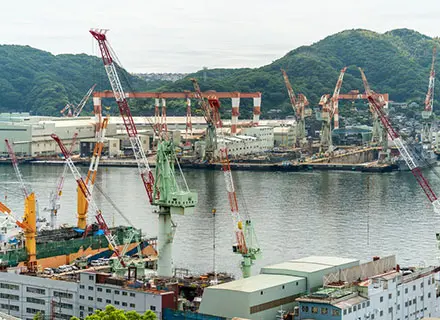

Japan is preparing to build its first large new shipbuilding dock since 2017, as part of a sweeping, government-backed roadmap to revive an industry that once led the world but has slipped to a distant third behind China and South Korea.
The last major dry dock built in Japan was completed by Imabari Shipbuilding in 2017, a 600-metre facility at its Marugame headquarters designed for ultra-large container ships, which was the country’s first new dock in 17 years at the time.
No comparable large-scale dock has been built anywhere in Japan since, even as rivals in China and South Korea continued expanding capacity through the following decade.
That is now set to change under the “Shipbuilding Industry Revitalisation Roadmap”, released by Tokyo at the end of 2025, which sets a target of doubling domestic shipbuilding volume to 18 million gross tonnes by 2035, compared with 2024 levels.
The plan is divided into three parts: the first part, until 2028, will focus on using automation and technology that saves labour, like welding robots; the second part, from 2029 to 2031, will concentrate on building and expanding facilities, including new docks; and the final part, from around 2032 to 2034, will help operate the new capacity and equipment that takes a long time to get, like large cranes.
To fund the effort, the government has committed to a 350 billion yen fund, implemented in three stages, with an initial 120 billion yen allocated in the fiscal 2025 supplementary budget. Public and private investment together are expected to total around 1 trillion yen, roughly 6.3 billion yen, over the next decade.
A separate “national dockyard” plan, reported by Nikkei and estimated to cost about 1 trillion yen, would have Tokyo pay for the repair or building of shipbuilding facilities, which would then be given to private companies to run. This approach aims to boost capacity that individual shipbuilders might not be able to afford on their own.
Minoru Kiuchi, Japan’s minister of economic security, has described reviving the shipbuilding industry as critically important for economic security, saying the government would work with the land ministry to strengthen supply chains and ensure a stable supply of vessels.
The push comes as Japan’s shipbuilding market share has fallen to under 10% of global new orders, down from around 20% at its peak, having been overtaken decades ago by state-backed rivals in South Korea and China.
The dock expansion is also closely tied to Japan’s trade and defence relationship with Washington.
A Japan-US shipbuilding working group has been examining standardising ship design and parts, with some proposals suggesting Japan design components that could be manufactured in the United States to help rebuild American shipyard capacity, which the Pentagon regards as critically depleted.
If the 2029-2031 phase proceeds as planned, the resulting facility would mark Japan’s first large new shipbuilding dock in well over a decade, a milestone officials hope will signal the Far East Asian country’s return as a serious contender in the global shipbuilding order book.