
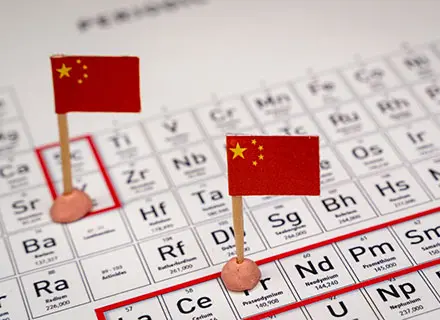

China’s tightening grip on rare earth exports could put as much as USD 6.5 trillion worth of global downstream manufacturing outside the world’s second-largest economy at risk, exposing the fragility of supply chains that underpin industries ranging from electric vehicles and consumer electronics to defence and renewable energy, the International Energy Agency (IEA) has warned.
In its latest Critical Minerals Outlook, the Paris-based agency said the full implementation of Beijing’s export restrictions on rare earths could have sweeping consequences for manufacturers worldwide, with the United States and Europe expected to bear nearly half of the economic impact.
China introduced export controls on seven heavy rare earth elements in April 2025, leveraging its dominant position in global production. The restrictions disrupted supply chains almost immediately, forcing some automotive manufacturers to suspend production.
Although expanded controls covering products made abroad using Chinese rare earths have been temporarily suspended until November 2026, the IEA said the episode underscores the risks posed by highly concentrated supply chains.
Rare earth elements comprise a group of 17 metals used in small quantities but are indispensable for permanent magnets found in electric vehicles, wind turbines, smartphones, aircraft, robotics and advanced military equipment. The IEA noted that while these materials account for only a small share of manufacturing costs, even brief supply disruptions can halt production and trigger significant economic losses.
“Our latest analysis shows that vast amounts of economic value depend on relatively small volumes of critical minerals, whose supply chains remain highly concentrated and are therefore vulnerable,” IEA Executive Director Fatih Birol said.
The report said similar vulnerabilities extend beyond rare earths. If trade in battery-grade graphite were completely disrupted, more than USD 300 billion in annual downstream production outside China would be at risk.
Export restrictions imposed by countries including the Democratic Republic of the Congo, Mozambique and Zimbabwe on cobalt, lithium and graphite have further heightened concerns over supply security.
The IEA said prices of critical minerals recovered during 2025 and early 2026 after four years of declines as supply tightened, while investment in the sector fell 9% in 2025 amid geopolitical uncertainty and price volatility.
To reduce future risks, the agency urged governments to build strategic stockpiles of 11 high-risk minerals. It estimated that creating multilateral reserves would cost countries other than the dominant supplier about USD 900 million – a relatively modest outlay compared with the potential economic losses from supply disruptions.
Western governments have already stepped up efforts to diversify supply chains, with public financing commitments for new critical mineral projects rising more than fourfold between 2023 and 2025 to USD 65 billion.
The report also highlighted the recent conflict in the Middle East as a reminder that geopolitical flashpoints can quickly disrupt supplies of aluminium, sulphur and other minerals passing through the Strait of Hormuz, reinforcing the need for more resilient and diversified global supply chains.