
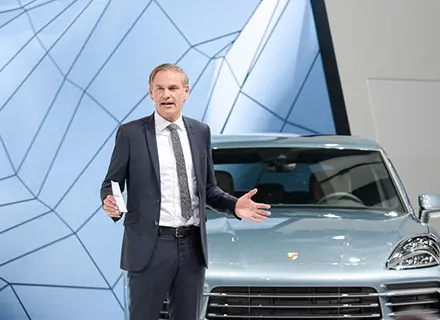

Trouble-ridden Volkswagen is in further doldrums, with CEO Oliver Blume indicating a further 50,000 job cuts to keep up with rivals in increasingly fierce domestic and international automobile markets, effectively confirming for the first time that the German major is looking to reduce up to 100,000 positions.
Blume is battling to streamline Europe’s biggest carmaker, whose profits have slumped as it faces billions of euros in tariff costs, stiff Chinese competition, and pressure on its domestic manufacturing network to become more efficient.
Volkswagen has already agreed to cut 50,000 jobs across the group, including its Porsche and Audi subsidiaries.
“The company must work on reducing costs further, having calculated a cost disadvantage versus comparable companies of 20%. This means a theoretical deduction of another 50,000 jobs worldwide. We are currently assessing across all brands, companies, and regions how many adjustments are actually necessary and feasible,” Blume said in the memo seen by Reuters.
The organizational restructuring plan has faced angry reactions from workers. As per the reports, during the last board meeting on July 9, labor representatives on the committee blocked the proposals, which, apart from job cuts, also pitched for the closure of four factories.
However, Blume has sounded undeterred in the latest memo, as he mentioned, “As of today, we still cannot confirm competitive use cases for the plants of Emden, Hanover, Zwickau, and Neckarsulm in the 2030s.” But he is now preferring “intelligent solutions” over closures, having pointed to the defense industry or the production of Chinese Volkswagen models in Europe as options for underutilized factories.
The company will further reduce its production capacity and gradually halve its model lineups—measures that analysts have still found inadequate for solving Volkswagen’s current woes.
“Of course, it’s understandable that not everything has been planned out down to the last detail yet and that certain issues still need to be further discussed and evaluated. There will certainly be more meetings in which we will work hard to find the best solutions,” Blume said.
As per the German business magazine Capital, the state of Lower Saxony is considering taking a stake in Volkswagen’s Osnabrueck plant, a move through which the provincial administration hopes to support the plant’s transition from automotive to defense production. Volkswagen sees the transition method as the viable one for other plants, whose future is under discussion.
Volkswagen has been in talks with defense companies, including Israel’s Rafael, over future prospects for Osnabrueck, where production is currently scheduled to end in 2027. To complicate things further, Volkswagen has posted an 8.6% drop in deliveries in the second quarter, the steepest fall in the automaker’s history in the last four years.
Post the board meeting, Volkswagen made no mention of job cuts or plant closures. Instead, it reiterated largely known targets to reduce complexity, measures that did not require supervisory board approval.
The model range, which spans roughly 150 lines across brands including Audi, Porsche, Skoda, and Cupra, would be gradually trimmed in the pursuit of focusing on the “most attractive market segments.” Production capacity will be reduced to nine million vehicles a year, down from 10 million currently and well below a pre-pandemic target of 12 million. So-called offering complexity, including equipment options, will be cut by up to 75%.
Germany’s largest industrial union, IG Metall, has been rallying workers at Volkswagen Group sites across Germany, urging management to present a strategy that safeguards production. While Volkswagen’s current labor agreement includes a truce against organized strikes, unions are now threatening to step up industrial action if management seeks to reopen commitments on job security.
However, the silver lining here has been both sides agreeing to the challenges the group is facing, including a severe reduction of profit margins, weakness in China, and the costs of electrification and tariffs. Reiterating that the global situation for the carmaker has been a deteriorating one over the past twelve months, Blume wants the company to become faster, more resilient, and more competitive.
Data seen by Reuters shows Volkswagen’s German plants operating at 81% of standard capacity in 2026, a figure expected to fall to 73% by the end of the decade. Zwickau, among the sites earmarked for possible closure, will likely see utilization drop from 88% this year to 42% by 2030.
Henning Gebhardt, a fund manager at HollyHedge Consult, said Volkswagen faced a “perfect storm” of weak Chinese profitability, tariffs, and stronger rival offerings, compounding pressure across the wider auto industry.