
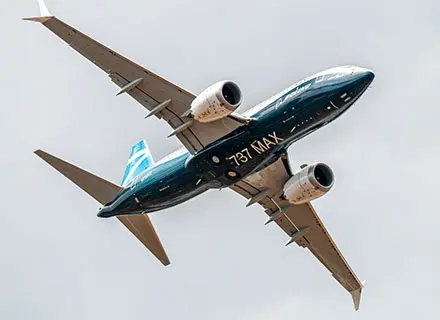

American aviation giant Boeing delivered 64 jetliners in June 2026, compared to 60 the previous month and in June 2025. The Kelly Ortberg-led company has delivered 314 aircraft through the first half, a 12% increase over the same period in 2025 and the highest number since 2018 (in terms of first-half deliveries).
The US planemaker, however, trails European rival Airbus, which delivered 89 jets in June and 351 in the first half of the year. Boeing’s deliveries will likely rise in the second half of the year as the venture increases output of its best-selling 737 MAX. The company currently is increasing 737 output from 42 jets a month to 47.
Boeing’s June deliveries included 42 737 MAXs and 13 787s. Its 787 deliveries included five jets that had been held up by seat certification delays to Saudi Arabia-based startup airline Riyadh Air. Boeing also delivered three 777 freighters and five 767s, including three for conversion into KC-46 aerial refuelling tankers by the company’s defence division.
Boeing booked 121 new orders and eight cancellations in June, for a net total of 113 new orders. The aerospace giant has so far received 7,206 orders for the 737 MAX, surpassing its previous best-selling 737 Next Generation, which received 7,159 orders.
Talking about the 737 MAX, Boeing is also in the final stages of getting regulatory certification for an engine anti-ice system fix for the jetliner, paving the way for the long-delayed MAX 7 and 10 versions to enter service.
The redesign has been done to address a mechanical issue that could cause overheating and possible engine failure. The issue, as per the company’s executives, has been the biggest obstacle to certification of the smallest and largest versions of Boeing’s best-selling jet.
As per the aviation analytics firm Cirium, Boeing has already built about 30 MAX 7s and nine MAX 10s awaiting delivery. The larger MAX 10 accounts for at least 28% of outstanding MAX orders.
The United States Federal Aviation Administration (FAA) said in May it expected to certify the smaller 737 MAX 7 this summer. South-west Airlines has been the biggest customer for that version. As per the planemaker, the more profitable MAX 10 is 98% through certification flight testing.
“We have two flight tests left, and we should be done real soon here,” said Chris Payne, Boeing vice president and general manager for 737 MAX development programmes.
Certification of the MAX 7 and 10 is years behind schedule, which has allowed European planemaker Airbus to expand its lead in the narrowbody market through its popular A320 and A321 families and their Neo and XLR variants.
Boeing has already undergone a stringent certification process following two fatal MAX 8 crashes in 2018 and 2019. Apart from that, regulators, especially the FAA, carried out intensive scrutiny of the company’s production and quality systems after a January 2024 mid-air cabin panel blowout on a nearly new Alaska Airlines MAX 9.
After the anti-ice system issue was discovered in 2021, regulators allowed the MAX variants already in service – the MAX 8, 8-200 and 9 – to continue flying and for Boeing to keep making the aircraft but delayed certification of the other versions.
“The fix to the system also reduces engine noise and mitigates fan flutter, based on testing at GE Aerospace’s Ohio facility,” said Mike Sinnett, Boeing’s senior vice president of product strategy, product development and development programmes.
The 737 MAX’s LEAP-1B engine is produced by CFM International, a joint venture of GE Aerospace and France’s Safran. Once the certification is done, Boeing will do the retrofitting of the engine anti-icing mechanism during the routine maintenance shifts, during which the aircraft will also go through intensive new wiring.
Keeping this in mind, Boeing has been working with regulators on a schedule that would allow airlines to make the repair when their planes are already in the hangar for heavy maintenance checks, reducing disruption and costs.
The MAX 10 will also introduce an updated flight crew alerting system, known as an enhanced angle-of-attack system, to meet safety requirements imposed by the US Congress following the two MAX crashes that killed 346 people and led to the model’s 20-month grounding beginning in 2019.
The system simplifies flight-deck alerts resulting from a failed angle-of-attack sensor, which overwhelmed pilots with “too much information” before the planes crashed in Indonesia and Ethiopia.
“The update is an IOU from the return-to-service (requirements) after the very unfortunate accidents. All in-service 737 MAX jets will have the new system installed within two years after regulators certify it,” said Bill Quashnock, Boeing’s 737 deputy chief pilot.
“Boeing is also more than 50% through certification flight testing for the 777-9 and is on track to start delivering the new widebody jet next year,” said Terry Beezhold, Boeing vice president and general manager of the 777-9 programme.
“The company still has to complete several major certification requirements, including getting regulatory approval for long-distance flights with few airports in between,” the official concluded.