
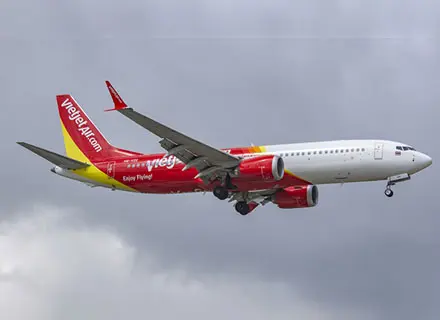

Dublin-based lessor Griffin Global Asset Management has delivered the first of six Boeing 737 MAX 8 aircraft to VietJet Group under a long-term lease, opening a new financing relationship between one of the world’s fastest-growing low-cost carriers and a leasing platform backed by Bain Capital.
The announcement, made on 19 July, marks the point at which a deal signed in Washington five months ago turns into metal on the ramp. Griffin and VietJet signed the financing agreement for six 737 MAX 8 jets in February, in a transaction the airline valued at roughly USD 965 million at list prices.
That agreement formed part of a wider package of commitments with American partners worth around USD 6.3 billion, signed on the sidelines of a state visit by Vietnamese leader To Lam to the United States.
A new financing partner
Both sides framed the delivery as the start of a long relationship rather than a one-off transaction. Jose Kling, Griffin’s head of commercial for Asia Pacific, said the lessor was pleased to welcome VietJet as a new customer and expected to support its operations for years to come, adding that the new-technology aircraft suited the carrier’s modernisation and expansion plans across its various operating markets.
Nguyen Thanh Son, VietJet’s chief executive, said the aircraft reinforce the airline’s commitment to a modern and fuel-efficient fleet while allowing it to widen regional and international connectivity. When the financing was first signed in February, Son held the title of managing director.
He was promoted to chief executive in April 2026, so the different titles across the two announcements reflect a career step rather than any inconsistency.
Speaking at the time of the original signing, he said the agreements reflected the airline’s push to broaden its international partnerships and build a modern, sustainable fleet.
For VietJet, the language about diversifying funding sources matters as much as the aircraft themselves. The carrier has openly described the Griffin arrangement as a step towards spreading its international funding base.
Low-cost airlines in Asia have historically leaned heavily on a narrow group of lessors and export credit agencies. Widening that pool reduces refinancing risk at a time when capital costs remain elevated and delivery schedules are anything but predictable.
Two Boeing tracks, one strategy
The Griffin lease sits alongside, rather than inside, VietJet’s much larger direct order with Boeing. That order began with a 100-jet commitment signed in Hanoi in May 2016 during a state visit by then US president Barack Obama, and was doubled to 200 aircraft through a memorandum signed at the 2018 Farnborough Airshow.
The additional 100 jets were confirmed as a firm contract worth USD 12.7 billion at list prices in February 2019, at a Hanoi ceremony witnessed by then US president Donald Trump during the US-North Korea summit, taking the full commitment to a value of roughly USD 24 billion.
Deliveries were originally pencilled in for 2019 to 2023, but the global MAX grounding and the pandemic pushed the timeline back by the best part of a decade. VietJet, long an Airbus-dominated operator, took its first aircraft from that direct order only last year.
The six Griffin jets are a separate transaction on top of that order book, part of a broader push by VietJet to bring forward capacity through leasing while its own Boeing order works through its backlog.
As of late 2025, when the first directly ordered MAX arrived, VietJet was operating around 121 aircraft with an average age of just over eight years, spanning A320-family narrowbodies, A330 widebodies, COMAC ARJ21s and Dash 8 turboprops.
The net effect is the same either way. The fleet is shifting from single-manufacturer simplicity to a dual-source model, financed through a mix of direct ownership and leasing.
Griffin’s Asian expansion
Griffin is a comparatively young name in a business dominated by AerCap, SMBC Aviation Capital and Avolon.
The company was founded by aviation executive Ryan McKenna and built through a partnership with Bain Capital Credit, which supplies capital to acquire and lease aircraft globally while Griffin handles lease management.
The business now runs offices in Dublin, Tokyo, Singapore, Puerto Rico and Los Angeles, and positions itself as a provider of bespoke capital solutions to airlines, manufacturers and financiers.
Its scale has grown quickly. In late 2025 Griffin closed an inaugural USD 1.245 billion series into its mid-life aircraft master trust platform, an issuance McKenna described as the largest in the history of the aircraft securitisation market, backed by 25 narrowbody and widebody aircraft with a weighted average age of 4.1 years on lease to 19 airlines across 15 countries.
Asia has been central to that growth. Griffin agreed a purchase and leaseback of ten Boeing 737-8s with Air India Express in December 2023. Sarit Chopra, a partner at Bain Capital, called India one of the fastest-growing aviation hubs in the world at the time, citing policy support and rising travel demand.
Vietnam is the logical next stop. Adding VietJet gives Griffin exposure to a carrier whose growth story runs alongside a national travel market expanding at pace.
Vietnam’s aviation boom
The backdrop is a country adding capacity across every major carrier at once. Boeing’s announcement of the Vietnam Airlines order cited estimates that Vietnamese air traffic could double to more than 75 million passengers a year over the next decade.
In February, three Vietnamese carriers placed orders totalling roughly 96 aircraft worth over USD 30 billion, with Vietnam Airlines finalising an USD 8.1 billion deal for 50 737 MAX 8s scheduled for delivery between 2030 and 2032, and Sun PhuQuoc Airways committing to as many as 40 787-9 Dreamliners.
The scramble for earlier capacity has continued since. At the Farnborough International Airshow this week, Vietnam Airlines said it would add 19 leased 737 MAX 8s from SMBC Aviation Capital, Avolon and Phoenix Aviation Capital, with deliveries due in 2028. These arrangements point to carriers working around production backlogs and long lead times by turning to lessors for nearer-term aircraft.
That is precisely the gap Griffin is selling into. When manufacturers cannot promise delivery slots, the lessors holding order positions become the fastest route to new metal.
Fuel costs cloud the picture
The expansion is not happening in benign conditions. Vietnam Airlines reported pre-tax profit of about VND3.95 trillion, roughly USD 150.1 million, at parent level in the first quarter of 2026, but said its performance was badly affected from April onwards by a sharp rise in jet fuel prices linked to the conflict involving Iran. Low-cost carriers with thin margins and high aircraft utilisation feel that squeeze quickly.
For VietJet, newer aircraft are part of the answer. A MAX 8 burns meaningfully less fuel per seat than the older narrowbodies it replaces, which turns fleet renewal from a branding exercise into a hedge against energy prices. Leasing rather than buying keeps the capital cost off the balance sheet while the fuel benefit accrues immediately.
What to watch
The remaining five aircraft in the Griffin package will show whether this becomes a durable relationship or a single transaction.
Also worth watching is how VietJet allocates the jets across its group operations, and whether the airline returns to Griffin for widebody financing as it weighs long-haul ambitions. For Griffin, the deal is a foothold in a market where nearly every carrier is buying at once.