
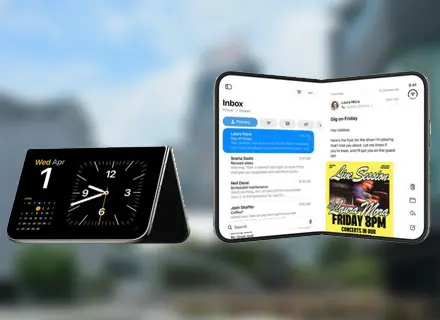

Apple finally has a folding phone. At its “Surprise and Shine” event at Apple Park on 9 September 2026, the company unveiled the iPhone Duo, its first foldable, starting at USD 1,999.
The launch was notable for a second reason.
It was the first keynote fronted by John Ternus, who became Apple’s chief executive on 1 September, ending the tenure Tim Cook began on August 24 2011 when he succeeded Steve Jobs.
Cook has moved to the role of executive chairman, and the handover means the most watched product debut in years doubled as the introduction of a new leader.
Ternus set the tone with a bold claim. “iPhone Duo is the most transformational change to iPhone since the original,” he said, adding that it “redefines what it means to use a foldable phone.”
Whether the market agrees will shape both the device’s fortunes and the credibility of Apple’s engineer chief executive.
What Apple announced
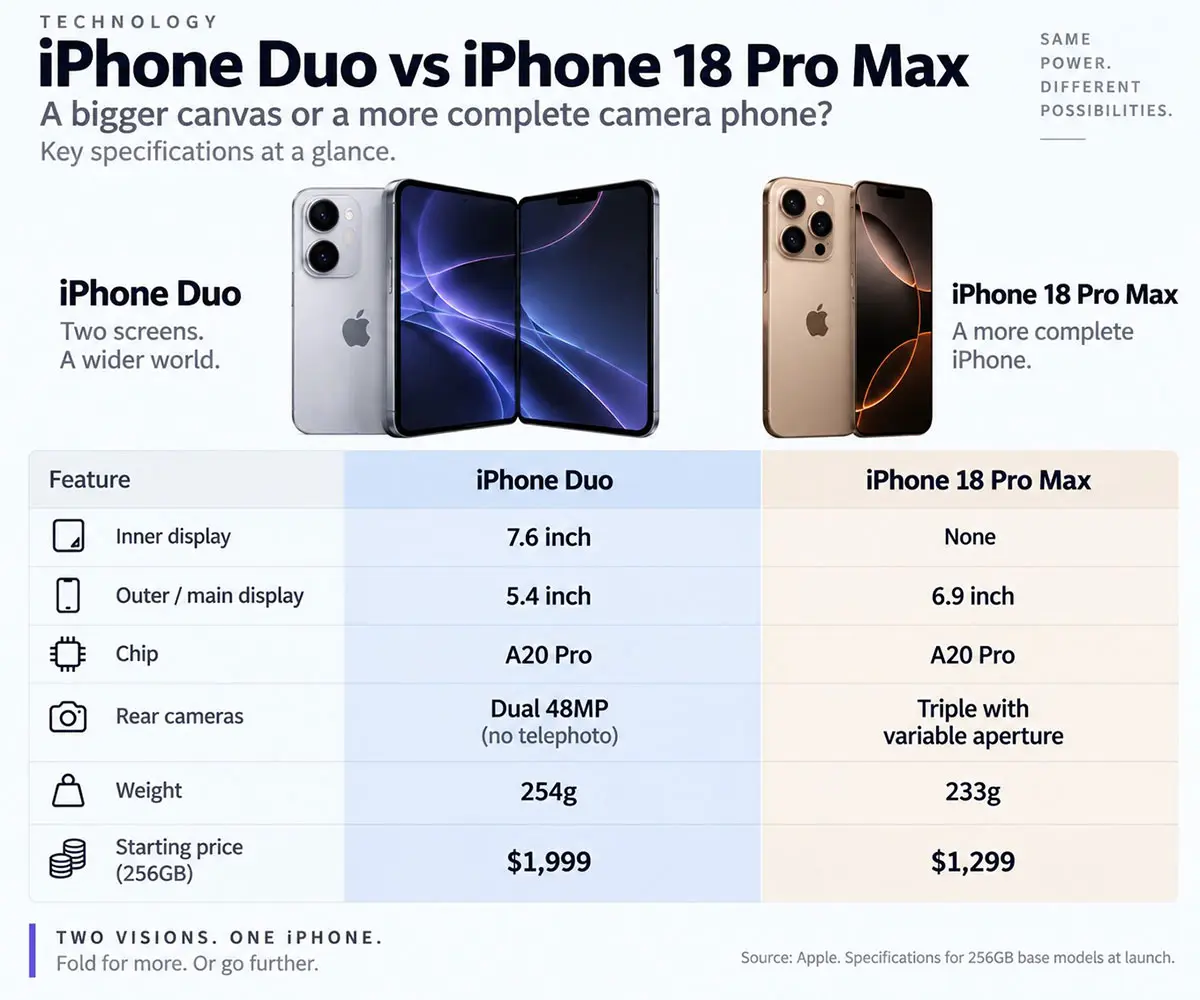
The iPhone Duo is a book-style foldable. Closed, it is short and wide, a shape Apple likens to a passport, with a 5.4-inch outer screen. Opened, it reveals a 7.6-inch inner display that Apple says is 50% larger than the screen on the iPhone 18 Pro Max.
Both are Super Retina XDR panels with ProMotion up to 120Hz and peak outdoor brightness of 3,000 nits.
The inner screen carries a matte nano-texture finish, a coating that reduces glare and, crucially, helps disguise the crease that runs down the middle of every folding phone.
The engineering is dense. The frame is mirror-polished grade 5 titanium and the hinge cover is 3D-printed from recycled titanium, with a mechanism Apple says uses more than 100 components.
Open, the Duo is 5.2mm thick, making it the thinnest iPhone ever when unfolded. Closed it is 11.3mm, and it weighs 254g. It carries an IP68 rating for dust and water resistance to a depth of six metres for 30 minutes, unusual for a folding device.
Security is handled by Touch ID built into the side button rather than Face ID, so unlocking works whether the phone is open or shut.
Inside sits the A20 Pro, Apple’s first 2-nanometre chip, the same processor used in the new iPhone 18 Pro. Supply-chain reporting points to 12GB of memory, though Apple does not disclose that figure. The rear camera is a dual 48-megapixel system, a main sensor and an ultra-wide, with no dedicated telephoto lens.
A dual-cell battery delivers up to 24 hours of general use, and a 60W or higher charger takes it to around 50 percent in about 20 minutes.
The Duo is eSIM-only worldwide and supports the Apple Pencil, with that feature arriving later in the year. It comes in two colours, star white and night sky, and runs iOS 27.1. Pre-orders open on 16 October and it ships on October 23, several weeks after the other new phones.
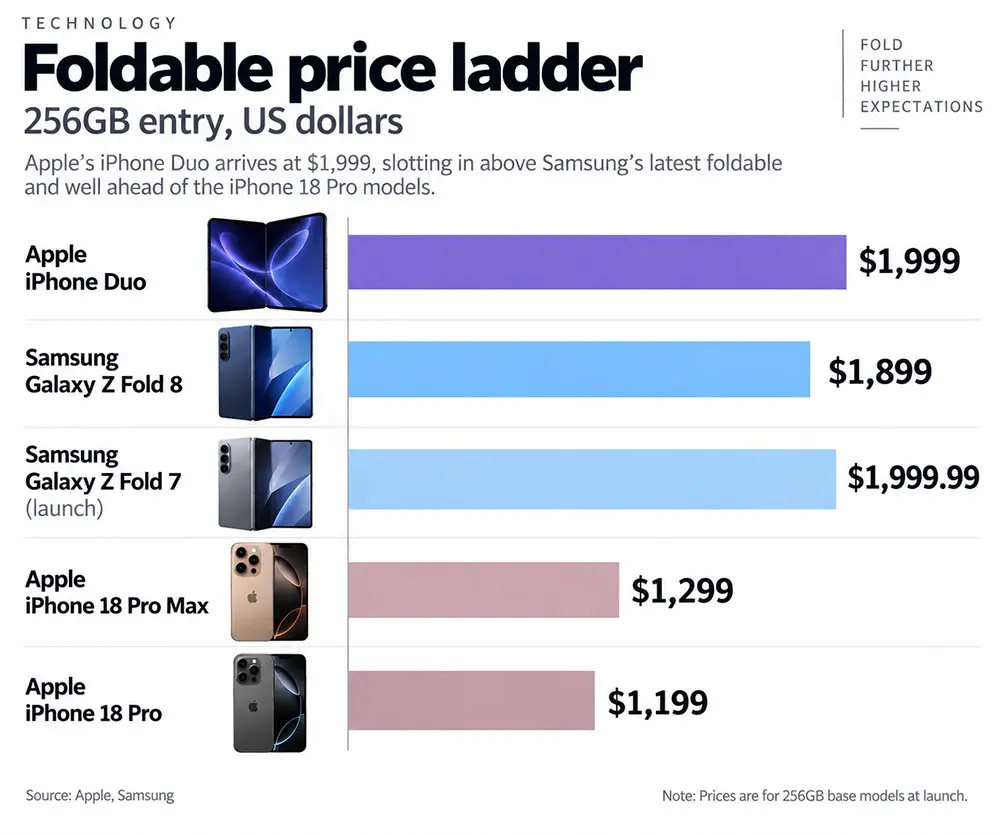
That gap matters. Apple also launched the iPhone 18 Pro at USD 1,199 and the iPhone 18 Pro Max at USD 1,299, each USD 100 more than last year.
Both keep the previous design but gain the A20 Pro chip, Apple’s own C2 modem in place of Qualcomm’s, a 48-megapixel main camera with a variable aperture (the first time an iPhone can control how much light the lens lets in), a smaller Dynamic Island and much longer battery life, up to 45 hours of video on the Pro Max.
These go on pre-order on September 12 and ship on September 18. Unusually, the standard iPhone 18, the cheaper iPhone 18e and the iPhone Air 2 were held back to spring 2027, so this autumn’s line-up is premium only.
Alongside the phones came the Apple Watch Series 12, the Apple Watch Ultra 4 and the AirPods 5. The software story centred on Siri AI, a rebuilt version of the assistant that Apple says handles 2.5 billion requests a day and works across more than 300,000 apps.IOS 27 arrived as a free update on September 14. Ternus used the stage to argue that the iPhone is the best personal device for artificial intelligence because Apple controls the hardware, the operating system and the data on the phone. Notably, Siri AI is not available in the European Union at launch.
What the reviewers think
The hands-on reaction was warm but not uncritical. Engadget called the Duo “Apple’s most exciting device in a decade” and praised the way the matte inner display hides both reflections and the crease.
TechRadar went further, saying Apple had “solved the foldable crease problem in the most wonderfully basic way”, noting the crease could be felt with a finger but not seen. MacRumors was more measured, reporting that “the crease is still there, but barely”, and that it remained visible in certain lighting.
Not everyone was convinced the compromises were worth it. Reviewers at The Verge repeatedly returned to the missing telephoto lens.
Senior reviews editor Nathan Edwards said he liked the form factor but was not willing to trade away the zoom camera he relies on. That points to the central tension. In several respects the cheaper iPhone 18 Pro is the better-equipped camera phone, so buyers are paying a large premium for the screen and the hinge, not for photography.
The question of lateness hangs over the launch. Samsung created the category with the Galaxy Fold, unveiled on February 20 2019 and released that September, and Huawei, Honor, Motorola and Oppo have all shipped folding phones since.Apple’s defence, echoed by Ternus, is that it waited deliberately for a design that felt seamless and durable. The counter-view is blunt. Apple has arrived more than six years after the category began and is charging more than the established leader.
What the analysts think
Financial reaction was mixed and the share price reflected caution. Apple closed at USD 315.34 on September 9, down 0.28%, as investors weighed the foldable against margin pressure from rising memory costs. Shares edged higher in after-hours trading.
The bulls were vocal. Dan Ives, partner and senior managing director at Yorkville Ives and Co., the merchant bank he co-founded after leaving Wedbush Securities, told CNN the Duo was the first new Apple product in a decade, since the AirPods, that could “move the needle” and might kick off a broader innovation cycle.
Gene Munster of Deepwater Asset Management doubled his estimate of the Duo’s share of iPhone revenue in the 2027 financial year from 5% to 10%, and argued the split launch could push March-quarter revenue growth towards 20% against a Wall Street consensus nearer 14%, because buyers who need a phone now are steered to the pricier Pro models.
Morgan Stanley’s Erik Woodring, rated Overweight with a USD 360 target, had called the foldable the most consequential launch since the iPhone X and estimated it could add around USD 14 billion in December-quarter revenue.
Bank of America’s Wamsi Mohan kept a Buy rating and a USD 380 target.
The bears focused on price and margins. Jefferies retained an Underperform rating. KeyBanc had warned before the event that the launch could prove a negative catalyst if the pricing caused sticker shock.
Morningstar expects the Duo to remain a low-volume premium product and sees gross-margin compression in 2027.
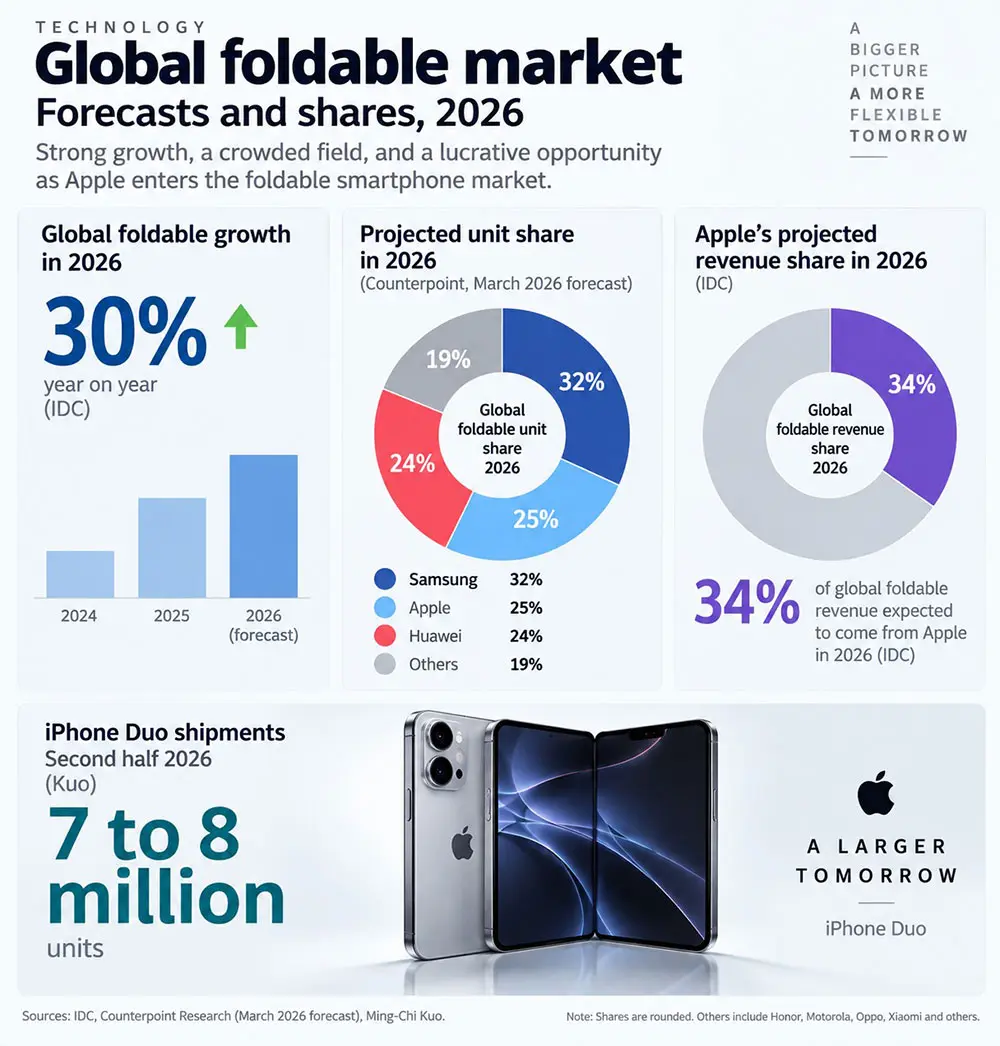
On volumes, Ming-Chi Kuo of TF International Securities forecast 7 to 8 million foldable units in the second half of 2026, with production potentially reaching 20 million or more in the next cycle, and warned that early supply would be tight.
Counterpoint Research’s March 2026 forecast expects Apple to take around 25% of the global foldable market in its first partial year, behind Samsung on about 32% and roughly level with Huawei on 24%, with cumulative foldable shipments passing 100 million by the end of 2026.
IDC pegs 2026 foldable growth at 30% and, on an average selling price near USD 2,400, expects Apple to capture about 34% of category revenue despite a smaller unit share.
Price, competition and the Ternus test
On price the Duo is a statement. At USD 1,999 it starts 100 dollars above Samsung’s Galaxy Z Fold 8, which begins at USD 1,899, and rises to USD 3,199 for 2 terabytes.
In the United Kingdom it starts at 1,999 pounds, and in India at 299,900 rupees, roughly 700 dollars or 700 pounds more than the iPhone 18 Pro Max in each market.
That is a punchy figure in a smartphone market that IDC expects to shrink sharply in 2026 as a memory-chip shortage pushes up component costs, with foldables the only growth segment.
For Ternus the launch is a clean expression of who he is. He ran Apple’s hardware engineering for years, and his updated company biography emphasises reliability, durability and materials.
A folding titanium phone is exactly the kind of product an engineer chief executive would choose as a first statement.
The risk is that it does not answer the criticism that has dogged Apple most, its slow progress in artificial intelligence.
The company’s response, that owning the device is the way to win the AI era, is a bet that will take longer than one keynote to judge.