


T-Mobile US published its second quarter results on 23 July to a distinctly mixed reception. The company beat on earnings and missed on revenue, account growth slowed again, and several analysts spent the following day trimming their price targets.
Diluted earnings per share came in at USD 2.99, up 5% on the year and comfortably ahead of a consensus sitting at around USD 2.60. Total service revenues rose 9% to USD 19.0 billion, with postpaid service revenues up 13% to USD 15.9 billion. Core adjusted EBITDA reached USD 9.54 billion, up 12%. Adjusted free cash flow was USD 4.8 billion on a margin of just over 25%, and net cash from operating activities hit USD 7.5 billion.
Total revenue told a less flattering story. At USD 22.79 billion it was up from USD 21.13 billion a year earlier, but it fell short of the USD 22.94 billion the Street had modelled. Net income rose just 1% to USD 3.2 billion, carrying the weight of costs tied to the UScellular acquisition, including USD 146 million of accelerated depreciation after tax.
T-Mobile added 277,000 postpaid accounts in the quarter, clearing the 259,000 to 264,000 range analysts had modelled but sitting 13% below the 318,000 added in the same period last year. Total postpaid accounts reached 34.7 million against 31.5 million, though much of that jump is the UScellular base rather than organic wins. Postpaid account churn came in at 0.99%, up from 0.92% a year ago.
The widening gap between slowing additions and accelerating revenue is not accidental.
Postpaid average revenue per account reached USD 152.91, up 2% on the year. Chief financial officer Peter Osvaldik tied the company’s approach to pricing and volume to customer lifetime value, and pointed past the headline number to the effect of earlier deals.
“If you look ex M&A, postpaid ARPA actually grew 3.7% on a year-over-year basis,” he said.
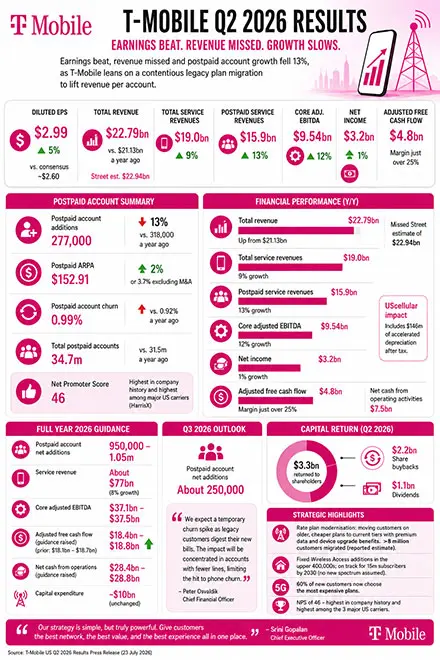 Behind that number sits a large and contentious exercise the company calls rate plan modernisation, under which customers on older, cheaper plans are being moved onto current tiers that bundle premium data with device upgrade benefits. Trade reporting puts the figure above eight million, though T-Mobile has published no number of its own. Chief operating officer Jon Freier told Reuters that around 60% of new customers are now choosing the most expensive plans on offer.
Management was candid that this will cost them in the near term. Osvaldik guided to roughly 250,000 postpaid account additions in the third quarter, a clear step down from the second, and attributed the dip to a temporary churn spike as legacy customers digest their new bills. He expects the damage concentrated in accounts with fewer lines, limiting the hit to phone churn.
Analysts covering the sector argue the pain will be short-lived, on the grounds that even after the increases T-Mobile’s pricing still sits below comparable front-book rates at AT&T and Verizon. Whether that holds through the autumn is the open question of the year.
For the full year, T-Mobile reaffirmed postpaid account net additions of 950,000 to 1.05 million, service revenue of about USD 77 billion representing 8% growth, and core adjusted EBITDA of USD 37.1 billion to USD 37.5 billion. First half additions came in at close to 500,000, which puts the company on track without much room to spare.
The one upgrade was cash. Adjusted free cash flow guidance moved to a range of USD 18.4 billion to USD 18.8 billion from USD 18.1 billion to USD 18.7 billion, and net cash from operations to USD 28.4 billion to USD 28.8 billion. Osvaldik credited efficiencies in cash income taxes alongside working capital gains from the company’s AI tooling. Capital expenditure guidance held at roughly USD 10 billion, and shareholders took USD 3.3 billion out of the quarter, USD 2.2 billion in buybacks and USD 1.1 billion in dividends.
Chief executive Srini Gopalan leaned on customer satisfaction, pointing to a net promoter score of 46, the highest the company has recorded and, on HarrisX data, the highest among the three major US carriers. He framed the whole approach as a single combination of network quality, value and customer experience.
“Our strategy is simple, but truly powerful. Give customers the best network, the best value, and the best experience all in one place,” he said.
Fixed wireless remains the growth engine that gets least attention. Broadband additions landed in the upper 400,000s, and the company is still targeting 15 million subscribers by 2030, a figure that assumes no new spectrum. Asked about the load that business places on the network, Gopalan pushed back on the premise.
“FWA does consume a fair amount of our capacity, but this is where the numerator-denominator issue comes in. It consumes a fair amount of our traffic today, which is not the same thing as a fair amount of our capacity,” he said.
T-Mobile also stopped publishing postpaid phone net additions this year, reporting accounts, ARPA and churn instead. It is a defensible framing given where the value now sits, but it removes the single cleanest number for measuring the three US carriers against one another, in the same year the company pushed through its largest price migration to date.