
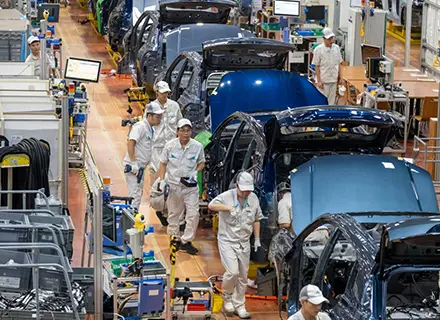

China’s manufacturing sector expanded at a faster pace in August, driven by increases in output, new orders, and exports, according to the RatingDog China General Manufacturing Purchasing Managers’ Index (PMI).
The index, compiled by S&P Global, rose to 51.5 in August from 50.9 in July, a crucial mark that separates growth from contraction.
Output rose at the fastest pace in three months, driven by stronger demand and capacity expansion, while the new orders grew at a quicker rate on the back of the sharpest rise in new export business in the first half of 2026.
As per the PMI, the employment rate remained unchanged after increases in June and July. However, stronger demand pushed backlogs of work to their fastest accumulation since March.
Finished goods inventories, on the other hand, grew at the sharpest rate since September 2025, and firms reportedly increased purchasing activity after scaling it back in July.
Despite input cost inflation edging up slightly from July, S&P Global found cost pressures to be relatively modest.
Chinese manufacturers cut output prices for the first time this year, citing factors like intense competition and promotional discounting.
“Weakening demand at home has strained a broader recovery in the USD 20 trillion economy, and external uncertainties, including trade tensions and geopolitical risks, continue to cloud the outlook, pressuring demand,” S&P Global said.
The GDP growth in the world’s second largest economy slowed to 4.3% in Q2, the slowest in more than three years and below forecasts. It grew 5.0% in the first quarter.
“Looking ahead, factories remained optimistic about production over the next 12 months, but overall confidence slipped to its softest level since January,” the PMI mentioned in its report.
The momentum in China’s manufacturing sector mirrored the overall global factory activity, which continued to progress smoothly in August.
Surging demand for AI hardware kept Asian factories busy, while new orders in Europe bounced higher, brightening prospects despite the prolonged Iran war fanning uncertainty.
In Europe, the continent’s manufacturing activities hit their fastest pace in more than four years, but the trend in the United Kingdom moved in the opposite direction by experiencing a growth slowdown.
However, factories there hired workers at the fastest pace in more than two years due to rising production requirements.
Among the other prominent European economies, Germany saw its factory growth hitting a more than four-year high, while France contributed to the overall expansion. Italy, however, saw its first contraction since January, with Spain also remaining in negative territory.
S&P Global’s Eurozone Manufacturing Purchasing Managers’ Index (PMI) rose to 52.7 in August from 51.9 in July, its highest reading since May 2022 but just shy of a preliminary estimate of 52. 8.
Coming back to Asia, solid demand for semiconductors and AI-related products propelled Japan’s manufacturing industry, with new businesses growing at the fastest pace since January 2018.
The S&P Global Japan Manufacturing PMI rose to 54.9 from 54.5, its highest since April and marking the eighth consecutive month of expansion.
South Korea, another tech hub, too witnessed activity expansion for a ninth straight month due to robust export demand. Its PMI eased to 52.3 from 53.1 but was still above the 50 mark.
The East Asian country witnessed a 68.7% expansion in its export activities in August and showed separate data.