
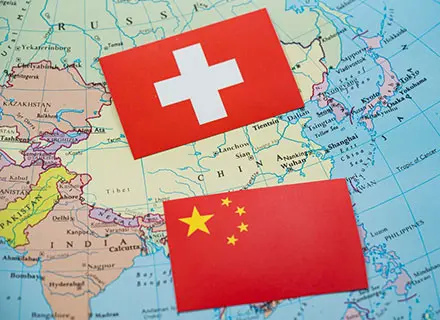

Switzerland and China have completed negotiations on an updated free trade deal that will increase the European major’s access to its third biggest trading partner.
Swiss president Guy Parmelin and China’s Commerce Minister Wang Wentao announced the conclusion of the talks after a meeting in Bern on Thursday (August 20).
Under the agreement, 99.8% of Swiss exports can enter the Chinese market duty free, upgrading an existing deal where the terms applied to only around half of shipments arriving from the European nation to the world’s second-largest economy.
Almost all Chinese exports to Switzerland are duty-free under the existing 2014 free trade agreement between the two countries, which was also Beijing’s first such deal with a European economy.
ALSO READ | Trump’s war, tariffs squeeze American wallets
Other areas covered in the new bilateral agreement include rules of origin and trade facilitation, trade in services, digital trade, competition, and economic and technical cooperation.
China has emerged as Switzerland’s third biggest trade partner after Germany and the United States, with bilateral trade amounting to 46 billion Swiss francs (USD 57.6 billion) so far in 2026.
Trade between the two countries has expanded from 31.7 billion francs in 2015 to 51.2 billion francs in 2025, stated the figures from the Swiss customs office.
The world’s second-largest economy has also become a big market for Swiss chemicals, pharmaceuticals, precision instruments, and watches.
Both sides are eyeing the year-end deadline for the updated deal’s signing. However, it will be subject to the legal review and domestic approval processes in both countries.
The development also coincides with Switzerland’s position in the midst of the US-China rivalry. Last summer, Washington imposed a 39% tariff on Swiss goods, at the time the highest rate among developed nations. A preliminary US-Swiss agreement would cap tariffs at 15%, but that deal is not legally binding yet.
Complicating things further, in July this year, Switzerland found its name among 60 countries that would face new US tariffs for allegedly not doing enough to combat forced labour. A 12.5% tariff has been imposed on Swiss goods.
Analysts view the China deal as a timely diversification for Switzerland, aimed at partially compensating for its volatile economic position that resulted from the trade uncertainties arising from the American shore. Beijing has also agreed to stricter rules on labour rights and environmental issues in a revised sustainability chapter of the deal.
Meanwhile, the Parmelin government has recommended the Swiss Parliament reject an initiative aimed at blocking a new agreement between Switzerland and the European Union (EU) that would mark the biggest overhaul in bilateral economic relations in a generation.
Backed by the billionaire founders of Swiss asset manager and private equity firm Partners Group, the so-called “Kompass-Initiative” aims to protect Swiss independence by broadening the scope of compulsory referendums on state treaties.
Agreed in December 2024, the EU-Swiss deal is currently being debated in the Swiss parliament. If passed, it is likely to face a referendum in 2027 at the earliest.
The ruling Federal Council, however, sees the Kompass initiative as creating legal uncertainty, apart from disrupting Switzerland’s established democratic system and threatening legal and economic stability.
“Instead of clarity, it creates more uncertainty and problems,” Justice Minister Beat Jans told a press conference.
The initiative aims to require approval for international treaties not only from a majority of voters but also from a majority of its 26 cantons, thereby increasing the threshold for passing such accords.
ALSO READ | US tariff policy is causing enormous uncertainty: Dr Conor O’Kane
The Kompass initiative also opposes the so-called “dynamic alignment” of laws under the EU-Swiss deal, in which Bern, subject to its own constitutional safeguards, adapts its legislation to relevant changes in EU law.