
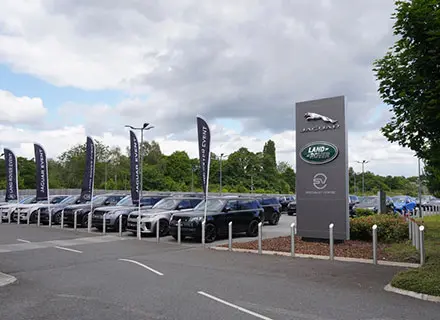

Jaguar Land Rover (JLR) is cutting around 4,000 jobs over the next two years as Britain’s biggest carmaker embarks on a sweeping cost-reduction programme aimed at saving 1.7 billion pounds and making its business less vulnerable to swings in demand, tariffs and production costs.
The Tata Motors-owned luxury carmaker said on Monday (August 7) that the workforce reduction was part of a broader plan to strengthen its competitiveness in a rapidly changing global automotive market.
The company plans to implement a voluntary redundancy programme, primarily targeting non-production and salaried roles. The company plans to implement a voluntary redundancy programme that will primarily focus on non-production and salaried roles.
JLR employs about 40,000 people globally, including roughly 30,000 in the United Kingdom. The scale of the reduction therefore represents a significant restructuring of one of Britain’s most important industrial employers.
The company’s immediate financial objective is to reduce its annual break-even point to about 300,000 vehicles. That target is close to the roughly 307,900 vehicles JLR produced in 2025, highlighting how sharply management wants to reduce the volume required to cover its costs.
JLR’s announcement comes after a particularly difficult year for the manufacturer. Its annual profit before tax and exceptional items plunged to just 14 million pound in the year to March 2026, from 2.5 billion pound a year earlier.
US tariffs, weaker demand in key markets, and the aftermath of a significant cyberattack that disrupted production have all impacted the company.
The cyberattack was particularly damaging. The disruption contributed to a 27% fall in overall production and cost the company about 200 million pound, according to the Guardian.
US trade policy has added another layer of pressure. America is an important market for JLR, particularly for its high-margin Range Rover and Defender models.
At the same time, JLR faces a competitive threat from Chinese manufacturers that have moved rapidly up the global automotive value chain. Chinese brands are increasingly competing with established European and Japanese manufacturers on price, technology and electric vehicles.
The pressure is particularly visible in the United Kingdom. Chinese models such as the Jaecoo 7 have gained traction in the British market, illustrating how quickly new competitors can establish themselves. Reuters has highlighted the growing challenge from Chinese brands as one of the factors weighing on JLR’s sales.
China itself has also become a difficult market for established luxury manufacturers. JLR has previously reported weaker volumes there, while the rapid expansion of domestic Chinese electric vehicle makers has made the market substantially more competitive.
The job cuts, nevertheless, come alongside a substantial investment programme.
That combination—cutting jobs while committing billions of pounds to future products—reflects the central challenge facing traditional carmakers.
JLR needs to become leaner while simultaneously spending heavily to remain competitive during the industry’s transition from internal combustion engines to electric vehicles.
The company has already been reshaping its product strategy. Its electrification push forms a central part of its longer-term plans, while the revival of the Freelander name through a partnership in China is intended to give JLR access to a broader electric-vehicle market.
Chief Executive PB Balaji, who previously served as Tata Motors’ finance chief, leads the latest restructuring.
His task is to restore financial resilience while protecting the premium positioning of JLR’s brands.
For Tata Motors, the restructuring comes at a sensitive point. JLR is the group’s flagship global luxury automotive business, and its performance has a direct bearing on the Indian parent’s financial results and investment plans.
The UK government is also watching the restructuring closely because of JLR’s importance to the country’s manufacturing base and supply chain.
Unions, meanwhile, have warned against workers bearing the cost of JLR’s financial difficulties.
For JLR, however, management’s calculation is clear: the company needs a substantially lower cost base if it is to protect its luxury brands and finance its next generation of vehicles.
The 1.7 billion pound savings target is therefore more than a conventional restructuring exercise. It is an attempt to reset the economics of the business.
By lowering its break-even point to 300,000 vehicles, JLR is seeking to become less dependent on high production volumes and better able to withstand downturns in global demand.
The test will be whether the savings can be achieved without weakening the company’s ability to develop the products needed for the next phase of the automotive industry.
JLR’s decision to cut thousands of jobs while maintaining billions of pounds in investment suggests that management sees cost discipline and technological investment as two sides of the same strategy.
The company is betting that a leaner organisation, a refreshed product range and greater focus on electrification can restore the profitability that has been eroded by tariffs, disruption and intensifying competition.