

The figure, based on a rolling three-month average, represents a 2.5 percentage-point increase in just nine months, according to Jens Eskelund, president of the European Union Chamber of Commerce in China.
The latest data underscore how rapidly China’s position in global containerised trade has expanded.
The increase comes despite a more fragmented global trading environment. US tariffs and efforts by companies to diversify supply chains have reduced China’s direct share of some markets, particularly North America.
Asia-Europe trade illustrates the trend. Container exports from Asia to Europe reached 10.77 million twenty-foot equivalent units (TEUs) in the first half of 2026, up 12.6% year on year, according to data compiled by the Japan Maritime Centre from Container Trade Statistics. China accounted for 8.53 million TEUs of those shipments, an increase of 14.6%.
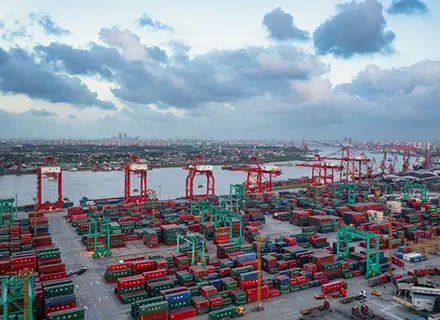
China’s export strength is also reflected in its ports. Shanghai handled 28.7 million TEUs in the first half of 2026, retaining its position as the world’s busiest container port, while Ningbo-Zhoushan handled 22.9 million TEUs, overtaking Singapore for second place, according to Alphaliner data reported by the South China Morning Post. Six Chinese ports were among the world’s 10 busiest during the period.
That strength has provided an important outlet for China’s manufacturing sector. Manufacturing output rose 5.3% during the first eight months of 2026, while retail sales increased only 0.4% year on year in August, according to figures cited by the EU Chamber.
China’s global trade surplus reached USD 805.51 billion between January and August, putting the country on course to exceed last year’s record of USD 1.2 trillion, according to the Financial Times.
The composition of trade has also shifted. While China’s direct surplus with the US has fallen, exports are increasingly being routed through third countries, complicating efforts by Washington and other governments to reduce dependence on Chinese manufacturing.
Europe faces a particularly pronounced imbalance. In 2019, China exported about 2.5 containers to Europe for every container shipped in the opposite direction.
“During the first eight months of 2026, the ratio had widened to six containers moving from China to Europe for every one moving from Europe to China,” Eskelund said.
The imbalance is likely to remain a major issue for policymakers. The EU is considering additional tariffs and other measures to protect domestic industries from import competition.
Beijing rejects claims that its industrial strategy amounts to excessive capacity.
The shift is nevertheless reshaping global shipping patterns. Chinese exporters are increasingly serving markets beyond the US and Europe, including Africa, Latin America, the Middle East and Southeast Asia.
That shift is pressuring competing manufacturing centres worldwide.
The development also comes as the shipping industry prepares for a substantial increase in vessel capacity.
The global container fleet expanded by 7.2% in 2025, while about 2.2 million TEUs of new capacity were delivered, according to Maersk.
A further wave of new ships is expected to enter service, raising questions over whether capacity growth will eventually outpace cargo demand.
China’s 40% share therefore represents more than a shipping statistic.
It is a measure of how central the country remains to global manufacturing and trade, even as supply chains diversify and governments seek to reduce strategic dependence.
For exporters, shipping companies and policymakers, the challenge will be managing the commercial opportunities created by China’s scale while addressing the trade imbalances that scale is producing.