
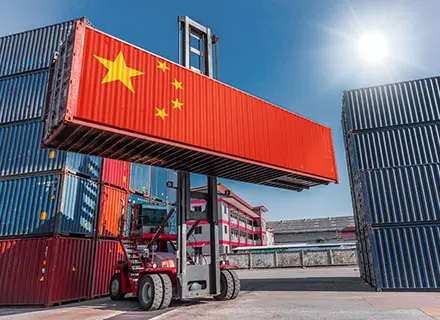

The first came from the customs administration. Chinese exports grew 25% in August in US dollar terms, quickening from 23.9% in July. The monthly trade surplus reached USD 119.09 billion.
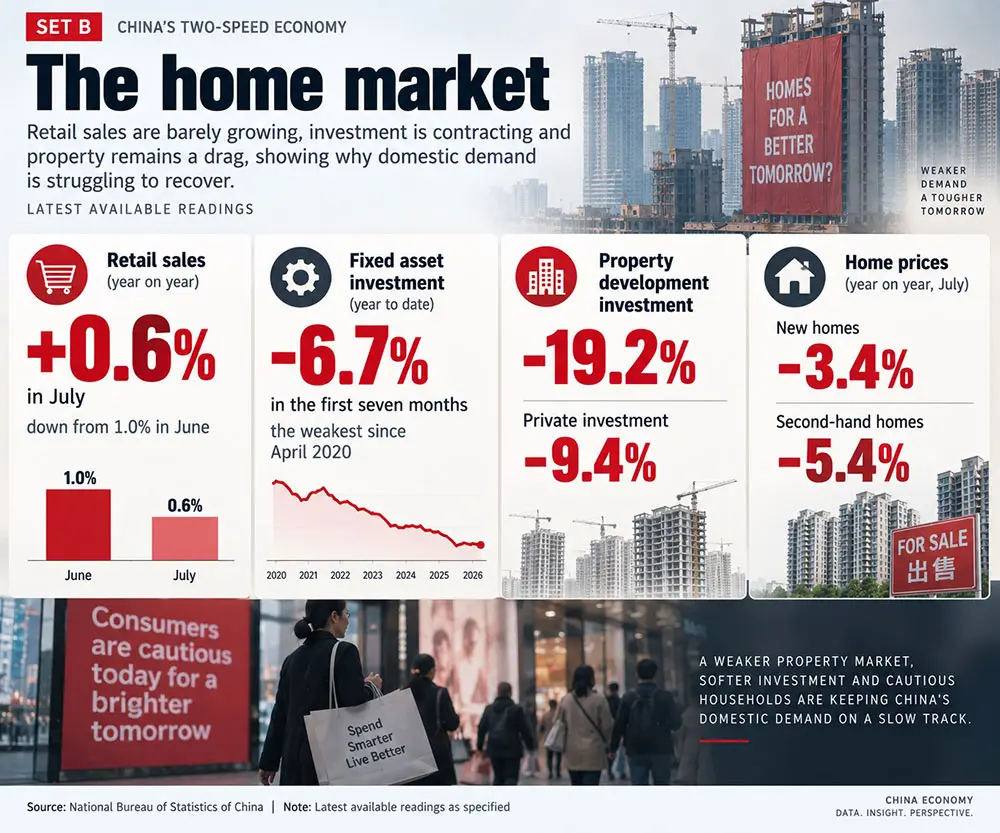
The second came from the statistics bureau. Retail sales in July grew 0.6% from a year earlier, down from 1% in June and well short of forecasts.
This is the dichotomy that now defines the world’s second largest economy. Chinese factories have rarely been more competitive abroad. Chinese households have rarely been more reluctant to spend at home.
Why the export side is roaring
The export boom is not simply a matter of cheap goods. It is being pulled by the global build-out of artificial intelligence infrastructure, which has lifted both prices and volumes for the high-tech goods China has spent a decade learning to make.
In the first eight months of 2026 the value of high-tech exports rose 42.9%. Semiconductor export values more than doubled, although volumes grew only 4.1%, a gap that shows how much of the gain is price rather than quantity.
There is a second, less flattering driver. Weak demand at home means Chinese manufacturers have spare capacity and thin margins, so they sell abroad at prices few rivals can match.
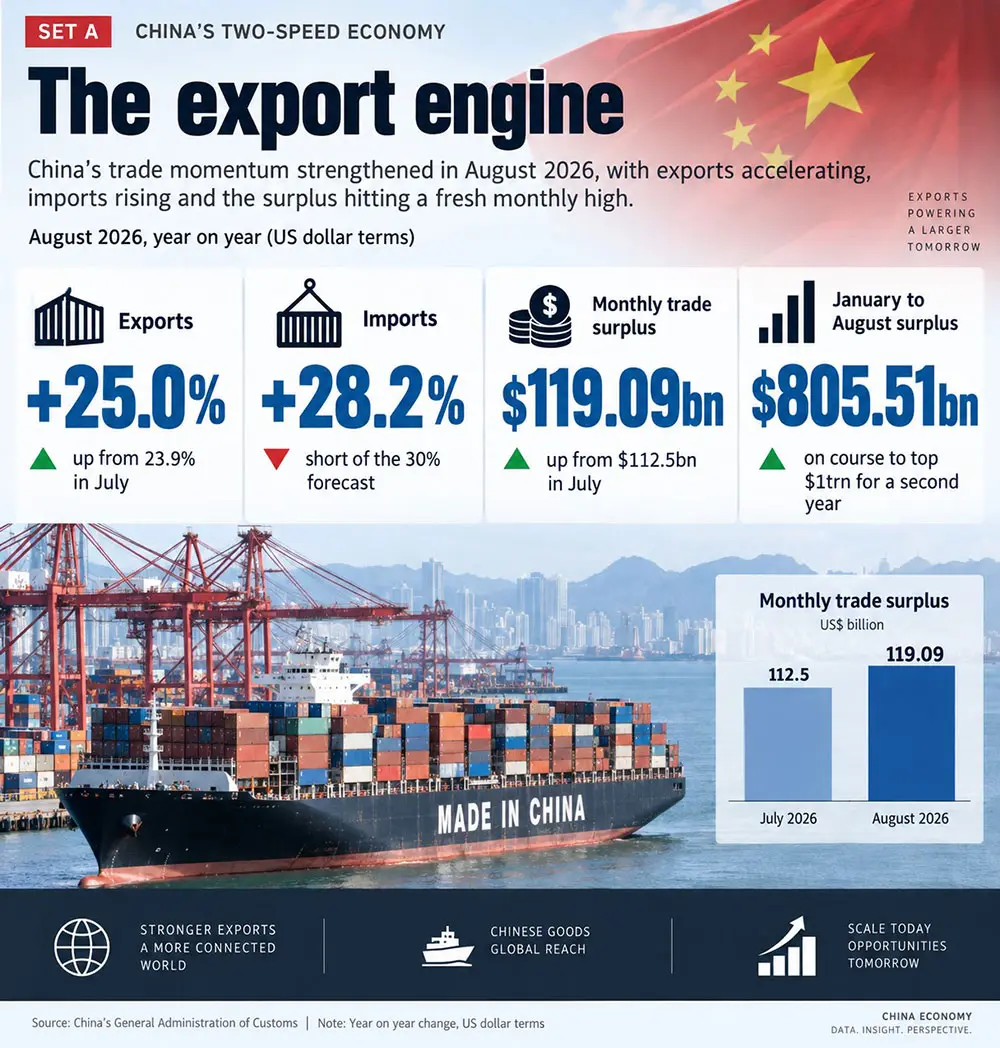
Imports, meanwhile, are flattered by the same AI cycle. August imports rose 28.2% but still missed forecasts, and once semiconductors and petrochemicals are stripped out, the underlying picture is much softer.
Why the home side is stuck
The core problem is household balance sheets. Property once accounted for something close to a third of Chinese growth and holds the bulk of family savings.
New home prices fell 3.4% year on year in July and second-hand prices fell 5.4%, extending an erosion of wealth that is now in its fifth year.
Families who feel poorer save more and spend less, which is exactly what the data show. Chinese households save roughly 30% of income, against about 10% in most developed economies.
Three other forces compound it. Employment insecurity is the first. Youth unemployment has hovered above 16% for much of the year, and the sectors that once absorbed graduates, construction and property services chief among them, are shrinking.
Thin social protection is the second. Healthcare, pensions and eldercare still leave households carrying risk that the state absorbs elsewhere, so precautionary saving stays high.
Fading policy support is the third. The consumer goods trade-in subsidies that propped up appliance and car sales in 2024 and 2025 have run their course, and the base effects are now working against the figures.
Local government finances sit underneath all three. Land sales to developers once funded a large share of municipal spending, and that revenue has collapsed with the property market.
Chinese analysts flagged exactly this in July, noting that a pullback in broad fiscal spending and tighter local government rules pushed almost every domestic indicator in the same direction in the same month.
The one genuine bright spot is services. Travel, leisure and transport spending has held up better than goods, and there are signs of a gradual shift in how Chinese households allocate what they do spend.
Officials expect per capita services spending to move towards half of total household consumption over the next five years. It is a real change, but it is starting from a low base and it is not yet large enough to offset a shrinking appetite for cars, appliances and homes.
Prices tell the story. Consumer inflation was 0.5% in July, and core inflation, once gold and trade-in effects are removed, was about 0.8%.
Producer prices fell 0.7% on the month. Firms facing falling prices cut wages and delay investment, which weakens demand further.
That loop is the reason economists describe the slowdown as structural rather than cyclical.
What Xi’s government is doing
Beijing is not ignoring the problem, and its response has broadened considerably in 2026.
The most significant move is institutional. In July the State Council approved the 15th Five-Year Plan for Expanding Consumption, the first time expanding consumption has been given a dedicated national plan of its own.
It targets total retail sales of around 60trn yuan by 2030 and, more importantly, sets out to raise the household consumption rate rather than simply the volume of sales.
Services take priority, with elderly care, childcare, culture, tourism, health, sport and education singled out.
The plan also promises to relax market access in services and revise the rules on paid annual leave, a quiet acknowledgement that people cannot spend on leisure they never get.
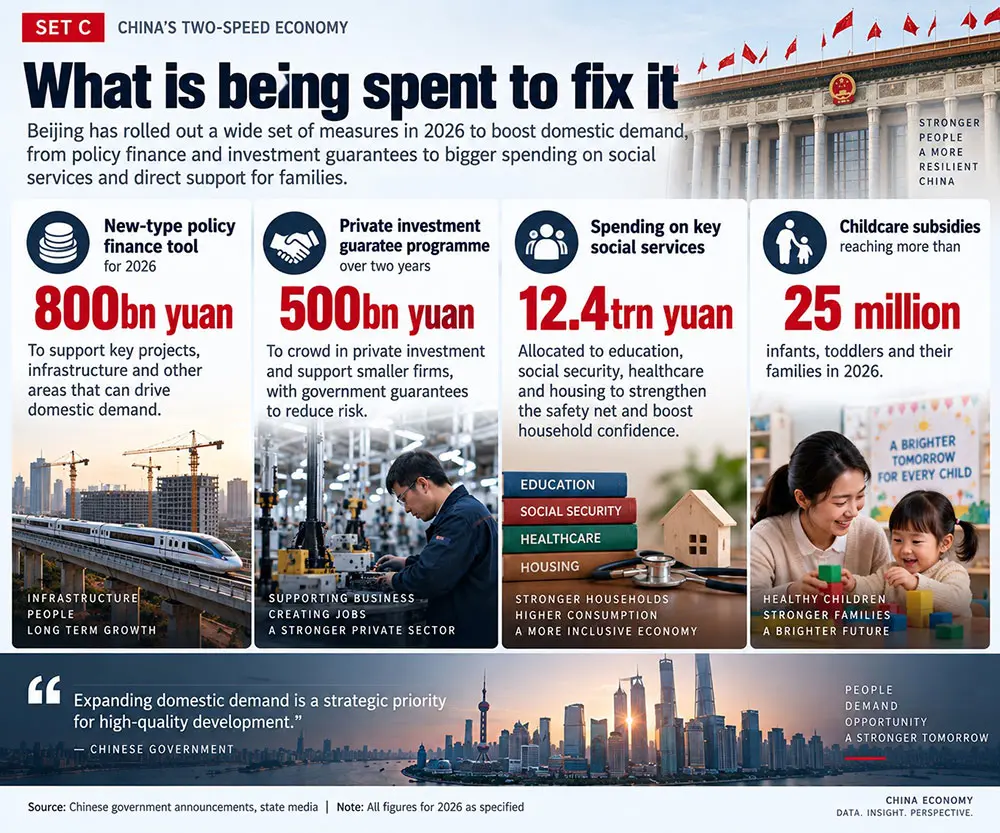
The fiscal arm is doing the near-term lifting. The finance ministry says 12.4 trillion yuan has been allocated to education, social security, healthcare and housing, and that childcare subsidies reached more than 25 million infants and toddlers and their families in 2026.
Three new measures took effect on August 1, extending consumption loan interest subsidies to working capital loans and credit card instalments and raising the number of participating lenders from roughly 100 to about 400.
On the investment side, Beijing has deployed an 800 billion yuan new-type policy finance tool, paired for the first time with a central government interest subsidy of 1.5 percentage points for up to two years on eligible loans to smaller private firms.
A 500 billion yuan private investment guarantee programme is being rolled out over two years.
Monetary policy remains what the central bank calls appropriately loose. The People’s Bank of China cut rates on structural tools in January and has signalled room for further reserve requirement and rate reductions, while pledging to keep the yuan broadly stable.
Running alongside all of this is the anti-involution campaign, an effort to curb wasteful capacity, local government subsidy races and destructive price wars. If it works, it should stop deflation feeding on itself.
Why the gap is not closing
The obvious criticism is one Chinese economists make themselves. Most of the money still flows to supply rather than demand. Policy finance tools, guarantees and industrial upgrading strengthen the export side of the ledger that is already strong, while direct transfers to households remain modest and highly targeted.
There is also a timing trap. Strong exports reduce the urgency to fix the weaker half of the economy. Growth targets can be met on the back of foreign orders, which allows the harder decisions on property, land finance and the social safety net to slip.
Scale is the third issue. The consumption plan is a five-year document, and its most powerful levers, pension top-ups, hukou reform and a broader safety net, are the slowest and most expensive to pull.
That is a risky bet, because the export boom is politically fragile.
A surplus heading past USD 1 trillion a year invites tariffs, quotas and anti-dumping cases across Europe, Asia and Latin America, not only the United States.
Washington and Beijing have been exploring reciprocal tariff reductions on about USD 30 billion of goods each ahead of a summit this month, but the wider pressure to rebalance trade is not going away.
For the rest of 2026, the indicator to watch is not the export headline. It is retail sales, core inflation and whether the new consumption plan converts into cash in household hands rather than credit lines for firms.
Until Chinese families feel secure enough to stop saving, the country will keep exporting the demand it cannot generate at home, and the world will keep pushing back.