
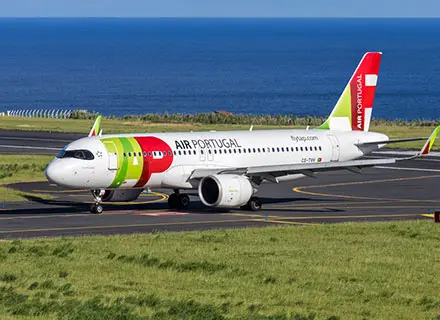

Lufthansa has won the race to become the strategic partner of TAP Air Portugal, beating Air France-KLM with a proposal valued at up to 1.2 billion euro (USD 1.3 billion) for a stake of as much as 49.9% in the Portuguese flag carrier.
The decision, announced by Portugal’s government on Wednesday, gives the German aviation group a stronger foothold in southwestern Europe and access to TAP’s valuable transatlantic network.
The first phase of the transaction covers 44.9% of TAP, with a further 5% reserved for employees.
Lufthansa can acquire that additional portion if staff do not exercise their purchase rights. Portugal will retain a 50.1% majority holding, but Lufthansa is expected to take responsibility for executive and operational management.
However, as per Lufthansa’s finance chief Till Streichert, separate talks are ongoing about the prospects of the German flag carrier potentially taking the remaining 50.1% majority stake in TAP from the government in the future.
While Streichert expects the deal to be closed in the first half of 2028 and yield 450 million euros in synergies, CEO Carsten Spohr told journalists the deal was “a perfect fit” for Lufthansa.
Spohr also said it would be an easier transaction for the European Union to approve than Italy’s ITA, whose turnaround is still ongoing, since there is less overlapping in business with Lufthansa.
The transaction remains subject to regulatory approvals, including scrutiny by the European Commission, and the process is expected to extend into 2028.
Prime Minister Luís Montenegro said Lufthansa’s financial offer was 16% higher than that of its only remaining rival, Air France-KLM, and carried less uncertainty.
The government valued the proceeds from the initial phase at 1.201 billion euro. Under Lufthansa’s proposal for a possible second phase, TAP’s total direct valuation would reach 2.552 billion euro, with Portugal potentially receiving additional cash and shares in the combined group.
The selection follows a competitive process relaunched in 2025, after earlier attempts to privatize TAP failed. British Airways owner IAG withdrew from the latest contest, leaving Lufthansa and Air France-KLM to submit final offers in September.
The government assessed the bids on financial terms, contractual protections, and industrial plans, including fleet expansion, investment, employment, and connectivity beyond Lisbon.
TAP’s appeal lies in its position between Europe and the Americas. Its Lisbon hub connects Portugal with Brazil, Portuguese-speaking African markets, and North America, making it a valuable bridge for tourism, trade, and diaspora travel. The carrier also operates routes across Europe and maintains links to Portugal’s island territories. For Lufthansa, the acquisition would extend its network into a part of Europe where its existing hubs have less reach.
The German group already controls Austrian Airlines, Swiss International Air Lines, Brussels Airlines, and Italy’s ITA Airways, among other businesses.
Adding TAP would strengthen its position in a consolidating European market, where airlines seek greater scale to withstand volatile fuel prices, labor costs, and competition from low-cost carriers and Gulf operators.
Lufthansa’s plan includes expanding TAP’s fleet from 101 aircraft to 117 by 2035 and to 130 thereafter, with the possibility of transferring up to eight Airbus A350-900 aircraft to the Portuguese airline after 2030.
The proposal also promises investment in maintenance and engineering, including a project in Santa Maria da Feira expected to create about 700 jobs. Further initiatives include a pilot-training school in Tancos and stronger operations at Porto, Faro, the Azores, and Madeira.
Portugal has sought to protect TAP’s national role while bringing in a private partner with the capital and expertise to support growth. The government assures that the airline will preserve its brand, headquarters in Lisbon, and connections to the islands.
TAP has experienced a mixed performance recently. The airline carried a record 8.2 million passengers in the first half of 2026, up 4.2% from a year earlier, while operating revenue rose 4.3%.
Yet it reported a net loss of 99.2 million euro for the period, reflecting pressure from higher operating expenses, including fuel.
In 2025, it reported revenue of 4.3 billion euro and earnings before interest, tax, depreciation, and amortization of 742.9 million euro, according to published accounts.
The purchase will add to Lufthansa’s financial and operational workload. The group is working to improve profitability and simplify its structure, while the integration of ITA Airways remains a major task.
Lufthansa will need to show that TAP can grow without weakening its turnaround.
Competition concerns also shaped the contest.
Observers viewed Air France-KLM’s hubs in Paris and Amsterdam as geographically closer to Lisbon and potentially more overlapping with TAP’s operations.
Lufthansa’s Frankfurt hub was viewed as posing a less direct threat to the Portuguese carrier’s Iberian base.
Portugal will retain majority ownership and has said a second phase could allow the selected investor to acquire control, subject to a separate process and approvals.
Lufthansa’s proposal envisages a further transaction by July 2028, potentially involving a share exchange that would leave the Portuguese state with about 5% of the combined company.
The outcome will be watched by rival groups seeking access to attractive routes, airport slots, and resilient long-haul demand across the Atlantic.