
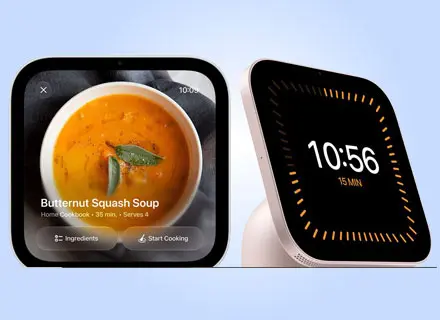

Apple has finally put a screen on the kitchen counter. On October 13 2026 the company unveiled HomeView, a USD 299 smart display that brings music, FaceTime calls, security camera feeds, household controls and a rebuilt Siri together in one device.
Preorders opened the same day and shipments begin on November 13, ahead of the holiday season.
After a decade of watching Amazon and Google dominate the smart home, Apple is changing gear.
The launch also arrives at a moment when the connected-home industry is wrestling with three big questions. Who controls the platform, how much should a smarter home cost, and how safe is it to fill a house with AI-powered gadgets?
What a connected home actually is
A connected home is one where everyday devices talk to the internet and to each other. Lights, thermostats, door locks, cameras, speakers, televisions, robot vacuums and even rice cookers can be switched on, monitored or automated from a phone, a voice assistant or a central screen.
Entertainment and control devices, such as smart speakers, streaming boxes and hubs, form the largest slice of the market. Security and access control, covering cameras, video doorbells and smart locks, is among the fastest growing. Energy management, lighting, kitchen appliances and home healthcare make up the rest.
What ties them together is an ecosystem, the software platform that lets one app or one voice assistant run everything.
Amazon has Alexa, Google has Google Home, Apple has Apple Home, Samsung has SmartThings and Xiaomi has Xiaomi Home. Whoever owns that layer owns the customer, and increasingly a monthly subscription.
How big is the market
Nobody agrees on a single number. MarketsandMarkets puts global smart-home revenue at about USD 95.8 billion in 2026, rising to USD 139.2 billion by 2032. Roots Analysis estimates USD 133.3 billion this year.
Global Market Insights takes a broader view that includes connected appliances, valuing the market at USD 186.3 billion in 2026 and forecasting USD 413.7 billion by 2035.
The direction of travel is clearer than the size. Every major forecast points to steady growth, driven by cheaper sensors, faster broadband, rising energy bills and security worries. Upgrading existing homes, rather than wiring new ones, is expected to grow fastest.
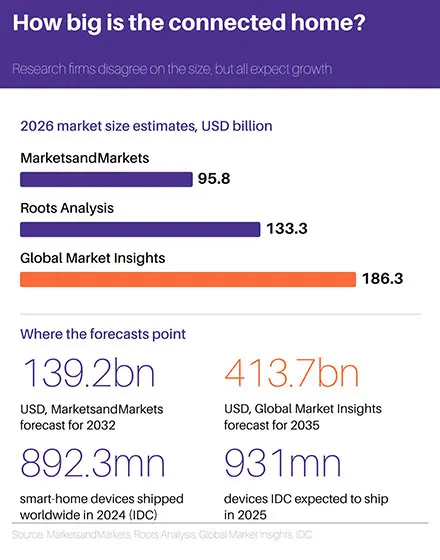
Device volumes are enormous too. IDC counted 892.3 million smart-home devices shipped worldwide in 2024 and expected about 931 million in 2025.North America remains the most mature market, with Technavio expecting the region to deliver roughly 40% of global growth to 2030.
Who runs the house today
The connected home has two kinds of giants. The first are platform companies, which own the assistant and the app. Amazon pioneered the category with the Echo speaker in 2014 and remains the household name in smart speakers and displays.
Google follows with its Nest range, now rebuilt around its Gemini AI. Apple, long a distant third, has relied on HomeKit and the HomePod.
The second group is the appliance makers, which sell the fridges, washing machines and air conditioners that increasingly come online.
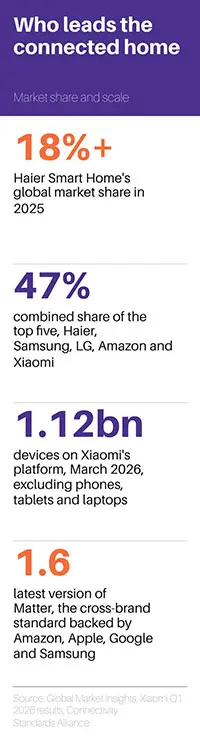 Global Market Insights reckons Haier Smart Home led the market in 2025 with more than 18% share, and that the top five, Haier, Samsung Electronics, LG Electronics, Amazon and Xiaomi, held 47% between them.
Matter, the glue meant to fix everythingFor years, devices from rival brands refused to work together. Matter, an open standard backed by Amazon, Apple, Google and Samsung through the Connectivity Standards Alliance, is the industry’s answer.
A Matter-certified bulb or lock should work with any major assistant, and many core functions run locally without needing the internet.
The latest version, Matter 1.6, arrived in June 2026. HomeView supports it, so Apple’s screen can control far more than Apple-branded gear.
Apple’s late but deliberate entry
HomeView is a seven-inch square display mounted on a speaker base, with a slimmer wall-mounted version sold at the same price.
It runs on Apple’s A18 chip and uses its front camera to recognise up to six members of a household by face, giving each person their own apps, calendar and messages.
A dedicated camera screen can show up to nine security feeds at once.
The real product, however, is Siri AI, the overhauled assistant Apple co-developed using technology behind Google’s Gemini models and released in beta in September. On HomeView it can pull a recipe from a text message, find a nearby market for a missing ingredient and update the shopping list.
 Personal requests only work when a user’s iPhone or iPad is on the home Wi-Fi network and has been unlocked recently, a safeguard for a shared kitchen screen.
There are gaps. HomeView will not be sold in the European Union because Siri AI is unavailable there, a restriction Apple blames on the bloc’s Digital Markets Act.
It goes on sale in eight markets, including the US, the UK, Canada, Australia and India.
The price of a smarter home
Affordability is where things get complicated. Entry-level gadgets have never been cheaper. Amazon’s Echo Dot costs USD 49.99, Google’s new Gemini-powered Home Speaker sells for USD 99.99, and Apple’s HomePod mini 2 costs USD 149.
Smart displays sit a rung higher. Amazon’s latest Echo Show 8 costs USD 179.99 and the Echo Show 11 USD 219.99, which makes HomeView at USD 299 the premium choice among mainstream screens.
The wall-mounted version also needs a separate mount from Schneider Home. In India, HomeView is priced at INR 39,900, well above the roughly INR 28,000 the US price converts to, and the cheapest mount adds another INR 6,900.
The bigger shift is towards subscriptions. Amazon’s Alexa+ costs USD 19.99 a month, although Prime members get it free. Google Home Premium costs USD 10 a month for features such as Gemini Live, or USD 20 a month for the tier that adds round-the-clock camera history.
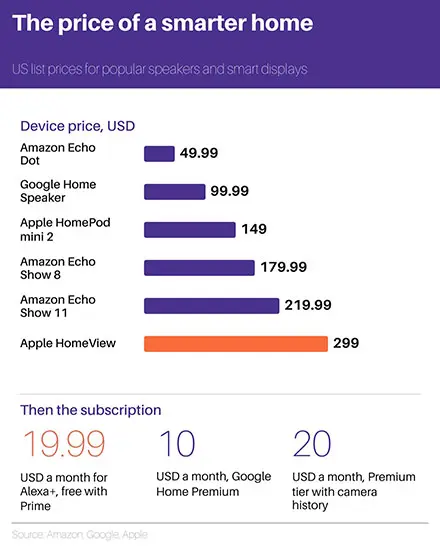
Even after the six-month free trial, three years on Google’s cheaper tier adds about USD 300 to a USD 99.99 speaker. Apple has announced no fee for Siri AI, but the trend is clear.The hardware is becoming the cheap part. The intelligence is what customers will increasingly rent.
Cheap devices, new dangers
The same week, AI company Anthropic published research that cast a shadow over the category.
Its Frontier Red Team warned on 12 October that small AI models may be only months away from being able to copy themselves onto ordinary internet-connected gadgets, such as smart ovens and off-brand Android TV boxes, and keep running there without a data centre or a human in charge.
To test the idea, researchers bought 15 off-brand Android TV boxes costing about USD 55 each, with 4 gigabytes of memory apiece, and split a single open AI model across them.
It worked, though at a crawl of under half a token per second.
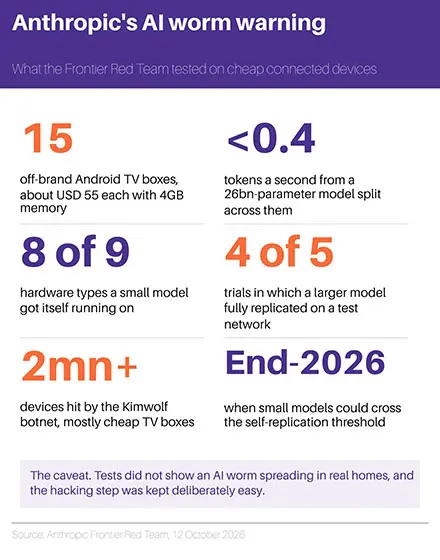 In other tests, a small model managed to get itself running on eight of nine types of hardware, and a larger model completed the full replication cycle across a test network in four out of five attempts.
The worry is scale. Anthropic pointed to Kimwolf, a botnet that infected more than two million devices, mostly cheap TV boxes. A self-replicating AI spread across a fleet that size would be hard to stop because there would be no central server to switch off. Unlike ordinary malware, it could also figure out unfamiliar devices unaided.The researchers were careful about limits. They did not show an AI worm spreading through real homes, they made the hacking step deliberately easy in their tests, and they described their timeline as rough.
Still, they expect small models to cross the threshold by the end of 2026. The underlying weakness is an old one. Many smart gadgets, especially the cheapest ones with little software support, are already easy to take over.
That puts affordability and safety on a collision course. The devices that open the connected home to more people are often the least protected. A home network is only as safe as its weakest plug, camera or TV box.
What it means for buyers and the industry
Buyers should choose brands that promise years of security updates, keep software current, put smart gadgets on a separate Wi-Fi network where possible, and avoid no-name boxes sold at rock-bottom prices. Add up the total cost, including subscriptions, before committing to an ecosystem.
For the industry, HomeView raises the stakes. Apple is betting that privacy, design and a smarter Siri will persuade iPhone owners to pay more for a screen that does much of what an Echo Show already does.
Amazon and Google are betting that cheap hardware plus paid AI will win the mass market. Haier, Samsung and Xiaomi are betting that the smart home will arrive through the fridge and the air conditioner rather than the speaker.
Whoever wins, the connected home is no longer just about switching on the lights with your voice. It is about whose AI lives in your kitchen, how much you pay it each month, and how well it is guarded against everything else on the network.
Image Courtesy: Apple