
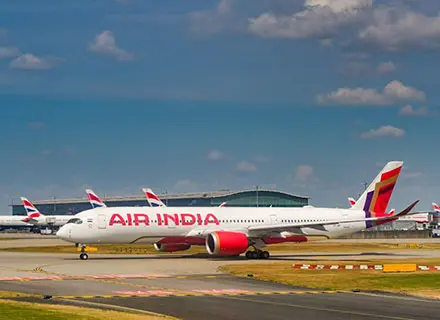

Air India is considering expanding its order for widebody aircraft as the Tata Group-owned carrier seeks to reclaim international market share, strengthen its long-haul network and establish itself as a major global airline.
Chief executive and managing director Tewolde Gebremariam said the airline was in discussions with aircraft manufacturers Boeing and Airbus, signalling a possible expansion of its already substantial fleet investment programme.
“We want to increase our order of wide bodies. Our network, our strategy demands more,” Gebremariam said on Tuesday at the Aviation India and South Asia 2026 conference in New Delhi.
He did not disclose how many additional aircraft the airline was considering.
The announcement comes as Air India attempts to accelerate its transformation under Gebremariam, who took charge in October after previously leading Ethiopian Airlines.
The executive said the carrier had significant growth opportunities and was determined to regain the international market share currently held by foreign airlines.
He stated that Air India has been underperforming, but that will change, and that the airline and its shareholders, Tata Group and Singapore Airlines, are adopting a long-term perspective on its development.
Air India’s ambitions extend beyond increasing the number of aircraft. The airline wants to carry more international passengers travelling between countries, using Indian airports as connecting hubs rather than relying primarily on passengers travelling to and from India.
This strategy requires a larger widebody fleet, which can operate long-distance routes and accommodate substantial connecting traffic.
Air India has already placed orders for hundreds of aircraft as part of its transformation programme. Its total order book has expanded to around 600 aircraft, including 80 widebody jets comprising Boeing 787 and 777X aircraft and Airbus A350s.
However, deliveries have been slower than planned. About 10 of the 80 widebody aircraft ordered have been delivered so far, while Air India currently operates a fleet of 61 widebody aircraft, including existing and leased planes.
Additional orders would therefore represent a further commitment to long-term capacity expansion rather than an immediate increase in available aircraft.
The airline is also examining how it deploys its existing fleet. Pakistan’s continued restriction on Indian airlines using its airspace, along with disruptions caused by geopolitical tensions in West Asia, has complicated international operations. Longer flying times increase fuel consumption, operating costs and aircraft utilisation pressures.
Gebremariam said Air India would rebalance its international network and hubs to improve efficiency. Delhi and Mumbai will remain central to its operations, but the airline is considering developing Bengaluru as a third major hub.
The proposed changes would involve shifting some international operations between existing hubs according to destination and airspace conditions.
Mumbai could see a greater concentration of flights to Europe and North America, while Delhi could strengthen services to Southeast Asia, East Asia and Australia, where routes are less affected by current airspace restrictions.
Bengaluru’s potential development as another hub would give the airline greater flexibility to distribute international traffic and attract passengers from southern India. It could also help Air India compete with established connecting hubs such as Dubai, Doha and Singapore.
India is the world’s third-largest aviation market, but foreign airlines continue to carry a substantial share of international passengers travelling to and from the country.
Millions of Indians travel overseas annually, while the country’s expanding economy, tourism industry and large overseas diaspora provide a growing market for international air services.
Air India wants to capture a larger portion of this traffic through direct services and international-to-international connections. The strategy would also help reduce the number of passengers who currently travel through overseas hubs to reach destinations that could potentially be served through Indian airports.
However, the expansion comes with considerable financial challenges. Air India has been struggling with losses despite substantial investment in aircraft, technology, cabin upgrades and operational improvements.
The airline reported a consolidated loss of more than Rs 22,000 crore for the financial year 2025-26, more than double its loss in the previous year, according to reports.
Gebremariam acknowledged that profitability remained a major priority and said he was more impatient than shareholders to see the airline turn profitable.
He is focusing on reducing operating expenses, improving efficiency and increasing revenues. The airline has established a cross-functional cost-saving team and is examining ways to improve operational performance, including closer integration with its low-cost subsidiary, Air India Express.
The carrier is also dealing with the financial and operational consequences of the June 2025 crash of flight AI171, as well as higher fuel costs and aircraft delivery delays.
Air India is understood to be seeking approximately USD 1.5 billion in additional funding from its shareholders, Tata Sons and Singapore Airlines, to support its operations and transformation.
Gebremariam’s experience at Ethiopian Airlines could prove important in executing the strategy. During his tenure, the African carrier expanded its international network, developed Addis Ababa into a major connecting hub and established itself as one of the continent’s leading airlines.
For Air India, the challenge will be replicating that growth while operating in a highly competitive market and managing substantial financial commitments.
The airline’s discussions with Boeing and Airbus are still at an exploratory stage, and no additional widebody order has been announced.
Nevertheless, the CEO’s comments indicate that Air India’s ambitions extend beyond completing its existing aircraft deliveries. The carrier is preparing for a longer-term expansion aimed at making India a more significant centre for international aviation.