
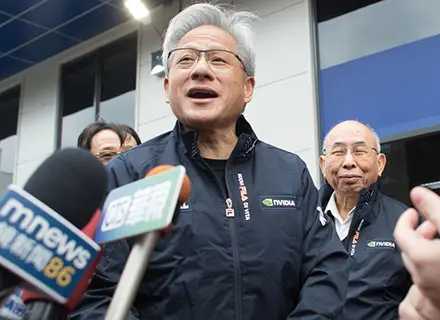

The chief executive of Nvidia, Jensen Huang, has spent the past few years becoming one of the most influential figures in the global technology industry. His company’s processors are at the forefront of the artificial intelligence revolution, his opinions hold significant influence in Washington, and his lobbying efforts play a crucial role in the ongoing discussion about America’s technological competition with China.
Now, the 63-year-old Taiwanese-born American businessman finds himself at the centre of an extraordinary controversy involving alleged Chinese espionage, a Singapore-based artificial intelligence infrastructure company, billions of dollars in Nvidia equipment, and a personal relationship that has drawn the attention of US intelligence agencies.
The allegations are particularly sensitive because they touch on an issue that has become central to American national security policy: preventing China from gaining access to advanced semiconductor technology that could strengthen its artificial intelligence and military capabilities.
Nvidia has announced an independent investigation into whether Huang was targeted by a foreign intelligence operation. The company, however, says it has no reason to believe that its trade secrets or US national security information were compromised.
So what exactly are the allegations, who is involved, and why has a controversy surrounding one executive become a matter of international significance?
The woman at the centre of the allegations
The controversy centres on Alice Huang, also known as Huang Le, a Chinese citizen and former executive of Singapore-based Megaspeed International, a company involved in providing computing infrastructure and cloud services.
She is not related to Jensen Huang.
According to a report published by The New York Times on October 29, US intelligence agencies had been investigating Alice Huang over suspicions that she was passing information to Beijing. American officials reportedly concluded that she was a Chinese intelligence asset.
The investigation initially focused on her business activities and the possibility that Nvidia’s advanced artificial intelligence processors were being diverted to China through intermediaries.
However, surveillance reportedly revealed that Alice Huang had developed a close personal relationship with Jensen Huang, bringing the Nvidia chief into the intelligence investigation.
The concern among US officials was that her access to the company’s chief executive could have provided opportunities to gather information about Nvidia’s business plans, its technology, and Huang’s efforts to influence American policy on semiconductor exports to China.
The reports have raised questions about whether the relationship could have been used to obtain commercially sensitive information or gain insights into the US administration’s thinking on artificial intelligence and China.
There is, however, an important distinction between being the alleged target of an intelligence operation and knowingly participating in one. The available reporting does not establish that Jensen Huang knowingly assisted Chinese intelligence or that he deliberately passed sensitive information to Beijing.
Nor has any publicly disclosed evidence established that Nvidia’s confidential technology or American national security information was compromised.
Who is Alice Huang, and what is Megaspeed?
Understanding the controversy requires looking at Megaspeed, the relatively obscure company whose business dealings first attracted American scrutiny.
Megaspeed International is registered in Singapore and operates in the business of artificial intelligence computing infrastructure. It has links to data centre operations in Southeast Asia, including Malaysia and Indonesia.
The company’s corporate history has attracted attention. It was formerly known as 7Road International before changing its name to Megaspeed in 2023. Its earlier ownership and corporate associations have raised questions about its links to Chinese technology businesses.
Alice Huang became a senior executive at the company during this period. She subsequently left her position, although the precise circumstances surrounding her departure have not been fully established in public reporting.
Megaspeed became significant because of the scale of its Nvidia-related purchases.
According to trade records cited by The New York Times, a Malaysian affiliate of Megaspeed purchased at least $4.8 billion worth of advanced AI equipment containing Nvidia technology between June 2024 and February 2026.
That is a substantial amount for a relatively little-known company operating in the data centre sector.
Megaspeed’s business model reportedly involved providing computing capacity to customers, including Chinese technology companies such as Alibaba. This meant that Chinese businesses could potentially access computing resources powered by Nvidia hardware located outside China.
That distinction is important. US export restrictions are designed to prevent certain advanced processors from being shipped directly to Chinese customers. However, companies can potentially access computing power through data centres located in other countries.
This has created a difficult enforcement challenge for Washington: restricting the physical export of a chip does not necessarily prevent Chinese businesses from accessing its computing capabilities through overseas infrastructure.
American officials have been examining whether Megaspeed and associated companies were involved in circumventing these restrictions.
The chip-smuggling investigation predates the spy allegations.
The scrutiny of Megaspeed did not begin with the allegations involving Jensen Huang.
US authorities had reportedly been examining the company’s operations since late 2024, amid suspicions that advanced Nvidia processors were being diverted to China.
One reported incident involved an American official visiting a data centre in Malaysia and finding Nvidia equipment still packed in boxes. This raised questions about whether the equipment had actually been installed at the facility or was intended to be moved elsewhere.
The US Commerce Department subsequently examined the company’s operations and its possible role in helping Chinese businesses obtain restricted AI hardware.
The investigation was later referred to the Department of Justice, according to reports.
The concerns also attracted attention from US lawmakers. In October 2025, Republican Senator Tom Cotton wrote to Commerce Secretary Howard Lutnick seeking scrutiny of Megaspeed’s ownership, affiliations, and potential violations of American export restrictions.
The allegations also featured in a report by short-selling firm Culper Research, which questioned the extent of Chinese demand driving Nvidia’s sales through Southeast Asian intermediaries.
Such claims need to be treated cautiously. Short sellers have a financial interest in a decline in the share price of companies they target. Their allegations are not proof of wrongdoing and require independent verification.
Nevertheless, the scale of the transactions and the possibility of restricted chips reaching Chinese customers made Megaspeed a company of interest to American authorities well before the latest controversy.
How did Jensen Huang respond?
Huang initially defended Nvidia’s relationship with Megaspeed following the publication of the espionage allegations.
Speaking to Bloomberg on October 29, he described the company’s dealings with Megaspeed as normal and said Nvidia had checked whether its processors were being illegally diverted to China.
He maintained that Nvidia had examined the company’s deployments and accounted for its GPUs.
The company’s position was that Megaspeed was a legitimate regional customer and that its interactions with Alice Huang were not unusual.
An Nvidia spokesperson said meetings with customers were part of a chief executive’s responsibilities and that Huang spoke with thousands of customer executives every year.
The company also stressed that its regional cloud customers received ordinary business information, rather than sensitive trade secrets or information relevant to American national security.
Nvidia further said that the allegations of chip smuggling involving Megaspeed had been investigated and debunked the previous year.
The company’s defence is significant because it seeks to separate two issues: the legitimacy of its commercial relationship with a regional customer and the alleged intelligence activities of an individual associated with that customer.
However, the independent board investigation announced on November 8 means that Nvidia will now have to examine whether its existing safeguards were sufficient.
The personal relationship adds another dimension.
The controversy took a more personal turn following revelations about Huang’s relationship with Alice Huang.
Reports by The New York Times and other publications described the relationship as close, with photographs and video footage from technology industry gatherings in Taipei showing the two together.
The relationship has now become a significant part of the controversy because of the intelligence allegations surrounding Alice Huang.
On November 8, Jensen Huang acknowledged in a message to Nvidia employees that he had been unfaithful to his wife.
He apologised to his family and colleagues, accepted responsibility for his actions, and said he understood the criticism that would follow.
His message did not identify Alice Huang by name. Nor did it provide a detailed account of the relationship or address the specific allegations about intelligence gathering.
However, the admission brought a personal dimension into what had until then largely been a debate about corporate security, export controls, and national security.
It also created a distinction between two questions that are now being examined publicly: whether Huang’s personal conduct exposed him to an intelligence operation and whether that operation resulted in any actual compromise of Nvidia’s business or sensitive information.
The first is a matter of personal conduct and corporate governance. The second has potentially much wider consequences for the company and the US government.
Why the US-China rivalry makes this particularly sensitive
The allegations cannot be separated from Washington’s increasingly aggressive efforts to restrict China’s access to advanced semiconductor technology.
Nvidia is at the heart of this conflict.
Its graphics processing units, or GPUs, are among the most important processors used to train and operate sophisticated artificial intelligence systems. They are also used in high-performance computing, scientific research, and applications with potential military uses.
Washington has imposed restrictions on the export of advanced AI processors to China, arguing that access to such technology could strengthen China’s military and intelligence capabilities.
The restrictions have changed several times as the US government has attempted to balance national security concerns with the commercial interests of American semiconductor companies.
Huang has been one of the most prominent critics of an overly restrictive approach.
He has argued that allowing American companies to sell chips to China, even less advanced versions, is important for maintaining US technological leadership and preventing Chinese businesses from becoming entirely dependent on domestic alternatives.
He has also warned that excluding Nvidia from the Chinese market could accelerate the development of China’s own semiconductor industry.
His lobbying has attracted considerable attention in Washington, particularly under President Donald Trump.
The administration has permitted certain Nvidia chip sales to China, including the H200 under specified conditions, although Chinese authorities have also placed restrictions on purchases.
This situation makes the espionage allegations especially awkward for the company.
If an intelligence operation had successfully obtained information about Nvidia’s export strategy, its discussions with American policymakers, or its commercial plans, it could potentially have provided Beijing with valuable insights at a sensitive moment in the technology rivalry.
There is no publicly established evidence that this happened. But the possibility is serious enough to warrant an independent corporate investigation.
Singapore pushes back against parts of the reporting
The allegations have also created diplomatic sensitivities for Singapore, where Megaspeed is registered.
The Wall Street Journal reported on October 30 that Singaporean officials had concerns about Alice Huang’s alleged links to Chinese intelligence and her relationship with Jensen Huang.
Singapore’s Ministry of Home Affairs issued a clarification on October 31, explicitly rejecting those claims.
The ministry said neither the Singapore government nor its officials had made the statements attributed to them by the newspaper. It also said there had been no Singapore government investigations into Alice Huang’s alleged ties to China.
However, Singapore confirmed that investigations into Megaspeed were ongoing.
Its police said the country did not enforce unilateral export controls imposed by foreign governments but would act against businesses and individuals involved in fraudulent or dishonest practices.
The distinction is important. Singapore was not endorsing the American intelligence allegations, but neither was it saying that Megaspeed’s business activities were beyond scrutiny.
China, meanwhile, rejected the espionage claims.
On October 30, Chinese foreign ministry spokesperson Guo Jiakun described the allegations as groundless speculation intended to smear China.
On November 9, Beijing reiterated its rejection, calling the allegations baseless.
The competing statements underline the difficulty of establishing what happened when intelligence assessments are based partly on classified information and the parties involved offer conflicting accounts.
Congress enters the picture
The controversy has also attracted the attention of American lawmakers.
On November 4, three senior Republican lawmakers wrote to Huang seeking a closed-door briefing on the allegations and Nvidia’s safeguards against foreign intelligence operations.
The lawmakers included Brian Mast, chairman of the House Foreign Affairs Committee; John Moolenaar, who heads the House Select Committee on China; and Eric Crawford, chairman of the House Intelligence Committee.
They requested that Huang brief them on November 18.
Their concern was not limited to his personal relationship with the former Megaspeed executive. They wanted to understand whether the alleged operation exposed weaknesses in the security protocols used by one of America’s most strategically important technology companies.
Nvidia said Huang regularly meets business leaders and customers around the world. It also maintained that regional cloud customers do not receive sensitive trade secrets or information relevant to US national security.
The congressional interest nevertheless raises the possibility of further scrutiny of Nvidia’s customer-screening procedures, export compliance, and dealings with overseas data centre operators.
Nvidia launches independent investigation
On November 8, Nvidia’s board announced that it was initiating an independent investigation into reports that Huang had been targeted by a foreign intelligence effort.
A committee of independent directors, assisted by external legal counsel, will oversee the inquiry.
The board said national and economic security were paramount to the company’s interests and those of its shareholders.
Importantly, it also said it had no reason to believe that either American national security or Nvidia’s trade secrets had been compromised.
Huang has agreed to cooperate fully with the investigation.
The board expressed confidence in him and the company’s leadership team, while saying it would provide further updates when appropriate.
The company has also indicated that Huang will continue as chief executive during the investigation.
The findings will be crucial in determining whether the controversy remains primarily a question of personal conduct or develops into a more serious corporate governance and national security issue.
What does this mean for Nvidia and investors?
The timing could hardly be more uncomfortable for Nvidia.
The company has become one of the world’s most valuable businesses, riding the extraordinary demand for processors used in artificial intelligence data centres.
Its fortunes are closely tied to expectations about how much technology companies will continue spending on AI infrastructure.
Huang himself has become almost inseparable from Nvidia’s investment narrative. He has led the company for more than three decades and is widely credited with positioning it at the centre of the AI revolution.
Any uncertainty surrounding his leadership could therefore affect investor confidence.
Nvidia shares came under pressure following the latest developments, with reports of a fall of around 5% in pre-market trading on November 9.
The immediate market reaction reflects several concerns: the possibility of further investigations, reputational damage, potential congressional scrutiny, and questions about whether Huang’s position could eventually be affected.
However, there is a difference between reputational risk and an established financial or operational loss.
There is currently no publicly established evidence that Nvidia’s technology has been compromised or that the company has suffered a loss of intellectual property as a result of the alleged operation.
The board’s investigation will need to establish whether any sensitive information was accessed, what safeguards were in place, and whether the company’s dealings with Megaspeed complied with applicable laws and export-control requirements.
For investors, the more immediate concern may be uncertainty surrounding the leadership of a company whose chief executive remains central to its strategy, public profile, and relationships with governments.
The bigger question: Can technology companies protect themselves from espionage?
The controversy raises a question that extends well beyond Nvidia.
As the global AI industry expands, technology companies are increasingly operating in an environment where commercial relationships overlap with national security interests.
Their executives meet government officials, overseas customers, data centre operators, investors, and technology partners. These interactions are essential to doing business, but they can also create opportunities for intelligence gathering.
The challenge becomes more complicated when a company’s customers operate in countries that are strategic competitors of the government under whose laws the company operates.
Nvidia’s experience illustrates this tension.
The company wants access to international markets, including China, because the commercial opportunities are enormous. Washington, meanwhile, wants to prevent the country’s most advanced processors from strengthening a geopolitical rival.
Overseas data centres add another layer of complexity. Even when chips are physically located outside China, their computing power may be accessible to Chinese companies through cloud services.
This makes it difficult to monitor not just where a chip is shipped, but who ultimately uses the computing capacity it provides.
The alleged intelligence operation involving Alice Huang adds a human dimension to these vulnerabilities. It highlights how business relationships and personal access can become matters of national security when the individuals involved operate around strategically important technology.
But the investigation must establish whether this was actually the case here, rather than treating intelligence allegations as proof of a breach.
For now, the central questions remain unanswered. Did Alice Huang deliberately cultivate a relationship with Jensen Huang as part of an intelligence operation? What information, if any, did she obtain? Was Nvidia’s customer-screening process adequate? And did any information reach Chinese authorities that could have affected American technology or export policy?
The answers will determine whether this episode becomes a personal scandal involving one of the world’s most powerful technology executives or a far more consequential case exposing weaknesses in America’s efforts to protect its semiconductor industry.
For Nvidia, the stakes are unusually high. Its processors have become indispensable to the AI economy, and its chief executive is one of the most influential voices in the global technology debate.
The company may be able to weather the immediate reputational damage. But the investigation will test something more fundamental: whether a business built on selling the world’s most strategically important technology can adequately protect itself from the geopolitical risks that come with that position.