
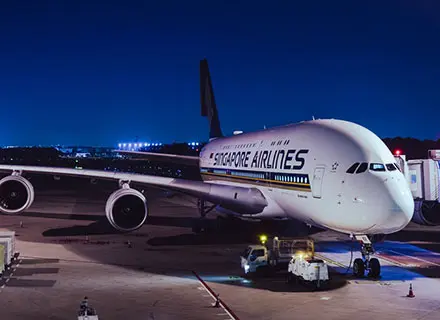

Singapore Airlines has launched the largest cabin refurbishment programme in its history, enhancing its premium travel services and joining the ranks of global carriers vying to attract affluent passengers with more luxurious in-flight experiences, despite rising fuel costs amid the ongoing Iran war.
The airline will be spending more than SUSD 2 billion (USD 1.6 billion) in upgrading seats and cabins across all four travel classes.
The new interiors are expected to enter service from the second half of 2027, bringing significant changes to its first-class, business-class, premium economy and economy offerings.
Airlines across the world, including Air France, British Airways and United Airlines, have already poured billions of dollars into improving their premium cabins.
With rising fuel costs squeezing operating margins and higher fares discouraging some price-conscious economy travellers, premium passengers have become an increasingly important source of revenue for the aviation industry.
Singapore Airlines, long regarded as a benchmark for premium international travel, is seeking to strengthen its competitive position through greater comfort, privacy and flexibility.
The centrepiece of Singapore Airlines’ biggest cabin refurbishment programme is the redesigned first-class cabin, where centre seats can be converted into what the carrier describes as the largest double bed in commercial aviation.
The airline has also introduced a distinctive curved suite design that uses space extending towards the aisles to provide passengers with more personal room.
The new configuration is intended to offer a more private and spacious environment for travellers on long-haul flights.
Business class will receive sliding privacy doors for the first time on Singapore Airlines, alongside fully flat beds.
The changes are designed to improve passenger comfort while providing greater separation from the surrounding cabin.
The overhaul also covers premium economy and economy, although the airline has placed much of its investment emphasis on the higher-end cabins.
“We look closely at how our customers work, dine, relax, and rest while travelling, and what they value most,” Singapore Airlines CEO Goh Choon Phong said at the launch event.
He added that customer feedback highlighted the importance of greater comfort and privacy, intuitive functionality and spaces that could be adapted to passengers’ needs, whether they wanted to work, rest or connect with family and friends.
The Singapore Airlines cabin upgrade programme will cover 72 aircraft, including Airbus A350-900s undergoing refurbishment and Boeing 777-9 aircraft that remain on order.
Together, these aircraft are expected to account for the majority of the airline’s long-haul fleet.
The new cabins were initially designed for the Boeing 777-9, which Singapore Airlines expects to become its next long-haul flagship.
The aircraft will eventually succeed the Airbus A380 in this role, although the A380 currently offers first-class passengers double beds that are smaller than those planned for the new suites.
However, repeated delays to the Boeing 777-9 programme have forced Singapore Airlines to extend its cabin investment to the A350 fleet.
Chief Commercial Officer Lee Lik Hsin told Reuters that the SUSD 2 billion-plus expenditure included the SUSD 1.1 billion A350 refurbishment programme announced in 2024.
The investment will be funded through the airline’s strong cash position, which stood at SUSD 9.1 billion at the end of June.
Lee said most of the expenditure would go towards premium cabins because first-class and business-class seats cost considerably more per unit than economy seats.
He also indicated that Singapore Airlines had not established a spending ceiling for its cabin investments, adding that the carrier would continue to invest when appropriate to maintain its market position.
“Our competitive advantage doesn’t derive from aircraft cabin product alone,” Lee said, highlighting the importance of cabin design, service quality, operational excellence and employees.
The investment also highlights the difficulties airlines face when introducing new aircraft interiors amid persistent manufacturing and certification delays.
Boeing initially expected to deliver the 777-9 around 2020. However, the programme has faced repeated delays due to certification setbacks, engine-related problems, the pandemic, and increased scrutiny from the US Federal Aviation Administration (FAA).
Deliveries are now expected in 2027, with Lufthansa anticipated to become the aircraft’s launch operator.
The delays have affected Singapore Airlines’ plans to introduce its new cabins across its long-haul fleet.
Lee said the seats had received certification for the 777-9, but the aircraft itself had not yet secured certification.
The seats also remained uncertified for installation on the Airbus A350, delaying their introduction on that aircraft by approximately six months.
Seat certification has become a wider challenge for the aviation industry as airlines increasingly demand customised cabin products with sophisticated features. Regulators must ensure that these designs meet stringent crash-safety requirements.
Boeing CEO Kelly Ortberg recently told investors that seat certification challenges had also affected deliveries of the manufacturer’s 787 Dreamliner aircraft.
Cybersecurity incident adds to Singapore Airlines’ challenges
The cabin investment announcement comes amid a separate cybersecurity concern involving Singapore Airlines’ reservation technology provider, Amadeus.
The airline said on Tuesday that approximately 46,000 booking records may have been affected by a cybersecurity incident involving Amadeus.
The exposed information included customers’ names, booking reference numbers, travel itineraries and booking classes.
For around 620 booking records, email addresses, telephone numbers, travel document details and KrisFlyer membership numbers may also have been accessed.
Singapore Airlines said Amadeus had confirmed that bank account and credit card information had not been compromised and that customer bookings had not been modified.
The airline also stressed that its own IT systems had not been breached.
As a precaution, Singapore Airlines is contacting affected customers with upcoming travel plans and changing their booking reference numbers.
The incident has affected several other airlines, including Cathay Pacific, Japan Airlines, South Korea’s Asiana Airlines and Malaysia Airlines. Cathay Pacific and Japan Airlines reported that the breach involved approximately 53,000 bookings and 92,000 customers, respectively.
Amadeus said it had identified a vulnerability affecting a travel booking display environment but did not disclose the total number of customers whose information may have been exposed.