
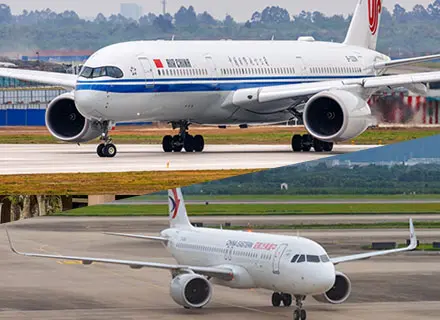

China’s three biggest state-owned airlines have reported first-half losses for the seventh consecutive year, hammered by rising jet fuel prices due to the Iran war.
Air China, China Eastern Airlines, and China Southern Airlines have posted combined first-half net losses of about 8.2 billion yuan (USD 1.22 billion), having warned in July about the figure potentially reaching nearly 9 billion yuan.
So severe were the losses that they ended up sharply reversing the airlines’ combined first-quarter profit of 4.82 billion yuan, which was boosted by strong Lunar New Year demand.
Flag carrier Air China reported a net loss of 2.3 billion yuan, widening from a 1.81 billion yuan loss a year earlier. China Eastern posted a loss of 2.2 billion yuan, versus a 1.43 billion yuan loss in the same period of 2025. China Southern reported a loss of 3.7 billion yuan, compared with a loss of 1.53 billion yuan a year earlier.
In a desperate bid to overturn the poor financial run, Air China has decided to increase flights to Europe and North America in the second half of the year.
As per the airline’s board director, Xiao Feng, international routes, during the summer travel season, performed better for the flagship carrier than their domestic counterparts. However, the overall results did not meet expectations.
The weak results further complicate the post-pandemic recovery efforts of China’s aviation sector. For China Eastern, the trio confronted a profit environment “severely undermined” by disrupted international routes and persistently elevated jet fuel prices linked to the Middle East conflict.
Fuel costs at each of the carriers rose between 35% and 38% in the first half of 2026.
Unlike their Asian and European rivals, Chinese airlines hedge little of their fuel purchases, leaving them more exposed to oil price swings.
China Southern said in its filing there was currently “no effective means available” to manage its exposure to fluctuations in jet fuel prices.
Revenue growth was strong at the carriers, with Air China up 10.5%, China Eastern up 11.1%, and China Southern up 9.7%, which somehow compensated for these businesses.
On the domestic front, weaker economic conditions and competition from high-speed rail and driving holidays have hindered the airlines’ ability to implement fare hikes.
Jet fuel prices have dropped from their peak in the second quarter, but they are still over 50% higher than they were before the Iran war.
The third quarter, considered to be the most profitable for Chinese carriers, has come with an unusually strong typhoon season disrupting domestic routes during the peak summer travel period.
As per the meteorological data, 21 typhoons have been formed in the northwestern Pacific Ocean and the South China Sea so far in 2026, nine more than the historical average for the same period.
The carriers have underperformed poorly at the stock market front as well, with Shanghai-listed shares of all three carriers falling at least 36% so far in 2026, with weaker domestic travel demand continuing to pressure the companies’ profit outlooks.
The companies haven’t announced dividends either.
The trio, however, has expanded their fleets of domestically made COMAC jets.
China Eastern grew its fleet of the narrow-body planes to 17 after taking three deliveries in the first half. Air China and China Southern, on the other hand, each operated 11 C919s, having taken two and three deliveries, respectively, in the period.
China Eastern said it expected to receive 13 fewer C919 deliveries than previously forecast between 2026 and 2028.
Air China maintained its earlier forecast, and China Southern did not disclose a forecast in its interim report.