
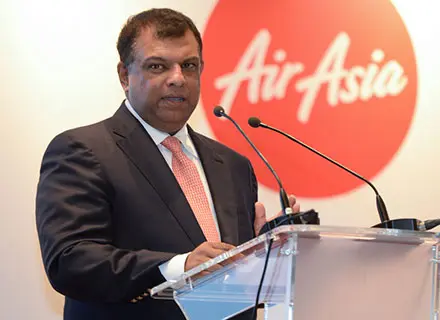

Amid the reports of the Malaysian government engaging Malaysia Airlines and Batik Air to discuss the possibility of whether the two carriers can absorb AirAsia’s domestic market share, the low-cost airlines’ CEO Tony Fernandes has said that the business had “strong liquidity” to weather soaring jet fuel costs, as he sought to ease investor concerns amid AirAsia’s shares touching near four-year lows.
Speaking at a media briefing last week, Fernandes said AirAsia was adept at managing cash and expected to raise more than USD 1 billion, mostly to refinance existing debt, by December or January.
“COVID was far, far worse than what we are dealing with now. We couldn’t fly then, but we can fly now, and our demand is robust,” he said.
AirAsia, like its industry peers, has suffered from a spike in jet fuel prices stemming from the Iran war.
The same phenomenon has contributed to the collapse of debt-laden US carrier Spirit Airlines in May and a Chapter 11 bankruptcy filing by Latvia’s airBaltic this month.
AirAsia’s current liabilities stood at 18.4 billion ringgit (USD 4.52 billion) as of June 30, against cash and bank balances of 954 million ringgit.
As per Fernandes, the second quarter marked the toughest period for the airline that controls about 60% of Malaysia’s domestic market.
The low-cost carrier’s CEO also forecast improving conditions as AirAsia adjusts fares to reflect higher fuel costs.
AirAsia’s fuel costs have surged 66% in the second quarter from the prior quarter to an average of USD 183 a barrel, and it has no hedging in place.
Since September 16, AirAsia’s shares have fallen about 24%, hitting the lowest level since December 2022. The stock has lost more than 70% of its value so far in 2026.
As per Reuters, Malaysia’s finance ministry has hired Alton Aviation Consultancy to assess AirAsia’s funding needs as it weighs what support, if any, it could extend to the airline given its importance to the local economy.
“We’ve never received any government support in the past 25 years. And as of today, we haven’t got any, and that’s it,” Fernandes said, refuting the media reports.
He said there had been no discussions with the government, and “we do not need rescue, bailouts, or whatever.”
For Fernandes, no one can replace AirAsia’s 100 planes in the country overnight.
“You have to have our cost structure, our brand, our market, and our network,” the CEO noted.
AirAsia will be advancing discussions with financial institutions, targeting up to USD 1 billion from international debt markets plus 700 million ringgit in local credit facilities, primarily to restructure its debt.
“The refinancing is…not raising fresh capital. It’s about bringing down costs,” Fernandes added.
AirAsia also is in talks with a major global bank on a bond transaction.
Furthermore, the loss-making low-cost carrier has received an offer from a Middle Eastern investor for USD 1 billion in funding with a term sheet signed pending due diligence.
The group’s load factor, which measures an airline’s ability to fill available seats, stood at 80% in Q3, and Fernandes predicted strong bookings for the fourth quarter, with operations in Indonesia, the Philippines, and Thailand emerging as positive developments.
The carrier has been restructuring aggressively, cutting underperforming routes, returning 25 older aircraft to lessors, and renegotiating contracts with vendors to reduce costs.
Last but not least, AirAsia is also accelerating its A321LR and XLR strategy to phase out fuel-inefficient A330s, and Fernandes said the airline expects “a pretty exciting announcement” with Airbus within the next month regarding its growth and strategy.