
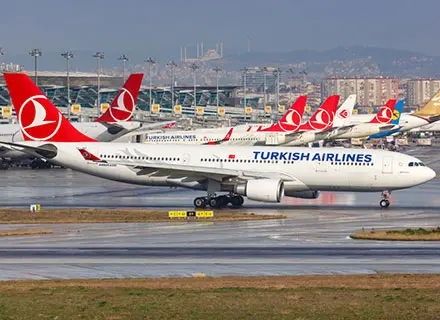

Turkish Airlines has finalised an order for up to 150 Boeing 737 MAX aircraft, ending months of uncertainty over a deal that had been threatened by a dispute over engine maintenance terms and strengthening the carrier’s plans for long-term fleet expansion.
The agreement covers 100 firm Boeing 737-8 aircraft and options for a further 50 737 MAX jets. Turkish Airlines will also have substitution rights for the larger 737-10, giving it flexibility to adjust capacity as demand develops. Boeing described the agreement as the airline’s largest single-aisle order from the US manufacturer.
Deliveries are scheduled between 2033 and 2037, according to Turkish Airlines’ disclosure to Turkey’s Public Disclosure Platform. The order is part of the carrier’s strategic plan to expand its fleet and network while increasing the proportion of new-generation aircraft. Turkish Airlines has previously said its wider fleet strategy targets an average annual growth rate of about 6% and aims for a fully new-generation fleet by 2035.
The finalisation is significant because the narrow-body portion of the Boeing deal had been held up for almost a year. Turkish Airlines had completed negotiations with Boeing but made the aircraft purchase conditional on reaching an agreement with CFM International, the engine manufacturer whose LEAP-1B engines power the 737 MAX.
The dispute centred on the commercial terms of long-term engine maintenance, including pricing and the allocation of risks associated with future repairs.
Turkish Airlines had also sought to establish a maintenance facility for 737 MAX engines that would give it earlier access to advanced repair technologies.
Reuters reported earlier this month that the disagreement had put the Boeing order at risk and raised the possibility that the airline could switch the narrow-body purchase to Airbus.
The resolution removes a major obstacle for Boeing as it seeks to rebuild momentum in its commercial aircraft business. The 737 MAX remains central to Boeing’s single-aisle product line, but the manufacturer continues to face challenges in increasing production.
Boeing Chief Executive Kelly Ortberg said last week that efforts to stabilise 737 MAX production at 47 aircraft a month were taking longer than expected. The company has been dealing with supply-chain constraints, including a slower supply of wings, while it works to certify a new production line in Everett, Washington. Boeing is targeting the production of 52 737s a month next year.
For Turkish Airlines, meanwhile, the order provides additional capacity for its extensive network centred on Istanbul. The 737 MAX is designed for short- and medium-haul operations and will allow the airline to add capacity on routes where smaller single-aisle aircraft are appropriate while replacing older aircraft over time.
Boeing says the 737 MAX family can deliver fuel savings of about 20% and a similar reduction in emissions compared with the aircraft it replaces. For an airline operating a large and geographically diverse network, those efficiency gains can be significant as fuel remains one of the industry’s major operating expenses.
The order also completes the narrow-body element of a much larger Boeing purchasing plan announced in 2025. Turkish Airlines had agreed to buy 50 Boeing 787 Dreamliners and take options on another 25 aircraft while planning the 150-aircraft MAX purchase. The combined commitment could therefore reach 225 aircraft, although the Dreamliner and MAX components have been subject to separate engine and commercial negotiations.
The carrier’s Boeing relationship is already substantial. Turkish Airlines operates a mixed fleet of Boeing and Airbus aircraft and has been pursuing an aggressive expansion programme as Istanbul strengthens its position as an international connecting hub.
The 737 MAX order also gives Boeing an important customer in a strategically located aviation market. Turkish Airlines connects Europe, Asia, Africa, and the Middle East through Istanbul, making its fleet decisions significant beyond the country’s domestic market.
The agreement comes as airlines globally continue to place large aircraft orders despite supply-chain constraints and lengthy delivery schedules. Limited production capacity at the two major commercial aircraft manufacturers has made long-term fleet planning increasingly important, with carriers securing delivery positions years ahead.
Turkish Airlines has indicated that its fleet expansion will continue beyond the Boeing order. Reuters reported earlier this month that the carrier was also evaluating regional aircraft, including Embraer’s E2 family and Airbus’ A220, while considering larger wide-body aircraft such as the Boeing 777X and Airbus A350-1000 for future long-haul requirements.
The finalisation of the 737 MAX agreement, therefore, represents more than just the conclusion of a delayed purchase. It gives Turkish Airlines greater visibility over its future single-aisle fleet while securing Boeing a major long-term customer order.
With deliveries stretching into the 2030s, the deal forms part of the carrier’s broader strategy to expand its network, modernise its fleet and reinforce Istanbul’s role as a global aviation hub.