
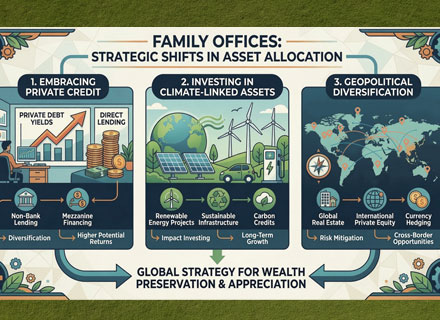

The global wealth management industry is entering one of its most significant transformations in decades. Across major financial centres from New York and London to Singapore, Dubai, and Zurich, family offices and ultra-high-net-worth investors are quietly reshaping the way they allocate capital. Traditional portfolios built around public equities, government bonds, and conventional banking products are no longer viewed as sufficient safeguards for preserving intergenerational wealth in an era marked by geopolitical instability, inflationary pressure, technological disruption, and climate uncertainty.
Instead, wealthy families are increasingly moving capital into private credit, infrastructure, climate-linked investments, strategic commodities, farmland, energy assets, and alternative jurisdictions.
This transition is happening at a time when the global economy faces overlapping pressures. Wars in Eastern Europe and the Middle East, supply chain fragmentation, rising protectionism, debt concerns, inflation volatility, and political polarisation have challenged assumptions that shaped investment strategies for more than two decades. For many wealthy investors, the old framework of diversification through public markets alone no longer appears adequate.
As a result, the modern family office is evolving from a relatively passive wealth management structure into a highly strategic investment institution that increasingly resembles a sovereign wealth fund in both scale and sophistication.
The Declining Appeal of Traditional Portfolios
For decades, wealthy families relied heavily on a classic portfolio mix of equities, bonds, real estate, and cash deposits managed through large private banks. That model delivered stability during periods of globalisation, low inflation, and predictable monetary policy.
Today, many of those assumptions are under strain.
Bond markets, historically viewed as safe havens, have become more volatile as central banks battle inflation and governments carry record debt burdens. Equities remain vulnerable to geopolitical shocks, regulatory intervention, and sudden swings driven by artificial intelligence optimism or macroeconomic fears.
At the same time, inflation has fundamentally altered how wealthy investors think about preserving purchasing power. Families with multigenerational wealth are increasingly focused on maintaining real value rather than chasing aggressive growth.
This shift has become especially visible among family offices, which collectively manage trillions of dollars globally. Unlike institutional investors constrained by quarterly performance targets, family offices often prioritise long-term strategic positioning over short-term returns.
That flexibility is allowing them to move more aggressively into alternative assets.
Private Credit Emerges as a Preferred Asset Class
One of the clearest winners from this shift has been private credit.
As banks face tighter regulations and reduced risk appetite following years of financial reform, private lenders have stepped into the financing gap. Wealthy investors are increasingly allocating capital to direct lending funds, specialty finance platforms, and private debt vehicles that offer higher yields and stronger downside protection than many traditional fixed-income products.
Private credit has become particularly attractive because it offers predictable cash flow during uncertain market conditions. Many family offices view direct lending as a way to generate income while maintaining greater control over risk exposure.
The appeal has grown further as borrowers increasingly seek non-bank financing solutions. Middle-market companies, infrastructure projects, renewable energy developers, and real estate operators are all turning to private lenders for capital.
For wealthy investors, the sector provides not only returns but also influence. Unlike public markets, private credit transactions often allow investors to negotiate terms directly, obtain collateral protection, and maintain visibility into underlying assets.
This level of control is becoming increasingly valuable in a world where macroeconomic shocks can rapidly destabilise public markets.
Climate Investments Are Becoming Strategic, Not Symbolic
Sustainable investing has also evolved significantly among wealthy families.
A decade ago, environmental, social, and governance investing was often viewed as a branding exercise or ethical overlay. Today, many family offices see climate-linked investments as strategic necessities tied to future economic competitiveness.
This change is driven partly by regulation and partly by economics.
Governments worldwide are directing enormous capital toward energy transition projects, clean infrastructure, battery supply chains, carbon markets, and climate resilience technologies. Wealthy investors increasingly believe these sectors will define the next phase of global industrial growth.
Importantly, many family offices are not merely investing through passive ESG funds. They are taking direct stakes in infrastructure assets, private climate technology firms, and long-duration sustainability projects.
This approach reflects a broader preference for tangible investments with strategic value.
Real assets linked to energy security, food production, and critical infrastructure are now viewed as essential geopolitical hedges as much as financial investments.
Geopolitical Diversification Is Reshaping Capital Allocation
Geopolitical risk has become one of the defining themes influencing global wealth management.
The fragmentation of globalisation is forcing wealthy families to reconsider where they store capital, hold citizenship, establish businesses, and invest assets.
Many investors are increasingly diversifying not only across asset classes but also across political systems and geographic jurisdictions.
This trend has accelerated following sanctions disputes, trade wars, banking crises, and rising tensions between major powers, including the United States and China.
For wealthy families, concentration risk now extends beyond markets into governments and regulatory regimes.
As a result, family offices are increasingly expanding operations into financial hubs perceived as politically stable and globally connected, including Singapore, Dubai, Switzerland, and parts of the Gulf region.
Cross-border diversification now includes multiple dimensions:
- Multi-currency exposure
- International property ownership
- Alternative residency programmes
- Overseas banking relationships
- Distributed business operations
- Strategic commodity investments
The rise of geopolitical hedging reflects growing concern that financial systems themselves are becoming politicised.
Sanctions, capital controls, taxation changes, and trade restrictions are no longer viewed as isolated risks. They are increasingly incorporated into long-term wealth planning.
Real Assets Are Regaining Strategic Importance
Another major shift involves the growing appeal of hard assets.
Farmland, logistics infrastructure, energy assets, ports, data centres, and industrial real estate are increasingly viewed as defensive investments capable of preserving value during periods of inflation and geopolitical stress.
Data centres, in particular, have become highly attractive due to the rapid expansion of artificial intelligence infrastructure and cloud computing demand.
Similarly, agricultural assets are gaining attention amid concerns about food security, water scarcity, and supply chain disruption.
Many wealthy investors now prioritise assets that generate both stable income and strategic relevance.
This represents a departure from purely financialised investment models toward ownership of critical infrastructure tied to long-term economic necessity.
The trend is particularly strong among Middle Eastern and Asian family offices, many of which are aggressively acquiring stakes in logistics corridors, renewable energy projects, healthcare infrastructure, and technology ecosystems.
Why Private Banks Are Reinventing Their Wealth Businesses
The transformation in investor behaviour is forcing major global banks to adapt rapidly.
Institutions such as UBS, JPMorgan Chase, and HSBC are increasingly repositioning their private banking divisions around alternative investments, family office services, geopolitical advisory capabilities, and customised wealth planning.
Traditional portfolio management alone is no longer sufficient for many ultra-wealthy clients.
Instead, private banks are being asked to provide highly specialised services, including:
- Access to private markets
- Co-investment opportunities
- Cross-border tax planning
- Succession structuring
- Political risk analysis
- Climate investment advisory
- Digital asset infrastructure
- Family governance consulting
Banks are also investing heavily in technology and artificial intelligence to improve personalisation and operational efficiency within wealth management.
At the same time, competition for wealthy clients is intensifying.
Independent family offices are becoming more sophisticated and increasingly capable of managing investments internally. This pressures banks to justify their fees through exclusive deal access and strategic expertise rather than conventional advisory alone.
The acquisition of Credit Suisse by UBS highlighted the growing importance of scale in global wealth management. Larger institutions are seeking to consolidate client assets while expanding their alternative investment capabilities.
Meanwhile, banks in Asia and the Middle East are aggressively competing to attract internationally mobile wealth.
The Rise of the Global Family Office
Perhaps the most important structural change is the rise of the institutionalised family office.
Historically, family offices primarily handled administrative and estate matters for wealthy dynasties. Today, many operate as highly sophisticated investment organisations with direct exposure to private equity, venture capital, infrastructure, and geopolitically strategic sectors.
Some family offices now rival major institutional investors in scale and influence.
This evolution reflects both opportunity and necessity. Wealthy families increasingly believe they must take greater control over investment strategy rather than rely solely on external managers.
The modern family office is often deeply global, technologically advanced, and politically aware.
It may include specialists in cybersecurity, artificial intelligence, climate science, tax law, and geopolitical analysis alongside traditional investment professionals.
Importantly, younger generations are also influencing priorities.
Millennial and Gen Z heirs often place greater emphasis on sustainability, technology, social impact, and long-term resilience compared to previous generations focused primarily on capital accumulation.
This generational transition is accelerating changes in portfolio construction and investment philosophy.
Technology, AI, and the New Wealth Infrastructure
Artificial intelligence is also reshaping wealth management itself.
Private banks and family offices are increasingly using AI tools for portfolio analysis, risk modeling, operational automation, and personalised financial planning.
However, AI is also influencing investment strategy more broadly.
The enormous infrastructure requirements tied to AI expansion are creating investment opportunities in semiconductors, energy grids, cooling systems, fiber optics, cloud infrastructure, and data centres.
Wealthy investors increasingly see AI not only as a technological trend but also as a long-term industrial transformation requiring massive capital deployment.
This explains why family offices are increasingly allocating money toward infrastructure linked to digitalisation and computing power.
At the same time, AI-driven market volatility and rapid technological disruption reinforce concerns about concentration risk in public equities.
For many wealthy families, owning underlying infrastructure appears safer than betting solely on technology stocks.
A New Era of Defensive Capitalism
Ultimately, the shift underway among wealthy families reflects the emergence of a more defensive form of capitalism.
The goal is no longer simply maximising returns during an era of expanding globalisation and cheap capital. Instead, the focus has shifted toward resilience, strategic positioning, and long-term wealth preservation amid fragmentation and uncertainty.
This does not mean wealthy investors are abandoning growth opportunities. Rather, they are becoming more selective, more global, and more politically conscious in how they deploy capital.
Private credit, infrastructure, sustainable assets, geopolitical diversification, and strategic real assets all serve a common purpose: reducing vulnerability to systemic shocks while preserving flexibility.
The implications for the broader financial industry are profound.
Banks, asset managers, and advisory firms must increasingly operate not just as investment providers but as strategic partners capable of navigating geopolitical complexity, technological disruption, and climate transition.
In many ways, the future of wealth management is becoming less about outperforming benchmarks, and more about surviving an increasingly unpredictable world.
For the world’s wealthiest families, capital preservation is no longer passive. It is becoming an active geopolitical strategy.