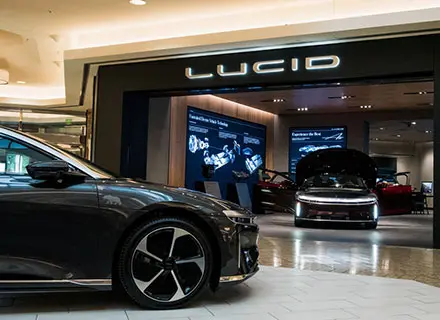

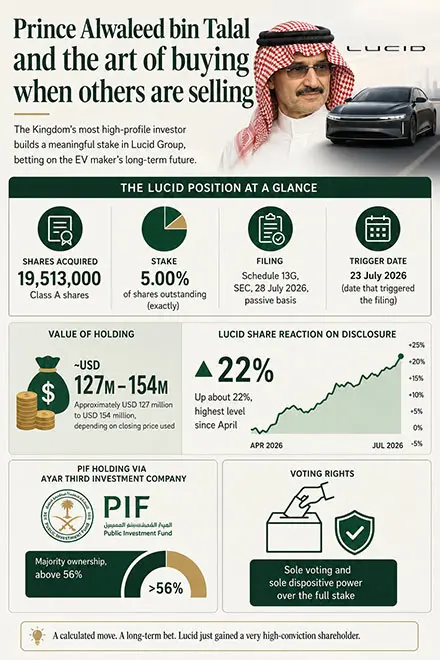
There was no press conference, no ribbon and no stage. On 28 July, a Schedule 13G landed at the United States Securities and Exchange Commission showing that HRH Prince Alwaleed bin Talal Al Saud had built a position of 19,513,000 Class A shares in Lucid Group, the California electric vehicle maker.
That works out to exactly 5.00% of the 390,256,808 shares outstanding, and it was worth somewhere between USD 127 million and USD 154 million depending on which day’s closing price you use, because the market moved so sharply once the news broke.
Lucid’s shares closed roughly 22% higher on the day of the disclosure, their strongest level since April 2026. A representative for the Prince confirmed the obvious, which is that the shares were bought during a slump in the price.
The filing was made on a passive basis, with the prince holding sole voting and sole dispositive power over the entire holding and no intention of steering the company’s management.
For anyone who has followed his career for four decades, the pattern is instantly familiar. Prince Alwaleed does not buy stories at their peak. He buys assets when the narrative around them has soured, then waits.
 The template that made a reputation
The template was set in 1991, when a young Saudi investor few people in New York had heard of put close to USD 800 million into Citicorp while the American banking system was in the middle of a property loan crisis. That single position went on to define his standing in global finance and earned him a nickname he has never entirely shaken off, the Arabian Warren Buffett.
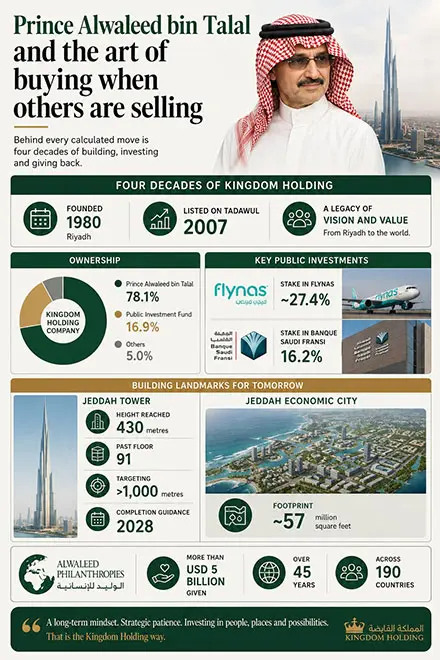
The same instinct runs through the portfolio he assembled afterwards. Kingdom Holding Company, which he founded in 1980 and listed on Tadawul in 2007, has taken positions across banking, hospitality, media, technology, aviation and real estate.
Four Seasons Hotels and Resorts, Fairmont Raffles Swissotel and full ownership of the Hotel George V in Paris gave him one of the most valuable luxury hospitality footprints in private hands.
Rotana Group and the Lebanese Broadcasting Corporation gave him reach across Arabic-language media. Positions in Apple, News Corporation, JD.com, Uber, Snap and Twitter, the last of which converted into a holding in X, put him early into the digital economy at a time when very few regional investors were looking that way.
More recently the focus has swung towards artificial intelligence (AI), with Kingdom Holding committing significant capital to Elon Musk’s xAI.
Prince Alwaleed retains 78.1% of Kingdom Holding, with the Public Investment Fund holding the 16.9% stake it acquired in 2022, an arrangement that ties his personal balance sheet directly to the state’s own investment programme without merging the two.
 Why Lucid, and why now
The Lucid purchase should be read on two levels.
Commercially, it is a classic Alwaleed entry. The company has had a difficult year, and the prince stepped in while sentiment was at its weakest, which is precisely the point in the cycle at which he has historically been most active.
He has done this before with Citicorp, with Fairmont and with hotel assets bought in the aftermath of downturns, and the discipline has rarely varied.
Strategically, the position carries a weight that goes well beyond its dollar value. The Public Investment Fund, through Ayar Third Investment Company, already holds a majority of Lucid, and Saudi Arabia is preparing to move to full-scale vehicle manufacturing in the kingdom.
Lucid is not simply a portfolio line for Riyadh. It is the centrepiece of an attempt to build an advanced automotive industry inside Saudi Arabia, complete with local assembly, engineering jobs and a supply chain that did not exist a decade ago.
When a senior member of the royal family puts his own name, rather than a sovereign vehicle, on a 5% holding, the message to global markets is unambiguous. The Kingdom’s commitment to this project is not a line item that can be quietly withdrawn.
Building upwards in Jeddah
The Lucid filing was triggered by an acquisition dated 23 July. On exactly the same day, Prince Alwaleed was standing on a construction site on the north side of Jeddah, announcing that Jeddah Tower had reached 430 metres.
That coincidence is worth pausing on. The tower, developed by Jeddah Economic Company with Kingdom Holding as its principal backer, is designed to pass one kilometre and become the tallest building in the world.
Construction restarted in 2025 under a contract worth around SAR 7.2 billion, and the project has since moved past the ninetieth floor with facade cladding and mechanical works under way.
Kingdom Holding has pointed to a workforce of roughly 5,200, an average five-day floor cycle and more than eight million hours worked without a lost-time incident. Completion is currently guided towards 2028.
Jeddah Tower anchors Jeddah Economic City, a development of some 57 million square feet intended to position the Kingdom as a destination for international business and premium tourism.
It will house residences, offices, a Four Seasons hotel and one of the highest observation decks anywhere. For Gulf executives watching capital allocation across the region, the tower is the clearest statement of intent that Kingdom Holding has made in years.
The domestic portfolio and the giving
Closer to home, Kingdom Holding holds a stake of about 27.4% in flynas, the low-cost carrier that completed its Tadawul listing in 2025, and 16.2% of Banque Saudi Fransi. The Kingdom Centre tower in Riyadh remains one of the capital’s landmarks and one of his best-known assets.
Then there is the giving, which the prince has repeatedly described as the part of his work he values most. Alwaleed Philanthropies reports more than USD 5 billion deployed over 45 years, reaching upwards of 1.5 billion beneficiaries across 190 countries.
In January this year, at the World Economic Forum in Davos, the organisation announced a fresh USD 15 million commitment to the Global Polio Eradication Initiative alongside the Gates Foundation, funding vaccination campaigns, surveillance and outbreak response over three years.
Bill Gates, Chair of the Gates Foundation, said: “Polio eradication is within sight, but the last mile is the hardest. Alwaleed Philanthropies’ latest commitment is exactly the kind of leadership the world needs to build a future where no family has to live in fear of polio paralyzing their child.”
HRH Princess Lamia Bint Majed Al Saud, Secretary General, Alwaleed Philanthropies, added: “This commitment builds on Alwaleed Philanthropies’ long-standing support for global health and its partnership with the Global Polio Eradication Initiative, reinforcing the critical role of philanthropy in addressing some of the world’s most complex public health challenges.”
In July, its Crafting Change project with UNESCO in Tanzania marked its own milestone in cultural skills training.
The lesson for the region
At 71, Prince Alwaleed remains one of the few Gulf investors whose personal conviction still moves a listed share price on two continents in a single session. The Lucid stake will be judged in time by returns.
What it demonstrates today is the discipline that has defined him since 1980, which is a willingness to commit capital at the point of maximum doubt and to stay committed for far longer than the market’s attention span allows.
For the region’s boardrooms, that is the more useful takeaway. Gulf capital has spent the past decade proving it can write very large cheques. The harder skill, and the one on display this week, is knowing when to write them.