
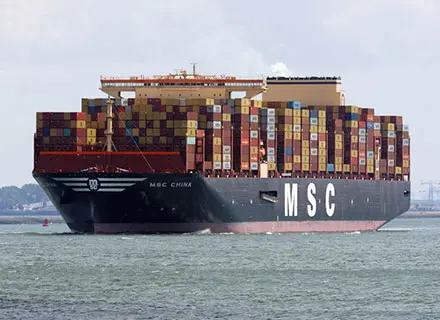

Mediterranean Shipping Company has launched a new maritime service into one of the least connected stretches of the East African coast, and the timing is not accidental.
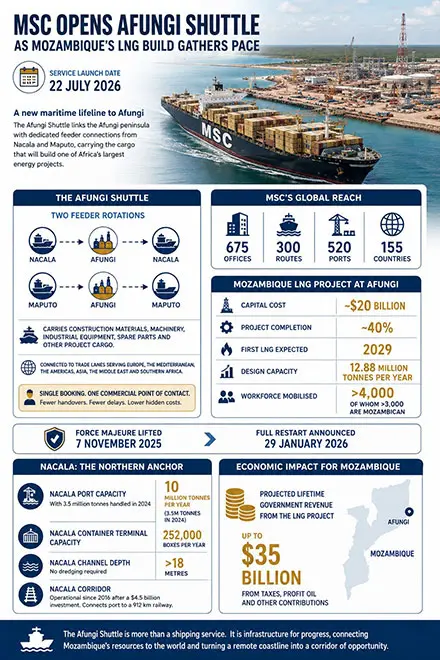
The Afungi Shuttle, announced on July 22, links the Afungi peninsula in northern Mozambique with dedicated feeder connections from Nacala and Maputo, giving contractors a scheduled sea route into a site that has spent most of the past five years cut off from normal commercial traffic.
The service is built around two rotations, Nacala to Afungi and back, and Maputo to Afungi and back. MSC says it will carry construction materials, machinery, industrial equipment, spare parts and other cargo needed for the development of the liquefied natural gas project at Afungi.
Customers get access through connections from trade lanes serving Europe, the Mediterranean, the Americas, Asia, the Middle East and Southern Africa, with a single booking and one commercial point of contact rather than a chain of separate arrangements.
That last detail matters more than it sounds. By folding the coastal feeder leg into the main booking, MSC is removing a handover point that has historically been where project cargo goes wrong, and where costs quietly multiply.
 Why Afungi needs its own shipping line
Afungi sits on a peninsula in Cabo Delgado, Mozambique’s northernmost coastal province, a long way from the country’s established logistics corridors. Road links are thin, the nearest sizeable port at Pemba has limited capacity for heavy project cargo, and the region carries a security history that has kept commercial operators cautious.
The project the shuttle is designed to serve is among the largest energy investments ever attempted in Africa. TotalEnergies and its partners declared force majeure in 2021 after an insurgent assault on the nearby town of Palma, and the half built site sat idle for four years.
The consortium voted to lift force majeure on November 7 2025, clearing the way for full mobilisation at the onshore Afungi site and the offshore installation areas.
A full restart was announced jointly at Afungi on January 29 2026 by TotalEnergies chief executive Patrick Pouyanne and Mozambican president Daniel Chapo.
Construction has since resumed onshore and offshore, with more than 4,000 workers mobilised, of whom over 3,000 are Mozambican nationals, and the project standing at roughly 40% complete after most engineering and equipment procurement was finished during the pause.
First gas is expected in 2029 from a development designed to produce more than 13 million tonnes of LNG a year, with the government projecting as much as USD 35 billion in lifetime revenue from taxes, profit oil and other contributions.
A project of that scale consumes an extraordinary volume of imported material. Steel, modular units, cranes, generators, camp infrastructure, pipe, valves and a constant flow of replacement parts all have to arrive by sea.
Without a reliable liner service, contractors are left chartering vessels individually, which is expensive, slow to arrange and difficult to plan against a construction schedule.
Nacala as the northern anchor
The choice of Nacala as one of the two feeder ports is telling. The port currently has capacity of 10 million tonnes a year and handled 3.5 million tonnes in 2024, running at about 35% of what it can take. Its container terminal is rated at 252,000 boxes a year, and its navigable channel runs deeper than 18 metres, removing the need for constant dredging.
In other words, Nacala has spare room and deep water, two things that are rare on this coastline. Maputo has also moved to concession an integrated expansion and development project at Nacala through an international tender, aimed at maximising capacity along the wider Nacala corridor.
That corridor, operational since 2016 after a USD 4.5 billion investment involving Vale, Mitsui and state operator CFM, connects the deep water port to a 912 kilometre railway.
Maputo, at the opposite end of the country, provides a second feeder point closer to South African industrial suppliers and to the established southern African logistics base. Between them, the two rotations give shippers a northern and a southern entry into the same destination.
A commercial bet with visible risks
For MSC, the shuttle is a low cost way to attach itself to a decade of project demand. The carrier operates a network of 675 offices, planning around 300 routes to 520 ports across more than 155 countries, and a short feeder loop is a modest addition to that footprint. If the LNG build runs to schedule, the return is a steady, predictable flow of high value project cargo through 2029 and beyond.
The risks are equally visible. The service is heavily exposed to a single customer base, and if the construction programme slows, so does the cargo.
Security in Cabo Delgado remains contingent on the continued presence of Rwandan and regional forces, and analysts have warned that a fortified project enclave does little for the communities outside its perimeter. There are also unresolved questions about resettlement and environmental impact in a sensitive coastal zone.
What to watch
The immediate test is utilisation. Feeder services into single project destinations either fill quickly or struggle, and the first few months of sailings will show which way this one goes. The second test is whether other carriers follow.
If MSC proves the route commercially, competitors will look at Pemba and Nacala with fresh interest, and northern Mozambique starts to acquire something it has never had, which is routine liner connectivity rather than one off charters.
The longer term prize is that a shipping lane built for gas construction does not have to stay that way. Ports serve whoever turns up.
Should the Afungi Shuttle survive past the construction phase, Cabo Delgado would gain a permanent maritime link, and a province better known for conflict would have a piece of infrastructure pointing in a different direction.