

China gave the world one of its most convincing arguments for artificial intelligence as a national project. It has the engineers, the factories, the state funding and a population quick to adopt new technology. What it did not have, it turns out, was a stock market able to price all of that sensibly.
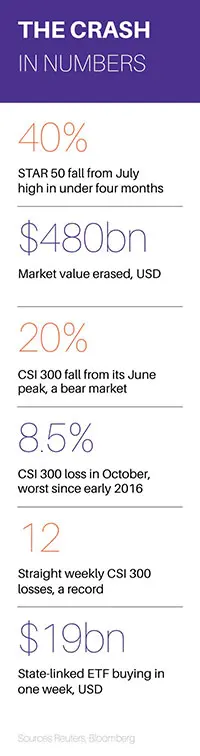
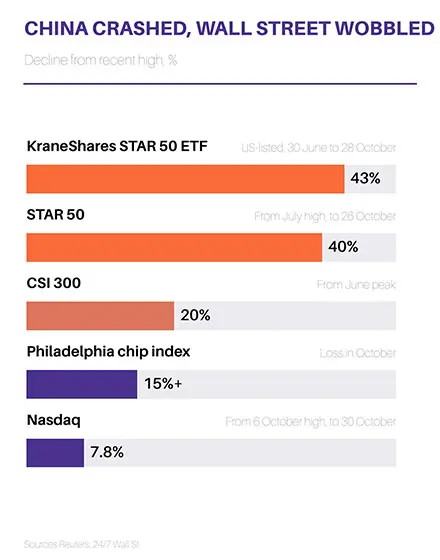
Reuters reported on 26 October that the STAR 50, the Shanghai index that tracks the country’s leading AI and chip companies, had fallen 40% from its July high in less than four months.
The slide erased roughly USD 480 billion in market value, and the selling continued. By October 30 the blue-chip CSI 300 had closed its worst month since early 2016, down 8.5%, and had fallen for 12 straight weeks, its longest losing run since the index was launched in 2005.
The collapse punctures an assumption that ran through Chinese and global markets alike, that technological ambition backed by the state would translate neatly into shareholder wealth.
It also arrives at an awkward moment for Wall Street, where investors are now asking the same questions of their own AI champions.
What the STAR 50 is and why it matters
The STAR Market opened in Shanghai in July 2019 as China’s answer to the Nasdaq.
It was designed to let young technology companies list faster, using a registration system rather than the slower approval process that governs the rest of the mainland market.
 The STAR 50 tracks its 50 largest members, a group dominated by chip designers, equipment makers and, more recently, suppliers of AI hardware.
For Beijing, the board is more than an exchange.
It is a funding pipeline for strategic industries that Washington has tried to choke off through export controls, and a way to steer household savings into technology rather than property.
That makes its performance a policy matter as much as a market one.
The rally that has now unravelled began in September 2024, when promises of economic stimulus sent Chinese shares sharply higher. It lasted roughly two years, and AI became its engine.
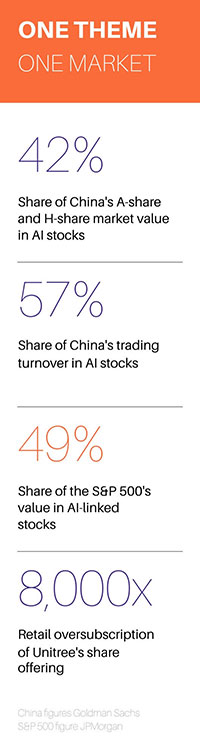
By the time the market peaked, AI-linked companies accounted for 42% of the combined market value of mainland A-shares and Hong Kong H-shares, and 57% of trading turnover, according to Goldman Sachs.
That is an extraordinary concentration for any market, let alone one dominated by retail investors.
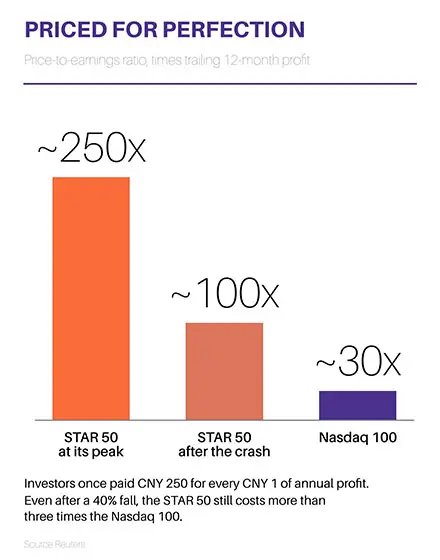
Valuations followed the crowd. At its high, the STAR 50 traded at nearly 250 times its trailing 12-month earnings.
Put simply, investors were paying CNY 250 for every CNY 1 of annual profit. Even after the crash, the multiple still sits around 100 times, against roughly 30 times for the Nasdaq 100.
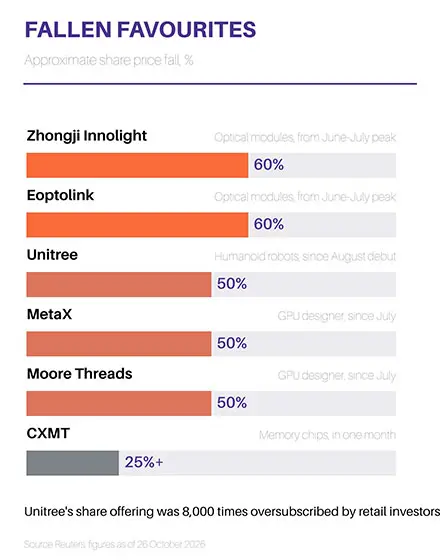
The listing frenzy captured the mood. Retail demand for robot maker Unitree’s share offering was 8,000 times greater than the shares available. Chip designers MetaX and Moore Threads jumped 700% and 400% respectively on their debuts last year.
Many small investors believed state backing made these companies safe. Chen Wensheng, a small business owner from Hainan, told Reuters he bought in because state-backed funds counted among Unitree’s investors.
 Why it burst
Reuters found no single trigger. Traders pointed to three pressures arriving together, namely stretched valuations, tax bills and the risk that the United States and its allies would ban Chinese equipment from their data centres.
The third factor hit hardest where expectations were highest. Optical component makers Zhongji Innolight and Eoptolink, whose products move data between servers in AI facilities, fell about 60% from their June and July peaks as Washington moved towards barring them from supplying US data centres.
Memory chipmaker CXMT lost more than a quarter of its value in a single month, while MetaX and Moore Threads have halved since July.
Earnings delivered a reality check. Unitree’s first results as a listed company showed third-quarter revenue up 70% to CNY 665 million, but net profit down 17.4% to CNY 112.7 million, well short of the CNY 224 million analysts expected, as research spending rose almost 250%.
Its shares have now halved since trading began in August.
Beneath the headlines sits a funding problem. A September study by Rhodium Group found that combined free cash flow at Alibaba, Tencent and Baidu swung from CNY 170 billion in 2025 to minus CNY 16 billion in the first half of 2026 as AI spending surged.
Chinese AI firms lean heavily on share sales and bank loans rather than bonds, Rhodium noted, which means a falling stock market directly restricts their ability to keep building.
 Beijing’s balancing act
Beijing wanted a so-called slow bull, a steady climb that would break China’s history of boom and bust and reward patient savers.
To that end, regulators cracked down on leveraged and high-frequency trading, and state-backed investors sold shares to cool rallies. The Wall Street Journal reported in February that the national team of state funds had shifted into selling mode to temper speculation in AI stocks.
Once the slide began, that machinery went into reverse. Nine exchange-traded funds favoured by state buyers drew CNY 128.7 billion, or about USD 19 billion, in a single week in October, according to Bloomberg data.
That was the largest such inflow since the tariff turmoil of April 2025, and it has not been enough to stop the bleeding.
Some local investors argue that policy itself helped inflate the bubble. Leo Wang of Beijing-based Qianchuang Capital told Reuters that giving technology firms heavier weightings in major indices had distorted how capital was allocated, creating a severe bubble in some sectors while draining money from others.
The longer-term cost may show up in capital raising. Hong Hao of Lotus Asset Management told Reuters the rout would halt listing plans for many companies.
 Regulators had already slowed approvals for humanoid robot firms while they examined whether valuations and revenue tied to state projects reflected genuine demand.
A market crash is not an industry crash
China’s AI sector is still spending heavily and still raising money.
DeepSeek recently raised USD 15 billion in one of the largest funding rounds in the country’s history, Bloomberg reported. Not every investor is fleeing either.
Goldman Sachs kept Innolight and CXMT on a revised list of recommended Chinese AI stocks in October, and HSBC research shows Asia-focused funds remain overweight China despite three months of net selling.
 What has died is the idea that every company attached to a national priority deserves a premium.
Wang Zhuo of Shanghai Zhuozhu Investment Management warned that chipmakers and AI suppliers would eventually be dragged into the same price wars that have squeezed margins across Chinese manufacturing.
Is America next?
The comparison with Wall Street is uncomfortable. AI-linked stocks account for about 49% of the S&P 500’s value, according to JPMorgan, a larger share than China’s 42% before its crash. America’s tech giants are burning cash too.
Rhodium estimates that free cash flow at Microsoft, Amazon, Alphabet, Meta and Oracle fell from USD 191 billion in 2025 to USD 14 billion in the first half of 2026, while the money they raised through debt jumped from USD 90 billion to USD 163 billion.
Markets have started to notice. On October 30 the Nasdaq fell 2.9% after disappointing results from Intel and Amazon, leaving it 7.8% below its October 6 closing high.
There are real differences. America’s tech leaders own vast, profitable businesses that can absorb years of heavy investment, and the Nasdaq 100 trades at a fraction of the STAR 50’s multiple. But China’s crash shows how quickly sentiment can turn once a market stops rewarding spending and starts demanding returns.
 The first lesson is that strategic importance is not a valuation model. Governments from Washington to New Delhi call AI and chips national priorities. That may justify public investment, but it does not make every listed supplier worth 250 times its earnings.
South Korea’s Kospi, heavy with chipmakers, fell 3.5% on October 30 as AI worries spread.
The third concerns ordinary savers. China wanted families to fund its tech ambitions through equities. Countries that have pulled households into the stock market, from India’s monthly investment plans to American retirement accounts built on index funds, should note how quickly a theme with official blessing can turn into losses for those least able to bear them.
The fourth is geopolitical. Export controls and supplier bans can shrink a company’s market almost overnight. Chinese optical suppliers learned that this year, and Western firms with deep exposure to China should not assume they are immune to the same treatment in reverse.
The last lesson is about cash. Rhodium’s numbers show Chinese and American giants facing the same arithmetic, with capital spending rising and free cash flow shrinking. China simply reached the reckoning first, pushed by thinner profits and frothier prices.
The bottom line
China’s AI industry has not failed. Its stock market has simply admitted that ambition is not the same as earnings.
The STAR 50’s collapse is best read as a stress test that arrived early. For investors elsewhere, the useful question is no longer whether the AI story is real, but how much of its future has already been paid for.