
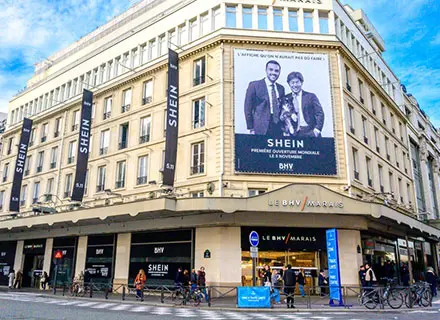

Shein rang the gong at the Hong Kong Stock Exchange on September 1, ending a listing attempt that had run through New York and London and taken the better part of six years.
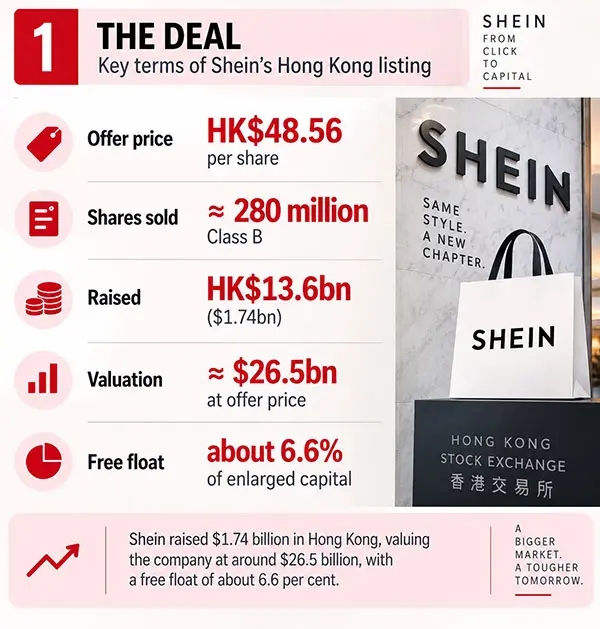
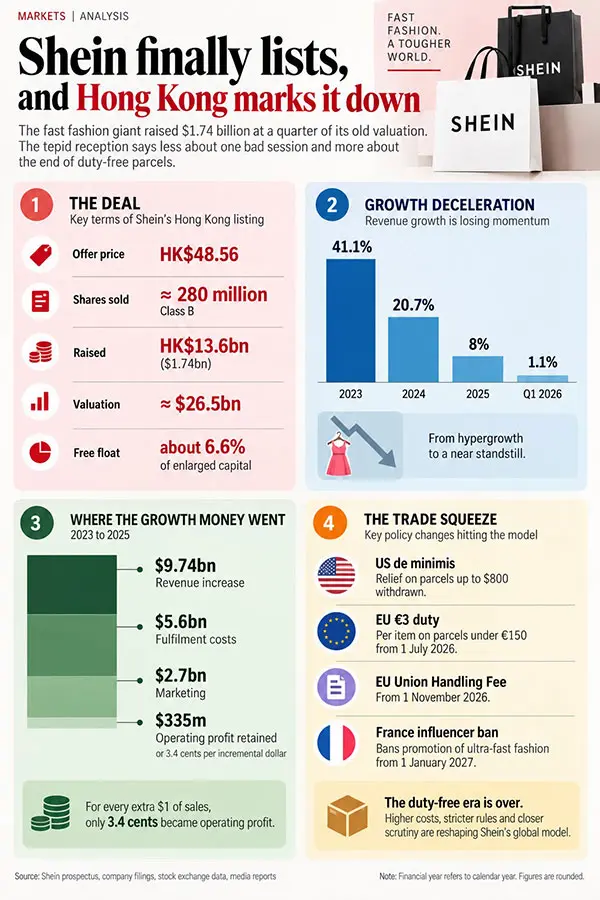
The company sold roughly 280 million shares at HKUSD 48.56 apiece, raising about HKUSD 13.6 billion, or USD 1.74 billion, and valuing itself at around USD 26.5 billion at the offer price.
That was below the top of its marketed range of HKUSD 49.50, and it was still one of the city’s biggest new share sales this year.
The first session was not kind. The stock fell by as much as 10% to HKUSD 43.80 before recovering to close at HKUSD 48.50, a whisker below its issue price and a valuation of about USD 26.3 billion.
Analysts attributed the rebound to stabilisation measures of the sort large listings use to avoid a bruising debut, with Goldman Sachs acting as stabilising manager.
It closed at HKUSD 46 on the second day while the Hang Seng Index finished flat, and by the close on September 3 it was changing hands around HKUSD 42, some 13% below where it was priced.
Chief financial officer Leigh Gui told the listing ceremony that the debut marked “a new starting point”. Founder and chief executive Sky Xu stayed out of the spotlight and let his executives speak.
The price is the story
The headline comparison is unavoidable. At roughly USD 26.5 billion, Shein came to market more than 70% below the USD 98.2 billion it was worth in private funding rounds in 2022.
 That gap has been reported as a humiliation, which is only half right. A private mark from 2022 records what one pool of capital paid in one liquidity environment. It is not a benchmark. The more revealing numbers come from the book itself.
The Hong Kong retail tranche was covered 5.63 times and the international tranche 2.59 times, modest by the standards of an exchange where hot deals are routinely subscribed hundreds of times over.
The offering represented about 6.6% of enlarged share capital, cornerstone investors took roughly a fifth of it and are locked up for six months, which leaves only about 5% genuinely trading.
Cornerstones committed about USD 383 million and included existing backers Boyu Capital, Tiger Global and General Atlantic, alongside Tencent, Greenwoods, Taikang Life and UBS Asset Management. Goldman Sachs, Morgan Stanley and JPMorgan sponsored the listing.
A thin float held up largely by insiders is not a vote of confidence from the wider market. It is a deal engineered to get done.
The loophole was the moat
Shein’s cost advantage was never purely operational. A large part of it was regulatory. Packages worth up to USD 800 once entered the United States free of duty under the de minimis rule, and that relief has gone.
 The European Union followed, agreeing a fixed 3 euro customs duty on parcels valued under 150 euro from July 1 2026, with an additional Union Handling Fee due from November 1 2026.
The scale involved explains the political urgency. The number of low-value e-commerce packages arriving in the bloc doubled in a single year to 4.6 billion, more than nine in ten of them from China, and France alone took in roughly 800 million small parcels.
Brussels had planned to close the exemption in 2028 and brought it forward under pressure from domestic retailers.
The effect on the accounts was immediate. Shein reported first-quarter revenue of USD 9.05 billion and swung to a net loss of USD 99 million from a profit a year earlier, reversing USD 395 million of net income in the same quarter of 2025.
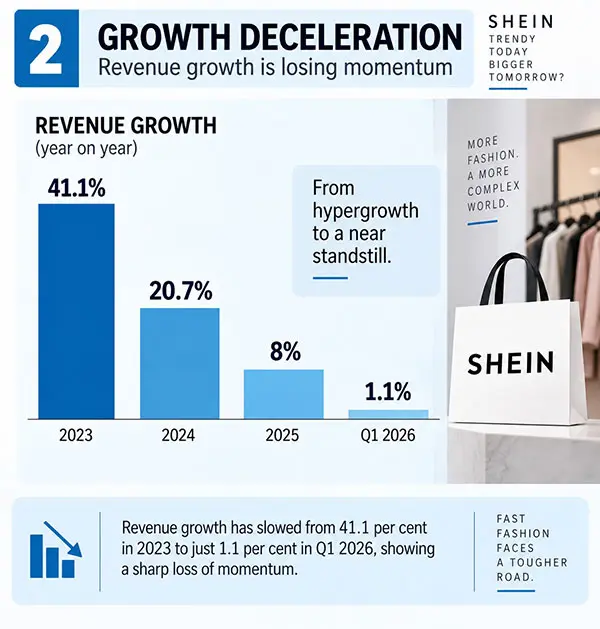
The company has guided first-half revenue growth broadly in line with the 1.1% it managed in the first quarter, with the operating margin slightly lower, blaming new European import charges, pricing pressure and softer demand in the Middle East linked to the Iran war.
The arithmetic underneath
Strip out the noise and the deceleration is stark. Revenue grew 41.1% in 2023, then 20.7% in 2024, then 8% in 2025, reaching USD 41.85 billion, while earnings fell almost 39% to USD 2.06 billion.
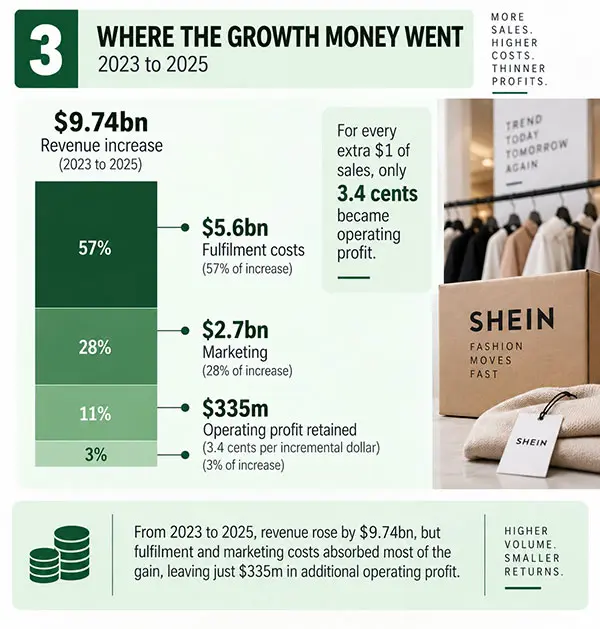 What makes this more than a cyclical wobble is where the money goes. Between 2023 and 2025 net revenue grew by USD 9.744 billion. Fulfilment absorbed USD 5.6 billion of that increase and marketing took USD 2.7 billion, leaving USD 335 million of additional operating profit, or roughly 3.4 cents on every extra dollar of sales.
That is the number investors are actually pricing. Growth at those incremental economics is close to worthless.
Crucially, this is not a collapse in pricing power at the product level. Gross margin held at roughly 68% in 2025 and around 70% in the first quarter.
The products still carry a healthy mark-up.
It is the cost of getting each parcel to each doorstep, plus the cost of persuading the customer to open the app in the first place, that has swallowed the profit. Duties simply added a third claim on the same dollar.
Who owns it, and who can sell
The share structure deserves attention from anyone tempted by the discount. The shares sold carry one-tenth of the voting rights of founder-held stock, and co-founders Sky Yangtian Xu, Maggie Gu, Molly Miao and Tony Ren control 90% of votes.
They retain close to 60% of the company, locked for 24 months. Shein has also agreed to pay up to about USD 3.5 billion in cash to investors who bought special shares in earlier private rounds, which is money leaving the business to settle the consequences of those older, richer valuations.
Jianggan Li of the consultancy Momentum Works called the deal a capital-structure event as much as a fundraising.
Bloomberg Intelligence analyst Catherine Lim has noted that with pre-IPO and cornerstone holders all accepting six-month lock-ups, the expiry in March 2027 will be a far more meaningful test of the company’s worth than the debut session. That is the date to diary.
Hong Kong was the only door left
The venue is itself part of the analysis.
 Shein filed in the United States in 2023, then turned to London, where the Financial Conduct Authority approved a draft prospectus before China’s securities regulator objected, largely over how the company described risks tied to its Chinese operations and Xinjiang.
Beijing signed off on the Hong Kong route in July, and there is no US listing and no depositary receipt. The company moved its headquarters to Singapore in 2022, but the listing has anchored its identity back where its supply chain always was.
The regulatory file is not closed either.
Shein has disclosed an ongoing US Federal Trade Commission consumer protection investigation that could carry significant penalties, and the European Commission is examining its handling of illegal products, the potentially addictive design of its platform and the transparency of its recommendation systems.
For Western institutions with mandates that limit Hong Kong exposure or that screen on labour and environmental grounds, the practical result is a narrower pool of natural buyers. That is a structural discount, not a sentiment one.
What has to be proved next
The bull case is not empty. Shein counted 281 million active users at the end of March and turned its inventory in just 36 days in 2025 under its small-batch testing model, a speed advantage that no customs rule can legislate away.
The prospectus points to marketplace and supply chain services for other brands, building on its 2023 purchase of the Missguided name from Frasers Group and its partnership with the French label Pimkie, and 40% of proceeds are earmarked for technology with another 40% for brand building.
The bear case is simpler. If a meaningful slice of the cost advantage was regulatory arbitrage, and that arbitrage has been withdrawn in the two largest markets within a year of each other, then the model must now win on merchandising and logistics alone, against Temu, Amazon Haul and every incumbent that spent five years learning from Shein.
There is also a question of shape. Holding stock closer to the customer, in European and American warehouses, would blunt the tariff hit but weaken the very thing that made the model work, namely tiny test batches, fast reorders and almost no inventory risk.
The competitive question is no longer who is cheapest but who can absorb a fixed cost per item and still look cheap.
The first real evidence arrives with second-quarter results. Watch three things. Whether US price increases stick without volume falling away.
Whether the loss narrows or deepens. And whether fulfilment and marketing costs finally grow slower than revenue.
Until then, a share price sitting below its offer is not the market being harsh. It is the market waiting.