
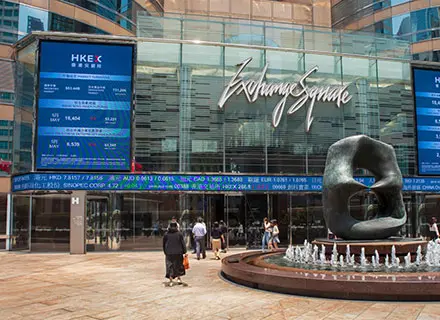

The city finished second in the global fundraising table, behind Nasdaq, which was carried by SpaceX and a run of artificial intelligence (AI) flotations.
What makes 2026 unusual is not the money already raised. It is how many companies are still waiting.
Two engines are doing most of the work
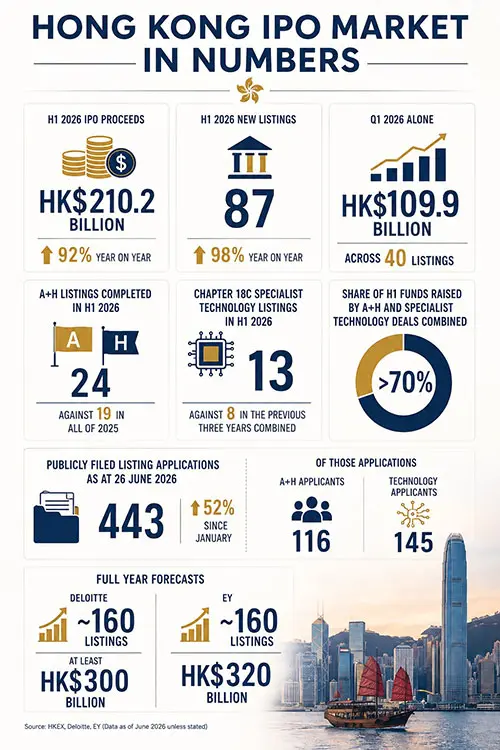
The first is the A+H listing, in which a company already quoted in Shanghai or Shenzhen sells a second tranche of shares in Hong Kong. Some 24 of of these were completed in the first half of 2026.
The second engine is Chapter 18C, the specialist technology route the exchange introduced in 2023 for companies that are commercialising deep technology and may not meet conventional profit tests.
 Thirteen such companies listed in the first half of this year, against eight in the previous three years put together. Between them, A+H and specialist technology deals accounted for more than 70% of everything raised.
The deals that set the tone
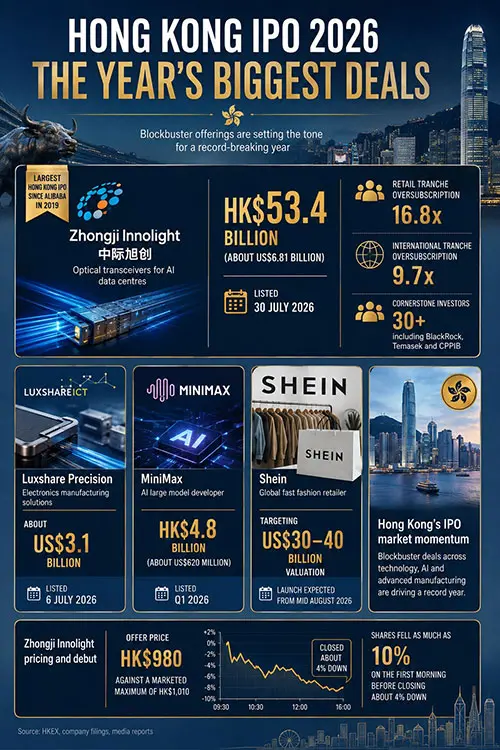
The year’s defining transaction came on July 30, when Zhongji Innolight, a Chinese maker of the optical transceivers that move data around AI data centres, raised HKUSD 53.4 billion, about USD 6.81 billion. That is Hong Kong’s largest share sale since Alibaba’s secondary listing in 2019 and the second largest in Asia this year.
The book was heavily subscribed. Retail orders came in at 16.8 times the shares available and the international tranche at 9.7 times, with more than 30 cornerstone investors including BlackRock, Temasek and Canada Pension Plan Investment Board.
Before that, Luxshare Precision had raised about USD 3.1 billion on 6 July, briefly the year’s largest. Earlier in the year the Shanghai AI developer MiniMax raised HKUSD 4.8 billion, and Biren Technology opened the year’s listing calendar on January 2.
The queue is at a record and it is jammed
As at 26 June, 443 listing applications had been publicly filed, a 52% increase since the start of the year. Among them were 116 A+H candidates and 145 technology companies. Advisers put the total number of companies waiting at more than 430, the fullest pipeline the exchange has handled since at least 2021.
 The bottleneck sits on the mainland side. Since March 2023, a Chinese company cannot be scheduled for a Hong Kong listing hearing until the China Securities Regulatory Commission has cleared its offshore filing. Applications lapse after six months, so a slow clearance forces the company to refresh its accounts and start again.
The rulebook was rewritten in July
On July 24 the exchange published the conclusions of the first phase of its listing framework competitiveness review, and the rule changes took effect the same day.
The most significant change lowers the market capitalisation threshold for companies with weighted voting rights, or dual class shares, to HKUSD 20 billion from HKUSD 40 billion, and allows a voting ratio of up to 20 to 1 for the largest applicants rather than the previous cap of 10 to 1.
The exchange also extended confidential filing to every applicant, not just a subset, eased the path for companies already listed overseas to add a Hong Kong line, and broadened acceptance of US accounting standards.
Alongside the rule changes, the exchange has been trying to widen the geography of its issuer base.
What happens next
The test of the second half is Shein. The fast fashion group, founded in China and headquartered in Singapore, cleared its mainland filing on 10 July and passed its Hong Kong listing hearing days later, after earlier attempts to float in New York and London stalled.
That is a severe reset. Private rounds valued Shein at USD 98.2 billion in 2022 and USD 64 billion by 2024. Its draft prospectus showed a USD 99 million quarterly loss, caused partly by a one off accounting charge of USD 328 million and partly by weaker sales after Washington scrapped the duty exemption on low value parcels. One person close to the deal said the company is pricing to support the shares afterwards rather than to maximise the headline number.
Forecasts for the full year cluster around HKUSD 300 billion to HKUSD 320 billion and roughly 160 listings, which would leave Hong Kong in the global top three.
For now, though, the American route for Chinese issuers is all but shut. Only one Chinese company raised money on a US exchange in the first half of this year, taking in USD 12 million, against 39 companies and USD 886 million a year earlier. That flow has to go somewhere, and it is going to Hong Kong.