


For most of the past decade, refining was the unglamorous corner of the oil business.
Pumping crude made the real money. The Iran war has turned that order on its head.
Since the US-Israeli war with Iran began in February 2026, the effective closure of the Strait of Hormuz and repeated strikes on refineries in Saudi Arabia have stripped huge volumes of fuel out of the global system.
Ukraine’s long-range drone campaign against Russian plants has removed more. The world is now short of diesel, jet fuel and petrol, even as crude prices have eased from their wartime peaks.
The result is a refining boom for the biggest listed oil companies.
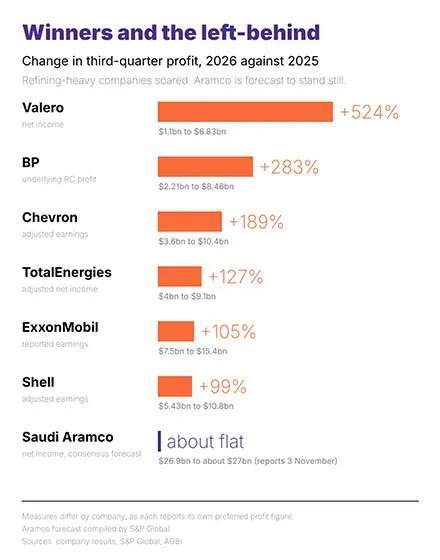
Third-quarter results published in the last week of October showed the scale of the boom.
ExxonMobil, Chevron, Shell, BP, and TotalEnergies all beat analysts’ forecasts, and in almost every case, the fuel-making business did the heavy lifting.
Exxon, the largest US oil producer by market capitalisation, is now earning more money from refining than from its exploration and drilling operations for the first time in at least six years.
In the Gulf, Saudi Aramcoposted a 34.5% increase net profit despite attacks on its facilities. The good numbers were attributed to higher revenue and exit from a joint venture..
But overall, State-backed producers across the Gulf, with much of their oil trapped behind a contested waterway, are watching their Western rivals benefit from a windfall.
 A rare inversion at Exxon
Exxon reported third-quarter earnings of USD 15.4 billion, double the USD 7.5 billion it made a year earlier.
Stripping out one-off items, profit rose to USD 17.5 billion, or USD 4.23 a share, ahead of the consensus forecast.
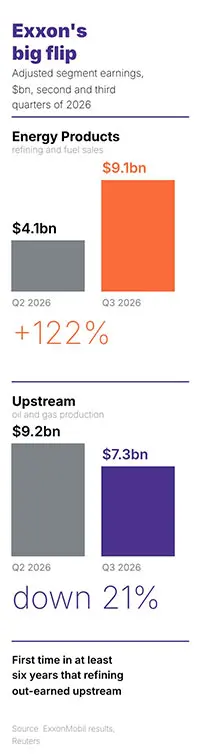
The headline number hides a striking change in where that money came from. Exxon’s Energy Products division, which houses its refineries and fuel sales, earned USD 9.1 billion on an adjusted basis, more than double the USD 4.1 billion it made in the second quarter.
Its upstream business earned USD 7.3 billion, down from USD 9.2 billion, as Brent crude averaged about 5.6% less than in the previous three months.
Even on reported figures, which include one-off charges, refining edged ahead with USD 7.2 billion against USD 7.1 billion from exploration and production.
For a company whose fortunes usually track the wellhead, it is an unusual moment.
Exxon was well placed to capture the boom. Its Gulf Coast refineries ran at full capacity in the quarter, and the company says it has delivered record refining performance this year, including its highest North American diesel volumes.
Chief Financial Officer Neil Hansen told analysts in late July that the main bottleneck in the international oil market was a shortage of global refining capacity, rather than a shortage of crude.
Chief Executive Officer Darren Woods told analysts that Exxon is now looking for ways to expand its existing refineries and upgrade them to make more fuel or chemical feedstocks.
Hansen said investment at its Baytown complex in Texas would add 100,000 barrels a day of US diesel and jet fuel output.
Exxon used part of the windfall to cut debt by USD 8 billion during the quarter and plans USD 20 billion of share buybacks in 2027, the same level as in each of the previous two years.
 Chevron and the European majors follow
Chevron told a similar story. The second-largest US oil company earned USD 9.9 billion in the third quarter, almost three times the USD 3.5 billion it made a year earlier.
Adjusted earnings of USD 5.28 a share comfortably beat the consensus forecast of USD 4.88.
Its downstream division earned USD 4.9 billion, more than four times the USD 1.1 billion of a year earlier, and its highest in at least six years.
That put fuel-making within touching distance of upstream earnings of USD 5.7 billion.
Chevron’s US refineries processed a record 1.09 million barrels of crude a day, running at close to 98% of capacity.
Across the Atlantic, the European majors posted even sharper gains.
Shell reported adjusted earnings of USD 10.81 billion, nearly double the USD 5.43 billion of a year earlier and its biggest quarterly profit since 2022.
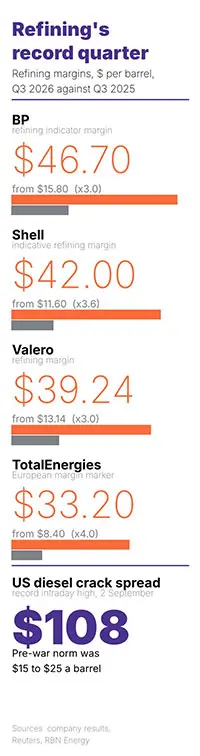
Its indicative refining margin reached a record USD 42 a barrel, up from USD 24 in the second quarter and $11.60 a year earlier.
BP’s numbers were starker still. Underlying replacement cost profit, its preferred measure, climbed to USD 8.5 billion from USD 2.2 billion a year earlier, it’s highest since 2008 according to Bloomberg.
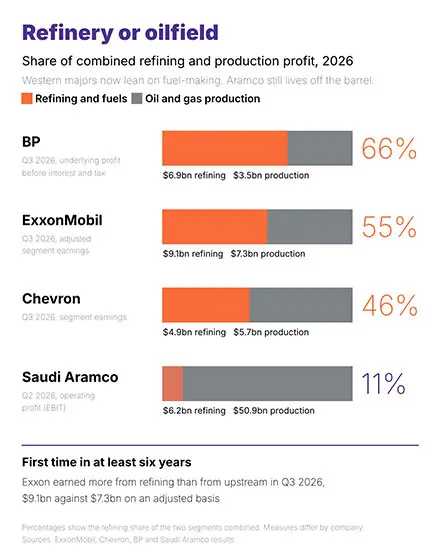
BP’s customers and products division, which includes refining, earned USD 6.9 billion before interest and tax, roughly double the USD 3.5 billion produced by its oil production and operations arm.
Its refining indicator margin averaged USD 46.70 a barrel, against USD 15.80 a year before.
TotalEnergies lifted adjusted net income to USD 9.1 billion, more than double the USD 4 billion of a year earlier, even though Brent averaged about USD 97 a barrel, down 7% on the previous quarter. Its downstream arm generated a record USD 4.1 billion.
The company’s European refining margin marker averaged USD 33.20 a barrel, almost four times its level a year earlier.
In Norway, Equinor’s Mongstad refinery made a record contribution as adjusted operating income almost doubled.
Independent refiners, which have no oilfields to cushion them when crude prices fall, have enjoyed the purest form of the boom.
Valero’s refining margin hit USD 39.24 a barrel in the third quarter, almost triple the USD 13.14 of a year earlier, and its net profit rose more than sixfold to USD 6.8 billion.
Why fuel became scarcer than crude
The reason refining has outshone production lies in where the damage has fallen. The war has not only trapped crude. It has also knocked out the plants that turn crude into usable fuel.
Iranian strikes have repeatedly hit Saudi Arabia’s refining system.
 Aramco shut its 550,000-barrel-a-day Ras Tanura refinery after a drone strike in the first days of the war.
In April, the Saudi energy ministry said attacks had hit the SATORP refinery in Jubail, a joint venture with TotalEnergies, as well as Ras Tanura, the Samref plant in Yanbu and the Riyadh refinery, directly affecting the kingdom’s exports of refined products.
The same wave of attacks cut Saudi oil production capacity by about 600,000 barrels a day.
Meanwhile, the Gulf’s fuel exports to Europe and Asia have largely stopped moving.
Traffic through the Strait of Hormuz has collapsed since Iran declared the waterway closed, and in May, Tehran set up a new body, the Persian Gulf Strait Authority, to issue transit permits.
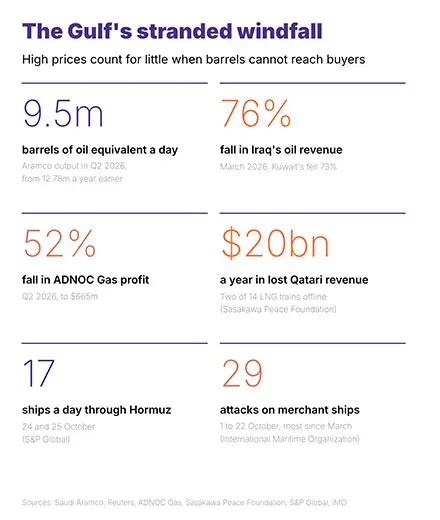
Reuters reported in early October that transits had fallen to their lowest in more than two months after attacks on tankers, and S&P Global counted just 17 ships crossing on each of October 24 and 25.
The International Maritime Organization recorded 29 attacks on merchant ships in the first three weeks of October, more than in any month since March.
Russia, the other big swing supplier of diesel, has lost capacity of its own.
Ukraine’s defence ministry claimed on October 4 that its strikes had disabled 51% of Russia’s refining capacity, a figure that could not be independently verified.
Data from Energy Aspects showed Russian refinery runs falling in July to their lowest level since March 2005, and the International Energy Agency says Russian diesel output has dropped by about 30%.
Moscow has responded by banning diesel exports, which has tightened the global market further.
The squeeze has landed hardest on diesel, the fuel that moves lorries, tractors and ships.
The US diesel crack spread, the gap between the price of diesel and the crude used to make it, typically sat between $15 and $25 a barrel before the war.
It passed USD 100 for the first time on August 17 and reached a record intraday high of USD 108.02 on September 2.
The average US pump price of diesel hit USD 5.82 a gallon, beating the record set in June 2022, while US diesel exports hit record levels as Europe, short of Gulf and Russian cargoes, turned to American supply.
That is why refiners in the US, Europe and India can now make more from processing a barrel than many producers can from pumping it.
Brent touched about USD 126 earlier in the war but has since traded closer to $100. Fuel remains scarce.
The Gulf paradox
On paper, the Gulf’s national oil companies should be the biggest winners of a war that has pushed oil prices sharply higher. In practice, many of them have been among the losers.
The problem is volume. A high price is worth little if the barrels cannot reach the buyer.
Aramco’s output fell to 9.5 million barrels of oil equivalent a day in the second quarter, from 12.78 million a year earlier.
Aramco still earns far more than any of its Western rivals in absolute terms, and it has a sizeable refining business of its own.
In the second quarter, its adjusted net income rose 33% to USD 33.4 billion, and adjusted downstream operating profit roughly doubled to USD 6.2 billion.
Chief executive Amin Nasser told analysts he expected refining margins to stay exceptionally strong through the second half.
But the shape of its earnings is the mirror image of Exxon’s. Upstream operating profit of USD 50.9 billion, achieved at an average crude price of $108 a barrel, dwarfed downstream, which accounted for only about 11% of the two combined.
At Exxon in the third quarter, refining made up about 55% of the equivalent total. At BP, it was about two-thirds.
That difference matters. The Western majors own refineries in places the war has not touched, from the US Gulf Coast to Rotterdam, and can run them flat out to meet demand.
Much of Aramco’s refining sits within range of Iranian missiles and drones, and several of its plants have been hit. Its fuel exports from the Gulf coast face the same blocked strait as its crude.
Aramco has softened the blow by sending more crude west through its East-West pipeline to the Red Sea, where Nasser said it was exporting around five million barrels a day.
Reuters estimated that this allowed Saudi Arabia to earn more from its March exports than a year earlier despite shipping 26% fewer barrels.
Even that route has been targeted. Attacks on a pumping station in April cut flows along the pipeline by about 700,000 barrels a day.
Stranded barrels across the region
Elsewhere in the Gulf, producers without a bypass have fared far worse. Reuters estimated that Iraq’s oil revenue fell 76% in March, the first full month of the war, to USD 1.73 billion, while Kuwait’s fell 73% to USD 864 million.
 The Oil & Gas Journal put lost export revenue for Gulf producers as a group at up to USD 2 billion a day.
Qatar, which supplies roughly a fifth of the world’s liquefied natural gas, halted production in the first week of the war and declared force majeure.
The Sasakawa Peace Foundation, a Japanese think tank, estimates that with two of Qatar’s 14 LNG trains knocked offline, the country has lost 12.8 million tonnes a year of capacity, worth about $20 billion in annual revenue.
In Abu Dhabi, ADNOC Gas reported a 52% fall in second-quarter profit to USD 665 million after attacks on its Habshan complex and blocked gas exports.
It has guided to third-quarter net income of between USD 600 million and USD 800 million, against USD 1.34 billion a year earlier, on the assumption that disruption in the strait continues.
The Western majors have not escaped the region unscathed.
Exxon warned in July that a full quarter of closure would cut its Middle East output by about 750,000 barrels of oil equivalent a day.
But their global spread of oilfields and refineries meant that losses in one region were more than offset by gains elsewhere.
A Gulf state company has no such hedge.
Asia’s refiners take their share
The refining windfall has not been confined to the West. Asian refiners with secure crude supply and export-oriented plants have also profited from the scramble for fuel.
India’s Reliance Industries, which runs the world’s largest single-site refining complex at Jamnagar, reported a 40.6% rise in quarterly net profit to USD 2.7 billion for the three months to September.
Earnings before interest, tax, depreciation and amortisation from its oil-to-chemicals business rose 68% to USD 2.66 billion, as Singapore diesel cracks averaged $65.80 a barrel, more than three times the level a year earlier.
Political heat
 Profits on this scale come with political risk. President Donald Trump complained in August that Exxon and Chevron were making too much money, and the latest results land as American motorists, hauliers and farmers face record diesel prices.
Talk of a US ban on diesel exports surfaced in September. European governments, which imposed windfall taxes on energy companies after Russia’s invasion of Ukraine in 2022, may face similar calls.
The companies appear to have learned from that episode, and several have prioritised repairing balance sheets over bigger buybacks.
Exxon cut debt by USD 8 billion during the quarter, BP reduced net debt by USD 8.4 billion to USD 13.9 billion, and Chevron cut total debt by USD 3.5 billion.
BP said it would use part of its surplus cash to pay off early its outstanding USD 5 billion post-tax bill for the 2010 Deepwater Horizon spill.
How long can it last
Refining booms are notoriously short-lived, and this one rests on a war that could end with little warning.
BP chief executive Meg O’Neill said the company was already seeing refining margins begin to soften as the summer driving season ended.
Analysts warn that a ceasefire or a reopened strait would bring down crude prices and squeeze fuel margins at the same time, as Gulf refineries restart and stranded cargoes return to market.
For now, there is little sign of that. Iran’s parliament speaker said in early October that the strait would stay closed until Tehran’s conditions were met, and Ukraine’s strikes on Russian plants show no sign of letting up.
The IEA has reported that the Moscow refinery was so badly damaged in June that it is expected to stay offline until early 2027.
For Aramco and its Gulf neighbours, the lesson of the war is that owning the cheapest barrels in the world counts for less when the route to market is shut.
For the Western majors, refineries once seen as a drag on returns have become some of the most valuable assets they own.
Whether they keep that status will depend less on boardroom strategy than on what happens in a stretch of water about 33 kilometres wide at its narrowest point.