
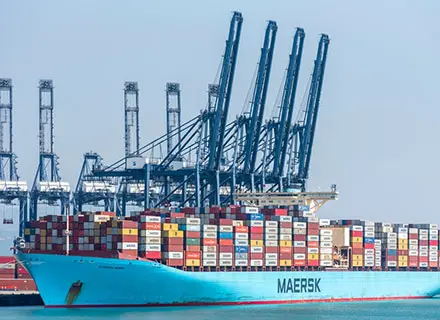

Danish shipping giant Maersk is embarking on an aggressive fleet expansion, marking a strategic reversal after years spent prioritising integrated logistics over the purchase of new vessels.
The company ordered 26 container ships in September, each capable of carrying 18,600 twenty-foot equivalent units (TEUs), taking its order book to 131 vessels, according to shipping data platform Alphaliner.
The orders signal a departure from a strategy pursued over much of the past decade, when Maersk invested heavily in logistics services connecting factories, warehouses, ports and customers.
But growing competitive pressure has prompted chief executive Vincent Clerc to adopt a more assertive approach to shipping capacity.
“We’re going to need more ships,” Clerc said in September, explaining the company’s changing requirements amid continuing trade disruption.
He also signalled that Maersk would “play more assertively” in the market.
Defending its global ranking
The expansion comes as Maersk faces the prospect of losing its position as the world’s second-largest container shipping line to France’s CMA CGM.
Switzerland-based Mediterranean Shipping Company (MSC) overtook Maersk as the world’s largest container carrier in 2022 and now operates a fleet of 1,015 vessels, according to Alphaliner data cited by the Financial Times.
CMA CGM, meanwhile, has expanded rapidly and has 160 ships on order. Combining its existing fleet with planned deliveries would put the French group ahead of Maersk in overall fleet size. CMA CGM expects to become the world’s second-largest container carrier in 2027.
The competition reflects a broader industry shift. Shipping companies are racing to secure capacity ahead of the next decade, when changing trade routes, geopolitical tensions and the potential end of vessel-sharing alliances could alter the balance of power between major carriers.
Peter Sand, chief analyst at maritime research company Xeneta, said CMA CGM had traditionally been the company chasing the industry leaders. Its expansion is now forcing competitors to respond.
Maersk’s orders are intended to defend its market position, maintain service coverage and reduce its reliance on chartered ships. Its fleet has already grown by about a fifth since the Covid-19 pandemic, but the latest purchases indicate that the company believes further investment is necessary to remain competitive.
Disruption changes the economics
The shift is also underpinned by Maersk’s changing assessment of freight rates. The pandemic, attacks on commercial shipping in the Red Sea, rerouting around Africa and disruption to important maritime corridors have increased sailing distances and absorbed available vessel capacity.
These developments have helped shipping companies charge higher rates while forcing them to deploy more ships to maintain service frequency.
Clerc has argued that the industry’s economics have changed. Between 2000 and 2020, he said, shipping companies experienced a relatively symmetrical cycle of profits during strong markets and losses during downturns.
Maersk’s financial outlook has also benefited from elevated freight rates. In August, the company reported second-quarter earnings before interest, tax, depreciation and amortisation (EBITDA) of USD 3 billion and operating profit of USD 1.6 billion, citing strong demand and higher ocean freight rates. It subsequently upgraded its full-year 2026 guidance.
The favourable market has encouraged competitors to accelerate their investment plans. Yet the strategy carries risks: the same disruptions that have supported freight prices could ease, leaving the industry with more ships than customers need.
Bigger ships, lower costs
Maersk is ordering vessels large enough to benefit from economies of scale while retaining flexibility across different routes and ports.
In February, the company ordered eight ships, each with a capacity of 18,600 TEUs, from China’s New Times Shipbuilding. The vessels will measure 366 metres in length and 58.6 metres in breadth, with delivery scheduled for 2029 and 2030. Their dual-fuel engines will be capable of operating on conventional marine fuel or liquefied gas.
The latest expansion continues that approach. Larger vessels can carry more containers per voyage, spreading fuel, crew and other operating expenses across a greater volume of cargo. Fuel can account for a substantial proportion of a ship’s operating costs, making vessel efficiency an important competitive advantage.
Maersk has nevertheless stopped short of ordering the largest ships available. Some of CMA CGM’s new vessels will accommodate more than 24,000 TEUs, but such ships are restricted to ports with sufficient depth and infrastructure.
Maersk has said deployment flexibility is a key consideration, allowing its vessels to operate across existing and future networks without being confined to a narrower range of ports.
Overcapacity threatens the industry
The fleet expansion race is raising concerns that the industry could eventually face a damaging surplus of capacity.
The Loadstar reported in September that the global container ship order book had reached a record level equivalent to more than 45% of the existing fleet, following new orders by Maersk and CMA CGM. The data, compiled by Linerlytica, showed 1,925 ships on order with a combined capacity of 15.6 million TEUs.
If global trade growth slows or vessels return to shorter routes through the Suez Canal and Red Sea, effective shipping capacity could increase sharply. Additional deliveries would intensify competition for cargo, putting downward pressure on freight rates and margins.
Maersk itself warned in February that new vessels and a possible return to Red Sea routes could weigh on 2026 earnings. It forecast EBITDA of USD 4.5 billion to USD 7 billion, compared with USD 9.53 billion in 2025.
Lars Jensen, chief executive of Vespucci Maritime, has questioned whether all major carriers can expand simultaneously without creating excess capacity. The industry, he noted, is effectively playing a zero-sum game in which not every competitor can achieve the same relative gains.
Maersk’s strategy therefore rests on a delicate calculation: that its larger, more efficient ships will strengthen its competitive position without arriving into a market already burdened by surplus capacity.
The company is betting that continued disruption and changing global trade patterns will sustain demand for shipping services. If that assumption proves wrong, its costly fleet expansion could become a liability rather than a competitive advantage.