
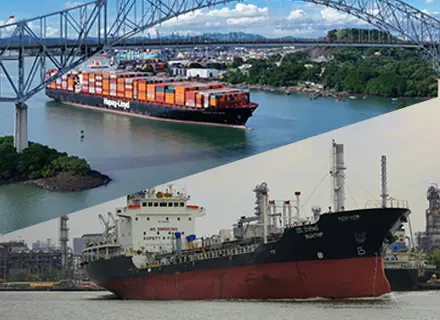

Two of the world’s busiest shipping corridors are in trouble at the same time, and the knock-on effects are landing on nearly everything that moves by sea.
The Panama Canal is cutting how deep ships can sit in the water, even though its lakes are full. The Strait of Hormuz, the narrow waterway that handles a fifth of the world’s oil, has just reopened after a war shut it down for months. Both events are pushing cargo owners towards the same overcrowded alternative, the ports of Los Angeles and Long Beach, right as shippers rush to beat a tariff deadline.
The result is higher freight rates, longer waits, and a supply chain with very few easy options left.
Why is Panama cutting ship draft?
Normally, the Panama Canal only restricts how deep ships can load when water levels actually run low. This time is different. The Panama Canal Authority has ordered a phased cut in the maximum draft allowed through the wider Neopanamax locks, from 50 feet down to 49.5 feet on July 3, then 49 feet on July 24, then 48.5 feet from August 15. But Gatun Lake and Alhajuela Lake, the reservoirs that feed the canal, are sitting well above their historical averages thanks to heavy rain through 2025 and an unusually wet start to 2026.
The reason for the caution lies ahead, not behind. Weather agencies, including NOAA and the World Meteorological Organisation, are forecasting a strong El Nino pattern developing through the rest of 2026 and into 2027. El Nino tends to sharply cut rainfall across the canal’s watershed.
The authority remembers the last severe drought all too well. Between 2023 and 2024, water shortages forced drafts down to just 38.5 feet and daily transits down to 24 ships, causing a global backlog. This time, the authority would rather cut the draft early and gradually, by about a foot at a time with a month’s notice, than be caught out again.
The cost of this caution falls on shipping lines and, eventually, on cargo owners. Every half foot of draft lost means a large containership has to carry several hundred fewer containers per trip. Some carriers are already capping the weight of Caribbean-bound boxes at 10 tonnes per container to stay within the new limits.
On top of this, the canal authority has rolled out a new booking system called LoTSA 2.5, which sells guaranteed transit slots for between 200,000 and 800,000 dollars each, with bids for same-day slot during busy periods reportedly reaching as high as 4 million dollars.
“With all the bombings, the missiles, the drones … companies are saying it’s safer and less expensive to cross through the Panama Canal,” said Rodrigo Noriega, a lawyer and analyst in Panama City. “All of this is affecting global supply chains.”
Meanwhile, Panama’s government is ‘maximising what it can earn from the Panama Canal’, Noriega said.
Ricaurte Vasquez, the canal’s administrator, said one company – that he would not name – paid an extra USD 4 million when its fuel vessel had to change its destination because of ongoing geopolitical tensions. “It was a ship carrying fuel to Europe, and they redirected it to Singapore, and it needed to get there because Singapore is running out of fuel,” he said.
Hormuz keeps oil markets confused
While Panama has been quietly restricting supply, the Middle East has been going through a much louder crisis. The Strait of Hormuz, through which about a fifth of the world’s oil passes, was effectively shut on February 28, 2026, after fighting broke out between the United States, Israel and Iran.
That closure took roughly 10.8 million barrels a day of oil off the market and sent prices soaring, with Brent crude averaging around 103 dollars a barrel through the second quarter of the year.
In April, Panama’s foreign ministry accused Iran of illegally seizing a Panama-flagged vessel owned by Italian company MSC Francesca in the Strait of Hormuz. Panama, which has one of the world’s largest ship registries, said the ship was ‘forcibly taken’ by Iran.
Relief came on June 18, 2026, when the US and Iran signed the Islamabad memorandum of understanding (MoU). The deal ended the fighting, opened a 60-day negotiation window, and reopened the strait to commercial shipping without tolls. Oil forecasters reacted quickly.
The US Energy Information Administration now expects Brent to average around 74 dollars a barrel in the third quarter of 2026, a steep drop from earlier projections, easing further to about 65 dollars in 2027.
But the agreement did not instantly fix the fractured supply chain as war erupted again. Tankers take weeks to reroute, and by the end of June. Roughly 1.4 million barrels a day of Gulf production remained shut in.
There is also a hidden cost from the months the strait was closed. Asian buyers, desperate to replace Middle Eastern oil and gas, ramped up the purchase of American crude and LNG, and much of that cargo travelled through the Panama Canal. Canal traffic rose 8% in the first half of 2026, adding even more strain to Gatun Lake just as the authority was trying to protect it. Southbound ships without a booked slot have faced waiting periods stretching up to 10.6 days.
As per the latest announcement from President Donald Trump, Uncle Sam has reinstated a naval blockade on Iran and will reimburse 20% on all cargo shipped through the Strait of Hormuz. The declaration came after Tehran claimed it had closed the vital waterway.
“The Hormuz Strait is OPEN and will remain OPEN, with or without Iran. We are reinstating THE IRANIAN BLOCKADE. The USA… will be reimbursed, at the rate of 20% on all cargo shipped, for any and all costs necessary to do the job of providing safety and security to this very volatile section of the World,” Trump said in a Truth Social post.
The number of tankers transiting the Strait of Hormuz has fallen to its lowest level since May 2026, as per Kpler’s latest shipping data. The heightened tensions have resulted in the emergence of a new normal: ships increasingly switching off their public AIS tracking transponders while crossing the waterway.
And the volatility is going to hit the world really hard. As per the ship broker Gibson’s report, “Should the renewed escalation in the strait lead to another prolonged closure of Hormuz, the world will find itself in a much tougher spot. With global inventories rapidly depleted in recent months, this is a recipe for much tighter supply, higher prices and significant downside risk for tanker markets.”
As per the LSEG and MarineTraffic ship-tracking data available on July 14, the Sea Faith oil products tanker was among the few visible vessels sailing towards the entrance to the Strait near the Iranian side of the waterway. The Iranian-flagged products tanker Niki, on the other hand, separately sailed towards the Strait’s entrance from the Iranian side of the chokepoint later on the same day.
“Commercial traffic through the Strait of Hormuz continued at reduced levels. Traffic patterns continued to reflect operator caution following recent attacks,” said the US Navy-led Joint Maritime Information Centre (JMIC) in an advisory dated on July 13.
As per the July 11’s satellite imagery, at least three pairs of tankers were involved in ship-to-ship transfers (STS) outside Hormuz off Oman’s coast in the Gulf of Oman. The procedure involves the transfer of oil from one vessel to another. Since the beginning of the Iran-Iraq war on February 28, STS transfers have enabled faster deliveries of oil onto waiting ships that do not need to sail through Hormuz.
Only six vessels transited the strait on Sunday, ship-tracking data from Kpler showed, the lowest number in five weeks.
“Tankers that exited the strait included the Very Large Crude Carrier Humanity, laden with two million barrels of Iranian oil, and another tanker, Capetan Andreas, carrying about 500,000 barrels of Kuwaiti oil products, while three empty tankers entered the Gulf to load oil. Most of the tankers switched off their transponders when crossing the Strait,” Kpler data read.
“There were no liquefied natural gas tankers that entered the Strait over the weekend that were visible on ship-tracking data. One tanker controlled by the Abu Dhabi National Oil Co exited the Strait between July 10 and July 12. The vessel was heading for Dahej Port in India,” it added further.
Rush of cargo driven by a tariff deadline
Double disruption at Panama and Hormuz has put global maritime trade activities under tremendous pressure. Add the separate story unfolding in Washington. A temporary 10% tariff on nearly all US imports, introduced under Section 122 in February 2026, was due to expire on July 24. Courts had ruled the tariff unlawful in May, but an appeals court allowed collection to continue until the scheduled expiry date. Fearing the Trump administration would simply replace it with a new tariff under different legal authority, importers rushed to bring goods in early. North American import volumes jumped 14.3% year-on-year in June alone, reaching 2.25 million containers, well ahead of the usual autumn peak season.
Carriers have used this surge to push rates upwards. Following a 2,000-dollar-per-container hike on July 1, several major carriers layered on further increases in the following weeks, alongside peak- season surcharges of up to 2,000 dollars per container. Spot rates to the US East Coast climbed to between 7,000 and 7,600 dollars per 40-foot container by late June, among the highest levels seen all year.
Why is everyone suddenly shipping via US West Coast?
Faced with Panama’s weight limits, expensive canal slots, and high East Coast rates, many shippers are switching to the US West Coast instead, unloading at Los Angeles or Long Beach, and sending goods inland by rail. Carriers have added extra sailings to meet the demand, which has eased the old-style congestion of ships queuing offshore. Anchorage waits are now under a tenth of a day.
The bottleneck has simply moved. Instead of ships waiting at sea, they are now waiting once they reach the berth. Discharging a vessel at LA or Long Beach now takes 28 to 58 hours, two to four times longer than on the East Coast or Gulf ports, largely because the cranes cannot keep pace with today’s larger ships.
Meanwhile, East Coast ports like Norfolk have their own problem, with containers sitting in the yard for more than 73 hours before leaving. And from August 1, the fee charged on containers moving through LA and Long Beach during peak hours rises nearly 5%, to just over 40 dollars per container.
Where is all this heading?
There is no clean way around this squeeze. Shippers can accept Panama’s shrinking draft limits, high slot prices, and weight restrictions, or move to the US West Coast and absorb slower berth times and rising fees.
Maritime players need to contend with the fact that disruption will likely persist through the rest of 2026. For now, the safest strategy for logistics teams is to lock in longer contracts with capped rate increases, spread bookings across more than one gateway, and keep alternative routeing options ready.