

Saudi Arabia’s USD 50 billion New Murabba real estate development has replaced its chief executive, adding to signs that the Kingdom is reassessing the scale, timing and priorities of its ambitious giga-project programme.
Sabah Barakat, a senior executive at Saudi Arabia’s Public Investment Fund (PIF), has been appointed Acting Chief Executive of New Murabba, according to the developer’s website. He replaces Michael Dyke, the British executive who had led the project since January 2024.
Barakat is also the Acting Group Chief Executive of ROSHN Group, another PIF-backed property developer. It was not immediately clear whether Dyke would remain with New Murabba in another capacity.
New Murabba said in a statement that its operations, partnerships and strategic direction remained in place despite the leadership change. The developer did not provide further details on the circumstances surrounding Dyke’s departure.
The management shake-up comes as Saudi Arabia’s sovereign wealth fund tightens spending across its vast portfolio of investments and reviews the timelines of several projects launched under Crown Prince Mohammed bin Salman’s “Vision 2030” economic transformation programme.
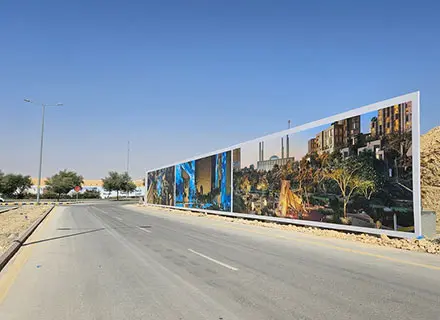
New Murabba is among the Kingdom’s most ambitious urban developments. Planned for central Riyadh, the project is designed to create a new downtown district covering around 14 square kilometres, with residential neighbourhoods, offices, cultural and innovation centres, hotels, retail space and green areas.
The development is expected to contain 18 communities eventually and accommodate more than 400,000 people. Its centrepiece is the Mukaab, a proposed 400-metre-high cube-shaped structure designed to house residences, hotels, entertainment venues and commercial facilities.
When New Murabba was announced in 2023, the development was targeted for completion by 2030. That deadline has since been pushed back to 2040, reflecting a broader recalibration of Saudi Arabia’s giga-project ambitions.
Property consultancy Knight Frank estimates the project’s cost at approximately USD 50 billion. Its scale illustrates the extraordinary investment Saudi Arabia has committed to transforming Riyadh and diversifying the economy beyond oil.
But the financial environment has become more challenging. Lower-than-expected oil prices and higher spending pressures have constrained government finances, while the Kingdom has increasingly focused on directing capital towards projects with clearer economic returns.
The PIF’s 2026-2030 strategy, released in April, reflected that shift, with several previously announced projects either omitted, delayed or substantially scaled back.
The sovereign wealth fund has been central to the “Vision 2030” strategy, deploying hundreds of billions of dollars into tourism, property, technology, entertainment, infrastructure and other sectors intended to create new sources of economic growth and employment.
However, the sheer number and scale of projects have raised questions over whether Saudi Arabia can deliver them simultaneously without putting excessive pressure on public finances.
Sources previously told AGBI that PIF had ordered minimum spending reductions of 20% across its portfolio in 2025. The measures affected more than 100 companies and contributed to project delays and job cuts.
New Murabba has already faced signs of a more cautious approach. Reuters reported in January that construction work on the Mukaab had been suspended, although development of the surrounding New Murabba district was continuing.
The change in leadership therefore comes at a critical point for the project. While the broader development remains part of Riyadh’s plans, the altered timeline and questions around the Mukaab underline the shift from the rapid expansion phase of “Vision 2030” to a greater emphasis on execution and capital discipline.
The appointment of Barakat could also strengthen coordination between New Murabba and other PIF-backed property developments. His concurrent role at ROSHN gives him experience across Saudi Arabia’s state-backed real estate sector at a time when the fund is attempting to rationalise its property portfolio.
The Kingdom is nevertheless continuing to develop its property market and attract foreign capital. In June, Saudi Arabia began accepting applications from non-Saudis to purchase property after the cabinet approved new ownership rules. New Murabba was included among the areas where foreign ownership would be permitted.
That policy could create an additional source of demand for projects such as New Murabba as Saudi Arabia seeks to develop a deeper property market and attract international investors.
For Riyadh, the challenge is now to ensure that its flagship developments deliver economic value without the spending overruns and delays that have become increasingly associated with some of the Kingdom’s mega-projects.
New Murabba’s longer timetable suggests that Saudi Arabia is prepared to take more time to achieve that balance.
The appointment of a senior PIF executive at the helm signals that the project remains strategically important, but its next phase is likely to be defined less by speed and spectacle and more by capital discipline, execution and measurable returns.