
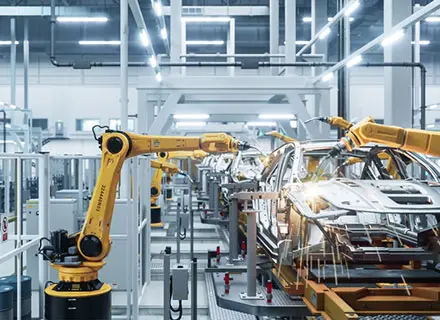

General Motors (GM) plans to increase the use of robots and other automation technologies across its North American factories by 20% by 2028, as the US automaker looks to contain rising labour and manufacturing costs while improving productivity.
The Detroit-based company is developing its own robots and assembling them at its facility in Kokomo, Indiana, according to people familiar with the plans.
The initiative is focused particularly on autonomous mobile robots, which can transport components and materials between different sections of manufacturing plants.
The 20% automation target and the production of robots at the Indiana facility have not previously been reported. GM will continue to purchase robotics equipment from external suppliers while expanding its in-house development capabilities.
The company is also extending its automation push to its supply chain. Suppliers bidding for new contracts are being asked to submit plans outlining how they intend to automate their operations.
GM is using a scorecard to assess suppliers’ automation efforts and is factoring their performance into contract decisions, according to people familiar with the matter.
The move comes as US automakers face mounting pressure to improve manufacturing efficiency amid higher wages, commodity prices and the costs of shifting more production and supply chains to the US.
GM’s automation strategy follows the 2023 labour agreement with the United Auto Workers (UAW), which secured substantial pay increases and other benefits for workers at the company, Ford Motor and Stellantis, the parent of Jeep.
GM estimated that the agreement would add approximately USD 575 in labour costs per vehicle.
Ford put the additional cost at about USD 900 per vehicle. Analysts had expected automakers to increase automation to offset at least part of the higher expenses.
The companies are also preparing for another round of potentially difficult negotiations with the UAW in 2028, when their current labour contracts will expire.
UAW president Shawn Fain has already expressed concern about the implications of artificial intelligence (AI) and automation for manufacturing jobs. Speaking at a union convention in June, he argued that workers were not receiving a fair share of the productivity gains generated by technology.
Fain warned that AI should not become another tool for employers to increase output and profits at the expense of employees.
GM, however, maintains that automation can improve workplace safety, product quality and operational efficiency while supporting its manufacturing workforce.
“As competition intensifies globally, we continue to put these technologies to work in ways that support our manufacturing teams,” the company said in a statement.
GM has used industrial robots for decades, particularly for tasks such as welding vehicle panels and moving materials along production lines. Its latest initiative seeks to expand the technology into other manufacturing activities, with AI and autonomous systems playing a greater role.
The company said last year that approximately 100 roboticists, AI engineers and hardware specialists were working on advanced robotics systems. Its broader technology strategy involves deploying machines alongside employees rather than relying exclusively on automated production.
Mikell Taylor, GM’s director of robotics strategy, discussed the approach during an episode of the Automated podcast in February. She stated that manufacturers should create production processes that maximise the unique strengths of both people and machines.
The strategy comes as GM faces a difficult cost environment. During its third-quarter earnings call in October, the company said higher commodity, logistics and memory costs were weighing on its financial outlook.
Copper prices had reached record levels, while hot-rolled coil steel prices were at four-year highs. GM said spot prices for both commodities had risen 10-15% since July and were approximately 50% above their average levels in 2025.
The company estimated that inflation would add around USD 400 million in incremental costs during 2026. It expected the combined impact of commodity inflation, logistics and dynamic random-access memory (DRAM) costs to reach approximately USD 2 billion for the full year.
Separately, GM is investing between USD 1 billion and USD 1.5 billion in 2026 to shift production to the US, strengthen its supply chain and expand software capabilities. These costs are expected to increase in the fourth quarter ahead of additional American manufacturing capacity coming online in 2027.
Chief executive Mary Barra has said the company is looking at ways to use AI across its operations to improve efficiency and manage fixed costs. GM expects to provide more details on potential savings when it announces its 2027 financial guidance.
Industry specialists say the increased use of robotics could help automakers reduce the number of labour hours required to manufacture vehicles, improving margins and allowing factories to operate more efficiently.
Laurie Harbour, an automotive industry specialist and partner at the tax and advisory firm Wipfli, said the objective was to reduce the time and labour required to produce each vehicle.
She also noted that automation could help manufacturers address labour shortages, an issue facing several industrial sectors.
The technology push is not limited to GM. Automakers globally are exploring robotics and AI to improve factory productivity and compete with manufacturers operating with lower production costs.
For GM, the challenge will be to secure efficiency gains without aggravating tensions with its workforce. How much automation changes manufacturing jobs will probably become an increasingly important issue in the next round of union negotiations in 2028.
The company’s plan signals that robotics will play a bigger role in its efforts to control costs and remain competitive in an increasingly expensive manufacturing environment.