
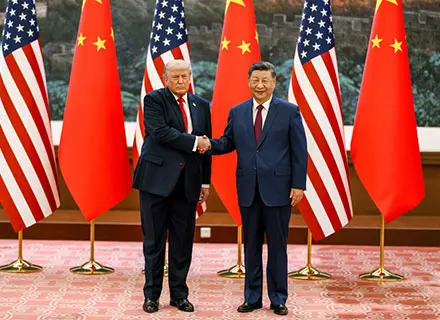

The much-anticipated meeting between United States President Donald Trump and his Chinese counterpart Xi Jinping, as part of the Republican’s series of meetings in Asia that will cover trade, security and a rare trilateral meeting involving Russia, will again put the focus on a major weakness in Washington’s trade strategy that remains unresolved: America’s dependence on China for critical minerals and specialised industrial components.
Despite billions of dollars in federal investments aimed at rebuilding domestic mining and manufacturing capabilities, the United States remains years away from developing a supply chain capable of challenging Beijing’s dominance.
The shortfall leaves American manufacturers exposed to Chinese export restrictions on rare earth elements, specialised magnets and other materials essential to semiconductors, robotics, military equipment and artificial intelligence (AI) infrastructure, amid the volatile geopolitical relations between the two global superpowers.
The dependence could complicate Trump’s negotiating position when he meets Xi on Thursday.
Washington can threaten additional tariffs and technology export controls amid the ongoing espionage fiasco involving Nvidia CEO Jensen Huang, but escalating trade tensions could jeopardise American access to materials that the world’s largest economy cannot currently produce or process in sufficient quantities, according to analysts.
China has already demonstrated its willingness to use its position in the critical minerals market as geopolitical leverage.
In 2025, Beijing imposed export restrictions on rare earth elements and magnets, disrupting production at Ford Motor and other U.S. manufacturers.
Washington subsequently negotiated to secure continued access to these strategically important materials.
The latest developments highlight the gap between Trump’s ambition to reduce America’s dependence on China and the time required to rebuild an industry that the United States largely abandoned towards the end of the 20th century.
The meeting between Trump and Xi will test whether the two countries can maintain their existing trade truce, which is scheduled to expire in January. The agreement includes export-control waivers covering certain critical minerals.
However, Beijing’s control over rare earth mining, processing and manufacturing gives it considerable influence over American industrial supply chains.
China has defended its export restrictions by arguing that the measures are intended to prevent critical minerals, dual-purpose in nature, from being used in military applications.
Beijing has also accused Washington of misusing export controls to restrict Chinese access to advanced semiconductor technology.
The disparity between the two countries is particularly visible in rare earth magnet manufacturing.
The United States had annual manufacturing capacity of about 4,500 metric tonnes of neodymium-iron-boron magnets in 2025, compared with about 210,000 metric tonnes in China, the International Energy Agency (IEA) said.
These specialised magnets are critical components in electric vehicles, industrial equipment and military systems. If Beijing were to impose additional export curbs, their scarcity could therefore pose serious challenges for American manufacturers.
China’s edge extends beyond mining, too. For decades the country has built the processing and refining facilities, technical expertise and manufacturing infrastructure required to convert raw materials into industrial components.
The US is working to rebuild those capabilities, with the Trump administration announcing several initiatives to accelerate domestic critical minerals production, including investments in mining companies, processing facilities and magnet manufacturing.
However, building mines, refineries, and processing facilities typically takes a decade or more, and many of the projects mentioned earlier are unlikely to begin commercial operations until the end of the decade or later.
South Korean company Korea Zinc is backing a USD 7.4 billion refinery in Tennessee, which is expected to open in 2030. The facility is designed to process copper, zinc and other critical minerals.
Mining companies Rio Tinto and BHP are also pursuing plans to develop what would become North America’s largest copper mine. However, the project is not expected to begin operations until the next decade.
The administration has separately agreed to take an equity stake in Trilogy Metals, which plans to start copper production in Alaska in 2031.
Other projects are further along.
Vulcan Elements has begun manufacturing rare earth magnets in North Carolina, although its products have not yet received customer approval for commercial applications.
MP Materials is expanding magnet production in Texas under a multibillion-dollar partnership with the Pentagon. The company is among the most prominent beneficiaries of Washington’s efforts to establish a domestic rare earth supply chain.
Meanwhile, Lithium Americas is developing Nevada’s Thacker Pass mine, described as North America’s largest lithium source. Commercial production is expected to begin in 2028.
Perpetua Resources is targeting 2029 for antimony production at its Idaho project. Antimony is an important material used in ammunition and armour manufacturing.
Despite these developments, the projects underline how difficult it will be for Washington to replace Chinese supplies in the short term.
The Trump administration’s critical minerals strategy also faces a domestic political challenge.
Democrats’ midterm election wins are likely to give control of Congress to the party between 2027 and 2029. Presidential polls, potentially increasing scrutiny of federal investments in private mining and materials companies.
Some Democratic lawmakers have questioned the administration’s approach to deploying public funds into commercial ventures.
US Energy Secretary Chris Wright, whose department has financed several critical minerals projects, said last week that he was “happy to explain everything we’ve done.”
The political debate could complicate efforts to secure long-term funding for projects that may take several years to generate commercial returns.
Nevertheless, reducing America’s dependence on Chinese minerals has become a national security priority that extends beyond the current administration.
Amid the uncertainties at the supply chain front, Washington is also preparing further restrictions on Chinese technology used in the infrastructure supporting the global AI boom.
As per the reports, amid the ongoing Nvidia espionage fiasco, the Trump administration intends to proceed with efforts to restrict imports of new models of Chinese optical transceivers used in data centres, despite opposition from some of America’s largest technology companies.
Optical transceivers allow data to travel through fibre-optic cables at extremely high speeds, making them essential components of modern data centres and the computing infrastructure that supports AI applications.
Reuters reported in August that the Federal Communications Commission (FCC) was considering a ban on new models of Chinese optical transceivers over national security concerns.
However, the proposal has encountered considerable resistance from Amazon, Google, Meta, Microsoft, CoreWeave and Cisco.
Executives from these companies reportedly met White House officials earlier this year to explain the potential consequences of restricting Chinese suppliers.
According to two people briefed on the meeting, the companies warned that replacing Chinese optical transceivers could take up to a decade because domestic manufacturers currently lack the production capacity required to meet demand.
The lobbying had raised doubts about whether the restrictions would proceed. However, three additional people familiar with the discussions told Reuters that the proposal was moving forward.
Washington’s concerns centre on the possibility that Chinese-made optical transceivers could be exploited to steal data, install malware or disrupt services at American data centres.
China accounts for approximately two-thirds of the global optical transceiver market, according to Counterpoint Research.
Chinese manufacturers, including Eoptolink and Zhongji Innolight, have established dominant positions in global supply chains and count major American hyperscalers among their customers.
Zhongji Innolight has also been added to the Pentagon’s list of Chinese military-backed companies, increasing concerns among US policymakers.
American manufacturers Coherent and Lumentum produce competing optical technologies. However, they currently lack the production scale required to replace Chinese suppliers, according to a report by the Foundation for American Innovation.
The proposed restrictions could therefore create another supply chain challenge for American technology companies already committing hundreds of billions of dollars to AI infrastructure.
One person familiar with the discussions told Reuters that US technology companies had also warned about the possibility of Chinese retaliation.
Beijing could potentially restrict exports of indium phosphide, a critical material required by American manufacturers to produce their own optical transceivers.
Such a move could undermine Washington’s efforts to reduce dependence on Chinese technology by creating another vulnerability in domestic manufacturing.
The FCC has nevertheless continued to pursue a tougher approach to Chinese technology imports.
Over the past year, it has successfully restricted imports of new models of Chinese drones, robots, power inverters and routers.
The controversy surrounding Nvidia has added another dimension to the debate, particularly following concerns about AI chips being smuggled into China and whether US export controls have been adequately enforced by the Commerce Department.