

A forensic filing in a California courtroom and a severed coding contract with Elon Musk’s SpaceX have swallowed the ChatGPT Ads milestone whole, and dragged a three-year rivalry back into the open
OpenAI picked an awkward week to celebrate.
On August 31 the company announced that ChatGPT Ads had reached USD 1 billion in annualised revenue run rate, roughly 200 days after launch, and opened self-serve buying to advertisers across India, Europe, the Middle East and North Africa.
Ads now run in more than 40 countries, served to free-tier and Go subscribers who make up the bulk of ChatGPT’s roughly one billion weekly users.
It is the sort of number a company publishes when it wants prospective investors to see a business with more than one engine. OpenAI has filed confidentially for a US listing and carries a valuation reported at around USD 852 billion.
Analysts were quick to note the milestone also confirms a miss. OpenAI told investors in April it expected around USD 2.5 billion in advertising revenue this year. A billion-dollar run rate in late August does not get it there.
That, however, was not what dominated the coverage. Two other developments landed in the same 24 hours, and both point at problems that no amount of ad inventory will fix.
Apple’s forensic turn
In a filing in the US District Court for the Northern District of California, Apple alleged that Chang Liu, a former senior system electrical engineer at the iPhone maker and a named defendant in its trade secret case, accessed a power converter circuit schematic while working at OpenAI, and trained an artificial intelligence agent on proprietary Apple material in March 2026.
The sting is in the provenance. Apple said the evidence surfaced on a MacBook that OpenAI itself handed over on 21 August as part of the discovery process. Having examined the device, Apple has asked the court to expedite discovery, which is rarely the move of a plaintiff who thinks its case is thin.
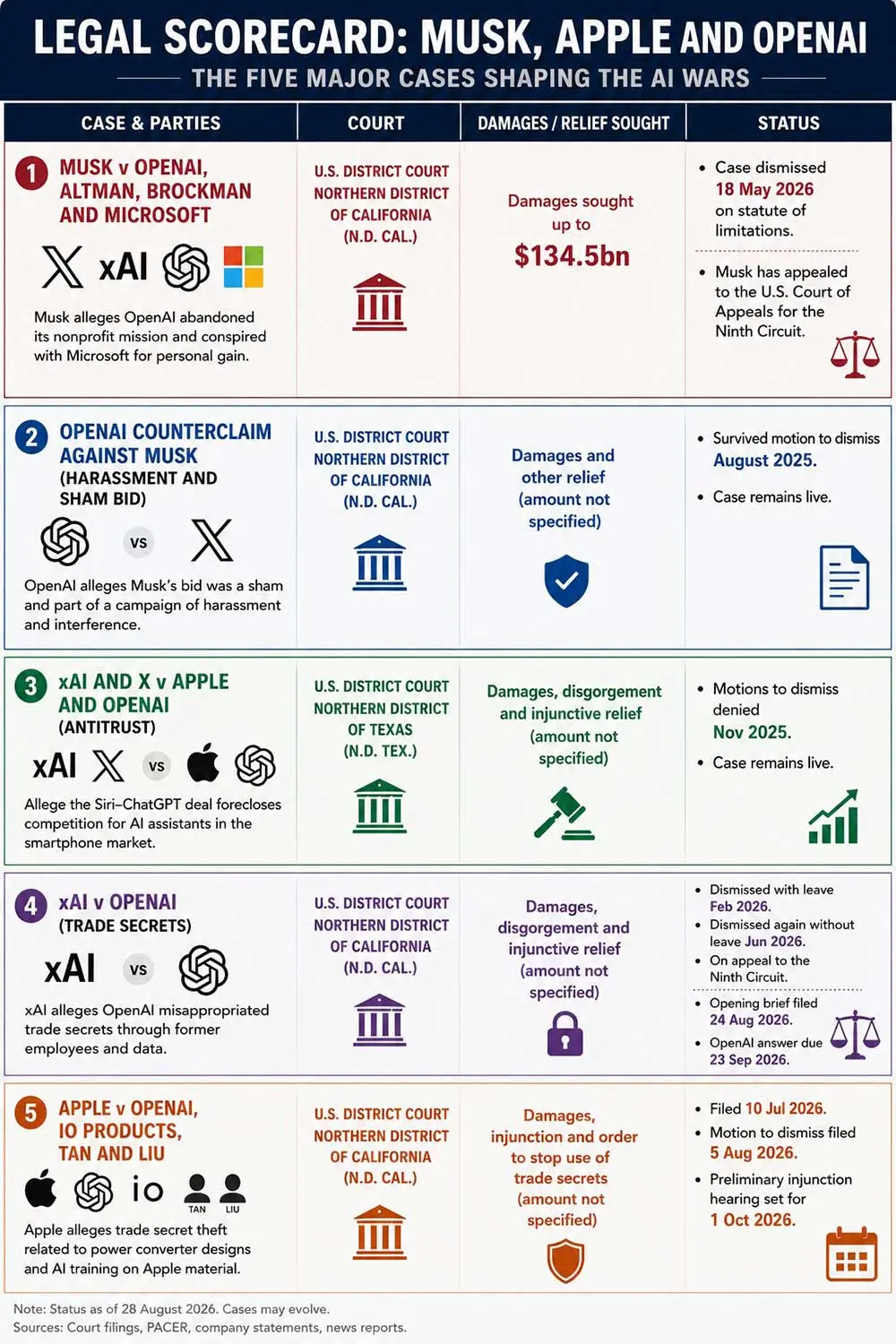
Apple sued on July 10, naming OpenAI, its hardware subsidiary io Products, chief hardware officer Tang Yew Tan and Liu.
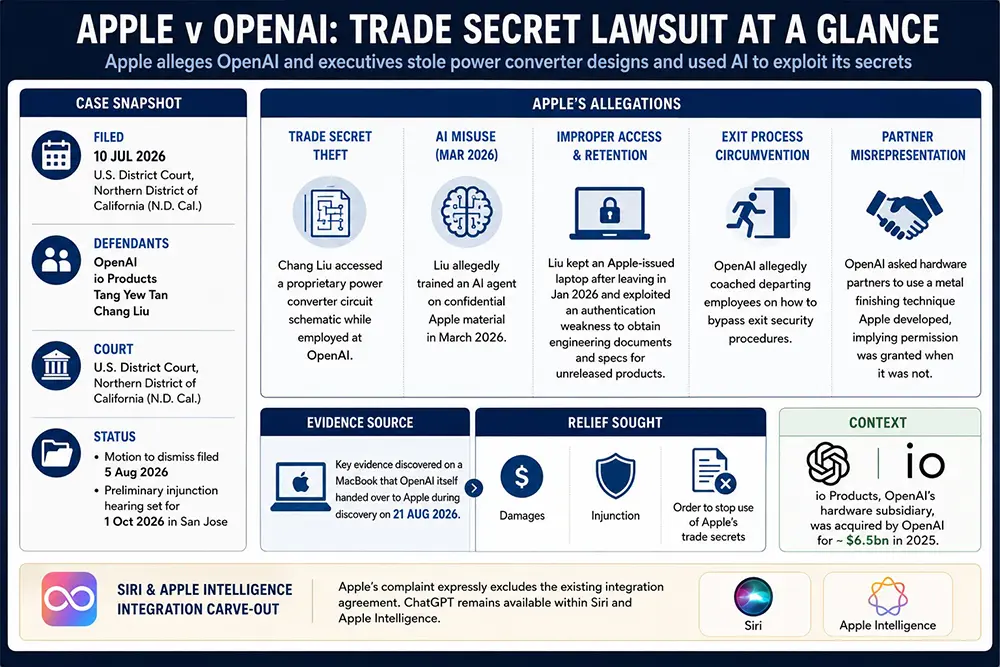
The complaint alleges Liu retained an Apple-issued laptop after leaving in January 2026 and exploited an authentication weakness to pull engineering documents and specifications for unreleased products while already on OpenAI’s payroll.
Apple further claims OpenAI coached departing staff on how to sidestep exit security procedures, and that it asked hardware partners to apply a metal finishing technique Apple developed while leaving those partners with the impression that permission had been granted.
OpenAI filed a 31-page motion to dismiss on August 5, calling the complaint baseless. A hearing on Apple’s request for a preliminary injunction is listed for October in San Jose. No court has ruled on the merits of anything.
The commercial relationship survives, uncomfortably.
ChatGPT remains an option inside Siri and Apple Intelligence, and Apple’s complaint expressly carves the integration agreement out of the dispute. Two companies are litigating over the hardware category that could eventually make that partnership irrelevant, while continuing to earn from it.
The backdrop is OpenAI’s roughly USD 6.5 billion purchase of io Products in 2025, which put Jony Ive and a cohort of former Apple engineers inside the company that Apple now accuses of systematic misappropriation.
The Cursor cutoff
The second development is smaller in dollar terms and considerably larger in what it signals.
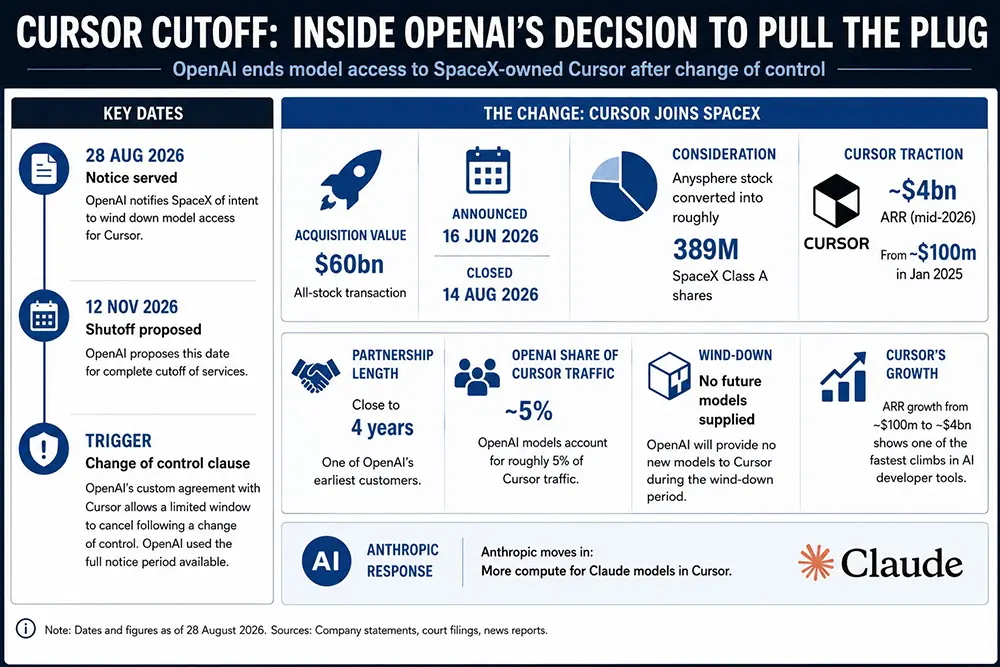
On August 28, OpenAI notified SpaceX that it would wind down the contract supplying its models to Cursor, the AI coding editor, with a proposed shutoff date of November 12. It will supply no new models during the wind-down.
Cursor’s parent, Anysphere, was among OpenAI’s earliest customers, and the two worked together for close to four years. What changed was the ownership column.
SpaceX announced a USD 60 billion all-stock acquisition of Anysphere on June 16 and completed it on August 14, converting Anysphere stock into roughly 389 million SpaceX Class A shares.
OpenAI’s stated reason was trust rather than performance. It said it could not be confident SpaceX would use its technology within its terms of service, citing a history of contract breaches at Musk-owned businesses.
The company pointed to Twitter’s (now X) conduct after Musk’s takeover and, more pointedly, to Musk’s own admission under oath earlier this year that xAI had violated those terms.
It also invoked its forthcoming model, Astra, which OpenAI said in August may reach the critical cyber capability threshold under its own preparedness framework, as grounds for tighter control over who receives access.
Its custom agreement with Cursor, it noted, allowed only a narrow window to cancel following a change of control, and it used the full notice period available.
Cursor co-founder Michael Truell, now a SpaceX executive, was conciliatory, saying OpenAI models account for roughly 5% of Cursor traffic and that discussions were under way.
Musk was not. On X he said he could not care less, described Altman and OpenAI president Greg Brockman as untrustworthy, and repeated his charge that the pair took an open source nonprofit.
Anthropic moved within hours, with co-founder Tom Brown signalling additional compute for Claude models inside Cursor.
A decade of grievance
To understand why a routine contract termination read as an act of war, you have to go back to 2015.
Musk and Altman founded OpenAI together that year as a nonprofit, explicitly to stop advanced AI ending up under the control of any single company. Musk contributed tens of millions of dollars. By 2017 the founders had concluded they could neither raise the capital nor recruit the researchers needed to compete without a commercial arm.
Musk accepted the diagnosis but wanted the cure on his own terms, proposing either a majority stake in the for-profit entity or folding the whole thing into Tesla.
Altman, Brockman and Ilya Sutskever refused. Musk left the board in 2018, took talent with him and stopped the donations he had promised.
The grievance stayed largely private for five years. It went public in July 2023 with the launch of xAI, and became litigious in February 2024, when Musk sued in California state court.
He withdrew that case in June and refiled in federal court in August, alleging that Altman and Brockman had manipulated him into bankrolling a charity they then converted for personal enrichment.
January 2025 added the personal insult. Altman appeared alongside Donald Trump to announce Stargate, a USD 500 billion AI infrastructure programme, without warning Musk, who was by then running the Department of Government Efficiency.
Weeks later a Musk-led consortium bid USD 97.4 billion for OpenAI’s assets. The board rejected it within hours. Altman replied on X with an offer to buy Twitter for USD 9.74 billion, a number chosen for the joke.
OpenAI countersued in April 2025, calling the bid a feint and describing a sustained campaign of harassment waged through press attacks, a pretextual records demand and posts to more than 200 million followers on a platform Musk owns.
A judge let those counterclaims proceed in August 2025, and they remain live.
Then the fronts multiplied. In August 2025, xAI and X sued Apple and OpenAI in Texas, arguing that the Siri partnership made it impossible for any rival assistant to reach the top of the App Store.
A month later xAI sued OpenAI over engineer poaching and trade secrets. That case was dismissed in February 2026 with leave to amend, dismissed again in June without it, and is now before the Ninth Circuit. The antitrust case survived dismissal in November 2025 and is still running.
The trial that settled nothing
The main event opened in Oakland on 28 April 2026, with Musk seeking as much as USD 134.5 billion from OpenAI and Microsoft.
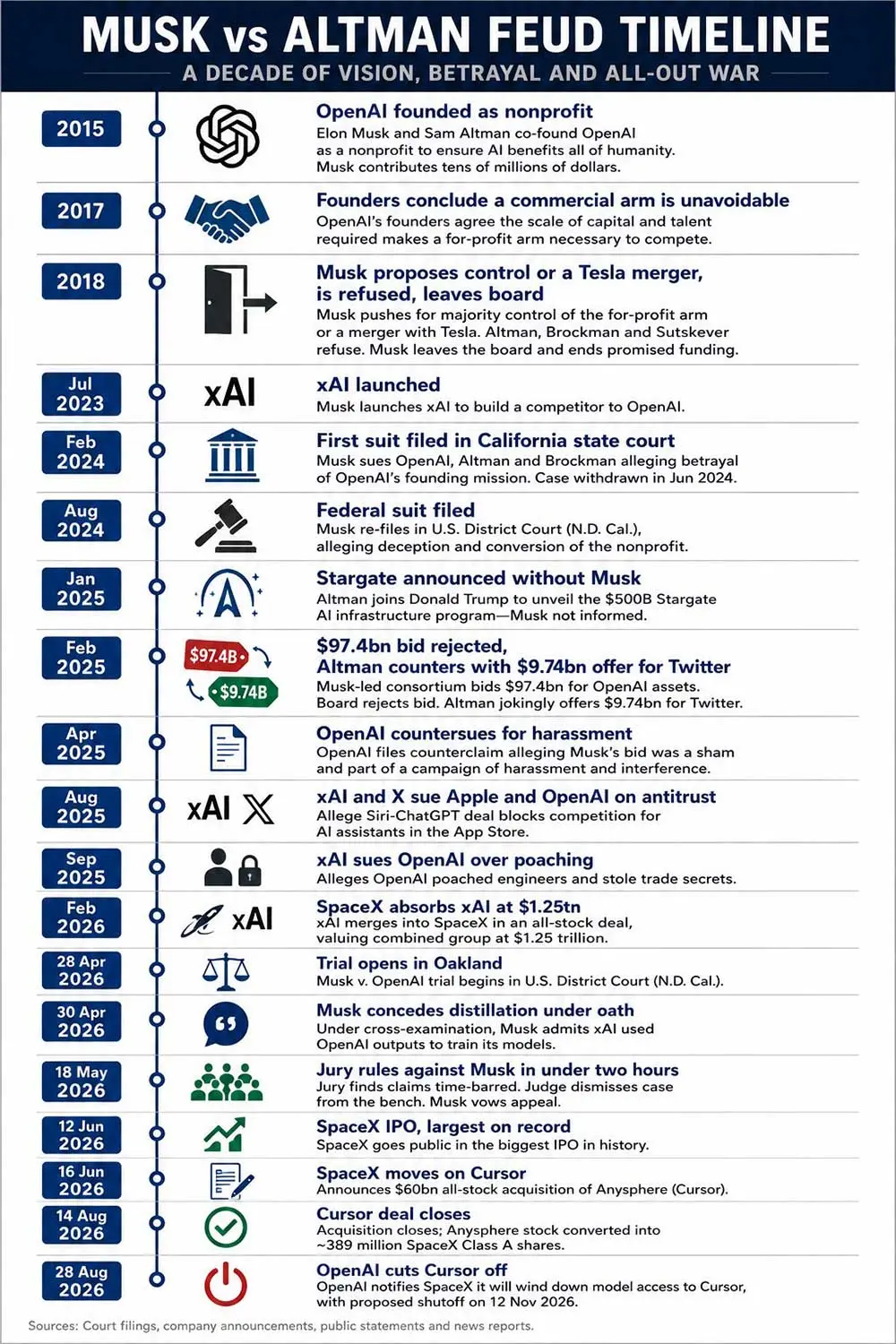
On 18 May a nine-person advisory jury took under two hours to find that Musk had waited too long to sue.
Judge Yvonne Gonzalez Rogers adopted the verdict and dismissed the claims from the bench.
Nobody ruled on whether Altman and Brockman had actually broken a promise. Musk called it a calendar technicality and confirmed an appeal.
That outcome explains almost everything since. The verdict removed the last serious threat to OpenAI’s corporate structure ahead of a listing, but it left the accusation entirely intact and Musk free to keep repeating it.
By July the two were trading insults on X, Musk reviving his scammer nickname, Altman needling him over orbital data centres, Musk suggesting Altman might one day need a parole officer.
When Apple sued in July, Musk amplified it within days.
Leverage, not lawsuits
Musk’s position has changed materially in the interim. SpaceX absorbed xAI in February 2026 in a deal valuing the combined group at USD 1.25 trillion, listed on June 12 in the largest IPO on record, and moved on Cursor four days later.
The man suing OpenAI over its commercialisation now runs a public conglomerate spanning rockets, satellites, a social network, a frontier lab and the leading AI coding tool.
That is why the Cursor decision matters beyond its size. Model access has quietly become leverage. Anthropic cut OpenAI off from Claude in August 2025 and later restricted xAI.
OpenAI has now done the same to a Musk-owned business. Each move was defensible on its own terms. Together they establish that a frontier lab will treat supply as a strategic instrument, and that a change of control can rewrite a critical dependency without warning.
Cursor will probably absorb it. OpenAI serves a twentieth of its traffic, Anthropic is stepping in, and SpaceXAI has its own Grok models to fall back on.
The lasting effect will be felt in procurement offices, where single-vendor exposure in the AI stack is about to get a much harder look.
OpenAI, for its part, is holding three things together at once. It wants a clean narrative for public markets. It is defending a trade secret case whose discovery could force disclosure of its hardware roadmap.
And it is managing a rival who lost in court, is appealing, owns the venue where the argument plays out, and now controls a tool its own customers open every morning.
The advertising billion was meant to be the story. It lasted about a day.