


Seven years after the first Galaxy Fold, a top book-style foldable still costs about twice as much as an excellent slab flagship, and the arrival of Apple’s first foldable iPhone in September 2026 has done more to confirm the premium than to break it.
The price landscape across the big four
Samsung remains the anchor of the market. Its Galaxy Z Fold7 launched in July 2025 at USD 1,999 for the 256GB model, rising to USD 2,499 for 1TB, according to Samsung’s own US store.
The clamshell Galaxy Z Flip7 started at USD 1,099, and a cheaper Flip7 FE arrived at USD 899.
In December 2025 Samsung went further upmarket with the Galaxy Z TriFold, a tri-folding device that launched in South Korea at KRW 3,590,400 (about USD 2,500) and reached the United States on January 30 2026 at USD 2,899, making it the most expensive phone Samsung has ever sold.
Huawei sits at the very top of the price ladder. Its Mate XT tri-fold launched in China at CNY 19,999 (about USD 2,809) and went international in early 2025 at 3,499 euros (about USD 3,660), per CNBC.
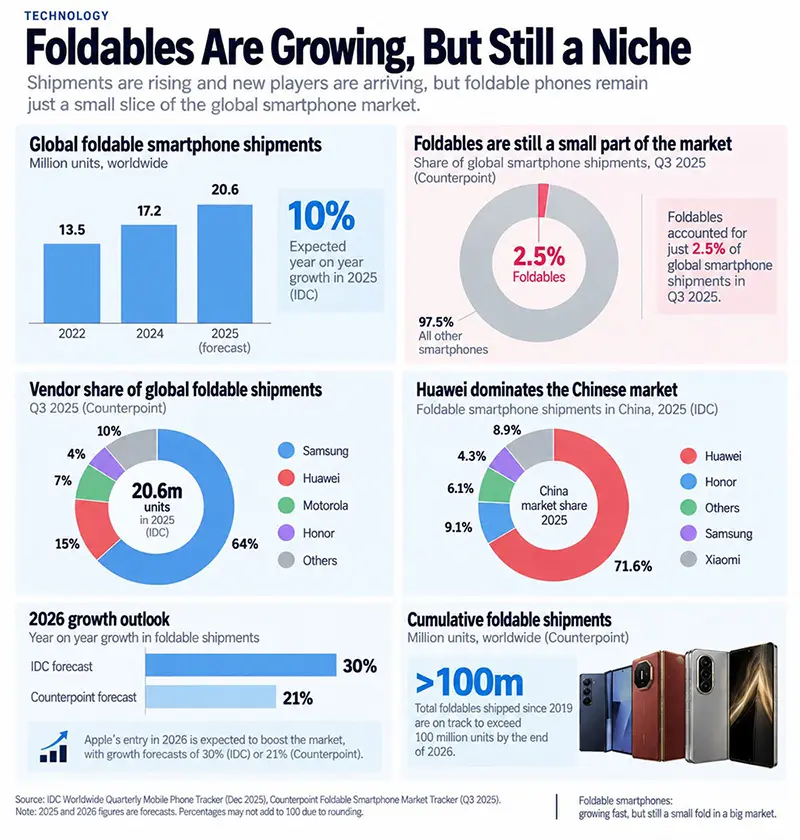
Xiaomi is the value player, but largely only at home. Its Mix Fold 4 launched in China in July 2024 at CNY 8,999 (about USD 1,237), with the Mix Flip clamshell in the same range.
Xiaomi does not sell these foldables through official global channels, so most buyers outside China rely on grey-market importers who charge several hundred dollars more.
Honor, another Chinese maker, launched the Magic V5 in China in July 2025 at RMB 8,999 and took it global at 1,999 euros and 1,699.99 pounds.
Apple was the missing name until this year. It unveiled its first foldable at its “Surprise and Shine” event on September 9 2026 alongside the iPhone 18 Pro line. Pre-event estimates clustered around USD 2,099 to USD 2,299, with UBS arguing that Apple’s buying power could push it as low as USD 1,800 to USD 2,000.
Analysts including Ming-Chi Kuo and Bloomberg’s Mark Gurman had long expected pricing above USD 2,000, making it Apple’s most expensive iPhone ever. Kuo has also warned that early yield problems could keep supply tight into 2027.
What actually drives the cost
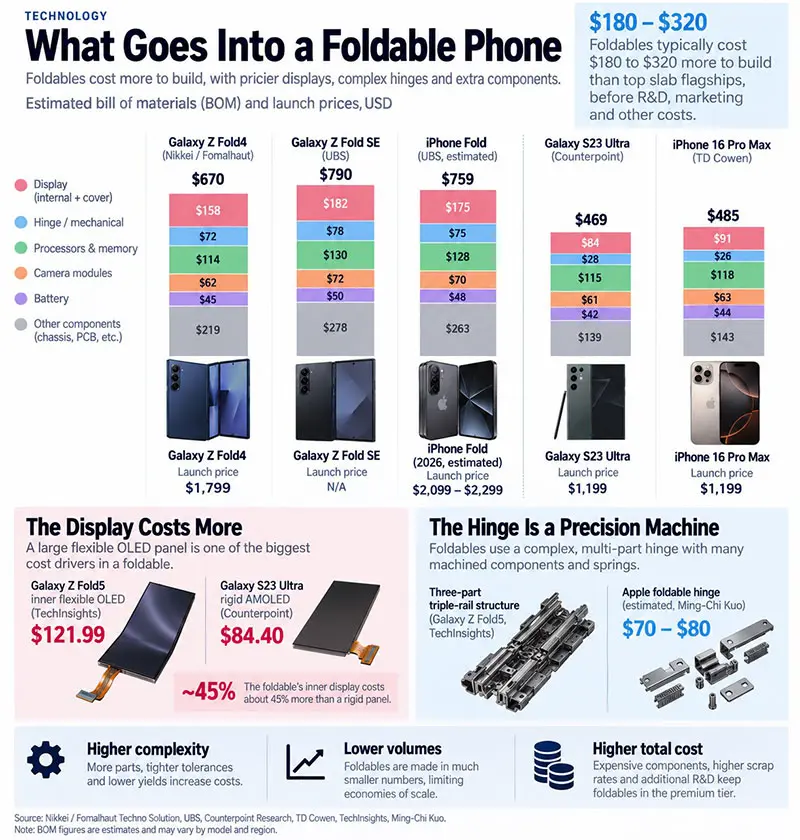
The single biggest factor is the display. A foldable needs a large flexible OLED panel that can survive hundreds of thousands of folds, plus a second cover screen.
TechInsights’ teardown valued the Galaxy Z Fold5’s inner flexible display subsystem at USD 121.99, against roughly USD 84.40 for the rigid AMOLED panel in a Galaxy S23 Ultra, according to Counterpoint Research.
Earlier flexible panels cost even more, with the Fold4’s inner display valued at USD 199.23.
These panels rely on ultra-thin glass (UTG), a sheet of real glass around 30 micrometres thick that Samsung introduced on the 2020 Galaxy Z Flip to replace the plastic (CPI) covers that scratched easily. UTG is flexible but delicate, and its yields are lower than ordinary glass.
The hinge is the second big cost. TechInsights found the Fold5 hinge uses a three-part “triple rail” structure, with each hinge carrying four springs and four side mountings screwed to a central support.
Everything else compounds the problem. Foldables need dual battery packs split across two halves, thinner chassis materials such as titanium and armour aluminium, and increasingly silicon-carbon battery cells to pack more energy into a slim body.
They demand extra display driver ICs, more durability testing, and foldable-specific software work. Manufacturing yields are lower and scrap rates higher, especially for tri-fold panels that must bend cleanly at two points.
Add it up and the bill of materials tells the story.
A Nikkei teardown with Fomalhaut Techno Solution estimated the Galaxy Z Fold4 cost about USD 670 to build, against a USD 1,799 launch price. UBS pegged the Galaxy Z Fold SE BOM at USD 790 and estimated Apple’s foldable at USD 759.
By contrast, Counterpoint put the Galaxy S23 Ultra BOM at USD 469, and TD Cowen estimated the iPhone 16 Pro Max at USD 485.
A foldable therefore costs roughly USD 180 to USD 320 more to build than a top slab, before you factor in R&D spread over far smaller volumes, richer warranty provisioning, and screen repairs that can run to USD 500 or more.
Samsung lists the Fold8 inner display replacement at USD 579.
How big is the foldable world, really
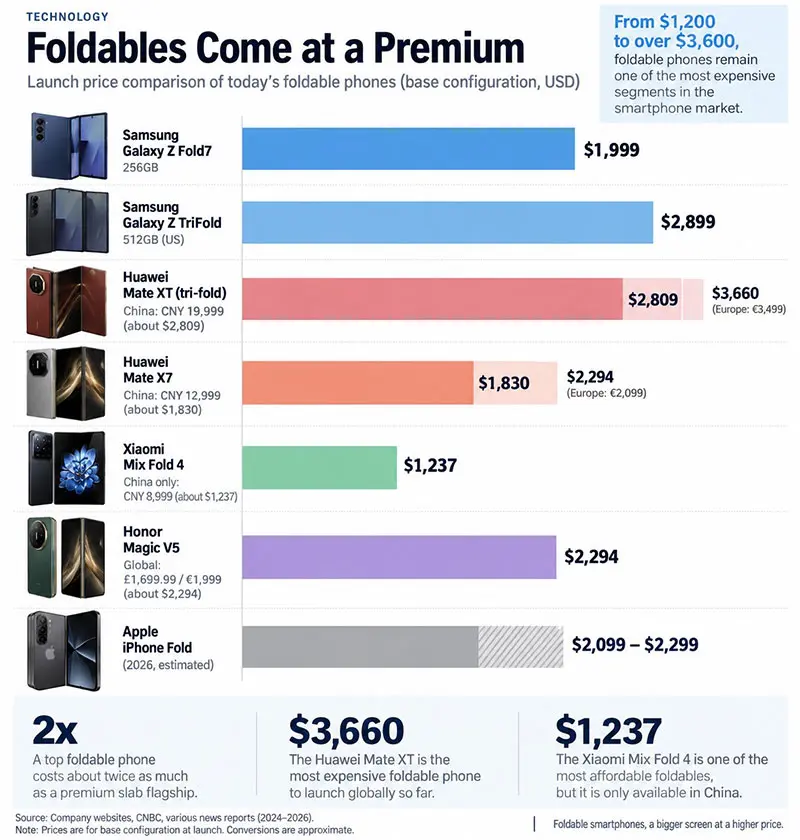
Despite the noise, foldables remain a niche. Global shipments were around 13.5 million units in 2022 and about 17.2 million in 2024.
IDC’s Worldwide Quarterly Mobile Phone Tracker, in a release dated December 9 2025, forecast 2025 shipments growing 10% year on year to 20.6 million units, which is still only about 1.6% of the roughly 1.24 billion smartphones shipped worldwide.
Counterpoint’s Foldable Smartphone Market Tracker measured foldables at 2.5% of global smartphone shipments in the third quarter of 2025.
Cumulatively, the installed base of foldables shipped since 2019 is on track to pass 100 million units by the end of 2026, according to Counterpoint.
That is tiny next to the billions of slab phones in use.
Is Samsung still king?
Mostly yes, but with an important asterisk. Counterpoint’s tracker put Samsung at 64% of global foldable shipments in Q3 2025, up from 56% a year earlier, with Huawei second at 15%, Motorola at 7% and Honor at 4%, as total shipments grew 14% year on year to an all-time quarterly high.
But Samsung’s lead has not always held. Huawei overtook it for the first time in Q1 2024, when its shipments surged 257% year on year and Samsung’s share fell to 23%, according to Counterpoint.
For 2026, Counterpoint forecasts Samsung’s share slipping from 40% to 32%, with Apple taking 25% and Huawei around 24%, so Samsung’s lead is real but narrowing.
Are prices finally falling?
Motorola’s Razr (2025) launched at USD 699.99 and is regularly discounted below USD 600, while Samsung’s Z Flip7 FE at USD 899 and Tecno’s Phantom V Flip series have pushed clamshells under USD 1,000.
However, at the higher end, prices have edged up, not down, as tri-folds and larger book-style devices push the ceiling higher.
For prices to fall meaningfully, several things need to happen. Panel yields must improve so that fewer expensive flexible screens are scrapped. Second-source hinge suppliers must bring competition to a concentrated market.
Chinese panel makers such as BOE, Visionox and TCL CSOT need to keep undercutting Samsung Display; BOE already overtook Samsung Display in foldable panel procurement in late 2023 as it supplied Huawei.
Above all, the category needs scale. Until foldables sell in the hundreds of millions rather than the tens of millions, the fixed costs of these complex, low-yield components will keep them firmly in luxury territory.
Apple’s entry may finally provide that scale, and IDC expects the category to grow 30% in 2026 while Counterpoint models a more cautious 21%, but even the bulls agree foldables will stay below 3% of the total market for years yet.